Guidelines for Developing Quantitative Safety Risk Criteria (eBook)
John Wiley & Sons (Verlag)
978-0-470-55293-3 (ISBN)
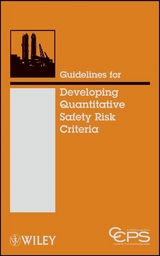
- Written by a committee of safety professionals, this book creates a foundation document for the development and application of risk tolerance criteria
- Helps safety managers evaluate the frequency, severity and consequence of human injury
- Includes examples of risk tolerance criteria used by NASA, Earthquake Response teams and the International Maritime Organization, amongst others
- Helps achieve consistency in risk-based decision-making
- Reduces potential liabilities in the use of quantitative risk tolerance criteria through reference to an industry guidance document
Written by a committee of safety professionals, this book creates a foundation document for the development and application of risk tolerance criteria Helps safety managers evaluate the frequency, severity and consequence of human injury Includes examples of risk tolerance criteria used by NASA, Earthquake Response teams and the International Maritime Organization, amongst others Helps achieve consistency in risk-based decision-making Reduces potential liabilities in the use of quantitative risk tolerance criteria through reference to an industry guidance document
Since 1985, the Center for Chemical Process Safety (CCPS) has been the world leader in developing and disseminating information on process safety management and technology. CCPS, an industry technology alliance of the American Institute of Chemical Engineers (AIChE), has published over 80 books in its process safety guidelines and process safety concepts series, and over 100 training modules through its Safety in Chemical Engineering Education (SACHE) series.
Preface xiii
Acknowledgments xv
List of Tables xix
List of Figures xxi
Acronyms and Abbreviations xxv
Glossary xxix
1 INTRODUCTION 1
1.1 What is Risk? 1
1.2 Scope of these Guidelines 7
1.3 Objectives of these Guidelines 8
2 FUNDAMENTAL CONCEPTS OF RISK ASSESSMENT AND RISK CRITERIA 11
2.1 A Brief History of Risk Assessment 11
2.2 The Qualitative Approach to Risk Assessment 15
2.3 Technical Aspects of QRA 21
2.4 Quantitative Risk Criteria 31
2.5 The Role of QRA and Risk Criteria 37
2.6 Risk Tolerance as a Function of Societal Values 39
2.7 Definition and Applications of the "As Low as Reasonably Practicable" (ALARP) Principle 44
2.8 Uncertainty and Its Impact on Risk Decision Making 46
3 LEARNING FROM REGULATORY PRECEDENTS 49
3.1 Why Study Risk Criteria? 49
3.2 The Evolution of Risk Criteria in the UK 51
3.3 The Evolution of Risk Criteria in the Netherlands 60
3.4 Comparison of Risk Criteria in the UK and the Netherlands 67
3.5 Learning from and Applying the Precedents 73
4 CONSIDERATIONS IN DEVELOPING RISK CRITERIA 79
4.1 Determine the Need to Establish Risk Criteria 80
4.2 Determine the Risks to be Addressed 82
4.3 Determine/Classify the Population to be Addressed 82
4.4 Determine Which Risk Criteria to Develop 84
4.5 Determine Whether Risk Criteria Will Distinguish Between New and Existing Facilities 85
4.6 Determine Philosophy for Continuing Risk Reduction 87
4.7 Develop Individual Risk Criteria 87
4.8 Develop Societal Risk Criteria 88
4.9 Qualifymalidate the Risk Criteria 88
4.10 Decide on a Philosophy for Apportioning and Scaling the Risk Criteria 91
4.11 Periodically Revalidate the Risk Criteria 98
4.12 Matching the Risk Criteria with the System and with the Risk Estimation Methodology 100
4.13 Risk Criteria in the Multinational Context 102
4.14 Consideration of Short DuratiodHigher Risk Activities 103
5 FUTURE TOPICS 105
5.1 Fostering the Application of Risk-Based Decision Making 105
5.2 Enhancing Risk Assessment Technology 106
Appendix A: Understanding and Using F-N Diagrams 109
Appendix B: Survey of Worldwide Risk Criteria Applications 119
Appendix C: Development of Company Risk Criteria 171
REFERENCES 191
INDEX 207
| Erscheint lt. Verlag | 8.9.2009 |
|---|---|
| Sprache | englisch |
| Themenwelt | Naturwissenschaften ► Chemie ► Technische Chemie |
| Technik ► Umwelttechnik / Biotechnologie | |
| Schlagworte | Approach • Arbeitssicherheit u. Umweltschutz i. d. Chemie • Aspects • Assessment • Brief • Chemical and Environmental Health and Safety • chemical engineering • Chemie • Chemische Verfahrenstechnik • Chemistry • Figures • fundamental concepts • glossary xintroduction • Guidelines • History • List • objectives • process development • qra • qualitative • Risikobewertung • Risk • Scope • Tables • technical • Verfahrensentwicklung |
| ISBN-10 | 0-470-55293-X / 047055293X |
| ISBN-13 | 978-0-470-55293-3 / 9780470552933 |
| Informationen gemäß Produktsicherheitsverordnung (GPSR) | |
| Haben Sie eine Frage zum Produkt? |
 PDF (Adobe DRM)
Kopierschutz: Adobe-DRM
Adobe-DRM ist ein Kopierschutz, der das eBook vor Mißbrauch schützen soll. Dabei wird das eBook bereits beim Download auf Ihre persönliche Adobe-ID autorisiert. Lesen können Sie das eBook dann nur auf den Geräten, welche ebenfalls auf Ihre Adobe-ID registriert sind.
Details zum Adobe-DRM
Dateiformat: PDF (Portable Document Format)
Mit einem festen Seitenlayout eignet sich die PDF besonders für Fachbücher mit Spalten, Tabellen und Abbildungen. Eine PDF kann auf fast allen Geräten angezeigt werden, ist aber für kleine Displays (Smartphone, eReader) nur eingeschränkt geeignet.
Systemvoraussetzungen:
PC/Mac: Mit einem PC oder Mac können Sie dieses eBook lesen. Sie benötigen eine
eReader: Dieses eBook kann mit (fast) allen eBook-Readern gelesen werden. Mit dem amazon-Kindle ist es aber nicht kompatibel.
Smartphone/Tablet: Egal ob Apple oder Android, dieses eBook können Sie lesen. Sie benötigen eine
Geräteliste und zusätzliche Hinweise
Buying eBooks from abroad
For tax law reasons we can sell eBooks just within Germany and Switzerland. Regrettably we cannot fulfill eBook-orders from other countries.
aus dem Bereich