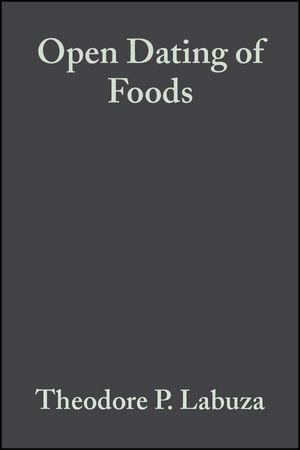
Open Dating of Foods (eBook)
248 Seiten
John Wiley & Sons (Verlag)
978-0-470-38488-6 (ISBN)
products from the farm or place of manufacturing to the consumer's
home. One principle is that the shelf life is a function of the
distribution conditions and can be looked at as the percentage of
consumers a manufacturer is willing to displease. Thus, one purpose
of an open date is to give consumers enough time to purchase a food
product and store it at home for a reasonable period of time before
the product reaches the end of shelf-life in terms of some degree
of quality change that is still acceptable.
If products are not stored or rotated properly in distribution,
then older products or those of lesser quality and perhaps
compromised safety because of abuse during distribution chain and
causing loss of confidence in the food category. Presently, the
lack of uniformity among manufacturers and across state borders has
made the practice of open dating confusing and misleading for
consumers, retailers and the government. This book addresses these
issues, and provides scientific and legal background to both
evaluate and influence federally-regulated open-dating legislation
in this country
Theodore P. Labuza, Ph.D., Department of Food Science and Nutrition, University of Minnesota, St. Paul, Minnesota and Lynn M. Szybist, 1701 N. Concord Road No.9, Chattanooga, Tennessee
1. Introduction.
2. Background and Rationale.
3. Temperature Abuse and Time-temperature Integrators.
4. Establishing an Open Date.
5. Current Practices.
6. Current Regulations.
7. Proposed Regulation.
8. Judicial action.
9. Perishable Refrigerated Products and Home Practices
Survey.
10. Conclusions.
References.
Appendix: A. Proposed 1999 TTI Legislation in Italy.
B. Canadian Open-Dating Legislation F&D.
C. NIST Handbook 130 - Uniform OPen Dating Regulation as Adopted
by The National Conference on Weights and Measures.
D. Extended List of State Regulations on Open Dating.
E. European Union.
F. 1999 Legisalative Proposal.
G. Proposed Federal Open-Dating Regulation.
H. Alabama Safe Foods Act of 2000.
Index
| Erscheint lt. Verlag | 3.7.2008 |
|---|---|
| Sprache | englisch |
| Themenwelt | Naturwissenschaften ► Biologie |
| Naturwissenschaften ► Chemie | |
| Technik ► Lebensmitteltechnologie | |
| Weitere Fachgebiete ► Land- / Forstwirtschaft / Fischerei | |
| Schlagworte | Food Science & Technology • Lebensmittel • Lebensmittelforschung u. -technologie |
| ISBN-10 | 0-470-38488-3 / 0470384883 |
| ISBN-13 | 978-0-470-38488-6 / 9780470384886 |
| Informationen gemäß Produktsicherheitsverordnung (GPSR) | |
| Haben Sie eine Frage zum Produkt? |
 PDF (Adobe DRM)
Kopierschutz: Adobe-DRM
Adobe-DRM ist ein Kopierschutz, der das eBook vor Mißbrauch schützen soll. Dabei wird das eBook bereits beim Download auf Ihre persönliche Adobe-ID autorisiert. Lesen können Sie das eBook dann nur auf den Geräten, welche ebenfalls auf Ihre Adobe-ID registriert sind.
Details zum Adobe-DRM
Dateiformat: PDF (Portable Document Format)
Mit einem festen Seitenlayout eignet sich die PDF besonders für Fachbücher mit Spalten, Tabellen und Abbildungen. Eine PDF kann auf fast allen Geräten angezeigt werden, ist aber für kleine Displays (Smartphone, eReader) nur eingeschränkt geeignet.
Systemvoraussetzungen:
PC/Mac: Mit einem PC oder Mac können Sie dieses eBook lesen. Sie benötigen eine
eReader: Dieses eBook kann mit (fast) allen eBook-Readern gelesen werden. Mit dem amazon-Kindle ist es aber nicht kompatibel.
Smartphone/Tablet: Egal ob Apple oder Android, dieses eBook können Sie lesen. Sie benötigen eine
Geräteliste und zusätzliche Hinweise
Buying eBooks from abroad
For tax law reasons we can sell eBooks just within Germany and Switzerland. Regrettably we cannot fulfill eBook-orders from other countries.
aus dem Bereich