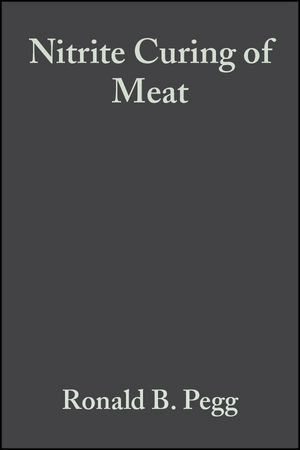
Nitrite Curing of Meat (eBook)
280 Seiten
John Wiley & Sons (Verlag)
978-0-470-38486-2 (ISBN)
preservation. However, only one century has passed since the German
researchers, Polenske in 1891, Kisshalt in 1899, and Lehmann in
1899, discovered that the active component in the curing process
was nitrite. Soon after the role of nitrite as a meat curing agent
was revealed, government regulators placed guidelines on the level
of nitrite and nitrate permitted for use in cured meat
formulations. In the late 1960s and early 1970s, the development of
the so-called "nitrite problem" surfaced because of the detection
of N-nitrosamines in processed meats. The industry was in an uproar
and the issue was of paramount interest to scientists and the
public. A major technical advance in the analytical technique for
N-nitrosamine detection was achieved when Thermo Electron of
Waltham, Massachusetts introduced the thermal energy analyzer
(TEA). This unit allowed the screening of a large number of samples
for nitrosamine with only a minimum preparation. The role of
nitrite in revealing the desired and unique flavor of cured
products, perhaps by suppressing the formation of lipid oxidation
products was another development in revealing other properties of
nitrite. Above all, the antimicrobial role of nitrite, together
with salt, had a major influence on the popularity of
nitrite/nitrate in food preservation.
This book provides a review of the desirable attributes which
sodium nitrite confers to meat during processing, as well as
drawbacks of nitrite usage, i.e., the presence of N-nitrosoamines.
In addition, solutions for the curing of meat without the use of
nitrite are presented. An examination of a multicomponent
nitrite-free curing system entailing the color, flavor, and
microbial protection of such a system is given.
Ronald B. Pegg, Ph.D.,Saskatchewan Food Product Innovation Program, Department of Applied Microbiology and Food Science, University of Saskatchewan, Saskatoon, SK S7N 5A8, Canada, and Fereidoon Shahidi, Department of Biochemistry, Memorial University of Newfoundland, St. John's, NF, A1B 3X9, Canada.
1. Introduction.
2. History of the Curing Process.
3. The Color of Meat.
4. Oxidative Stability of Meat Lipids.
5. Flavor of Meat.
6. Meat Microbiology.
7. The Fate of Nitrite.
8. Potential Health Hazards of Nitrite.
9. Possible Substitutes for Nitrite.
Glossary.
Index
| Erscheint lt. Verlag | 3.7.2008 |
|---|---|
| Sprache | englisch |
| Themenwelt | Naturwissenschaften ► Chemie |
| Technik ► Lebensmitteltechnologie | |
| Weitere Fachgebiete ► Land- / Forstwirtschaft / Fischerei | |
| Schlagworte | Food Science & Technology • Lebensmittel • Lebensmittelforschung u. -technologie |
| ISBN-10 | 0-470-38486-7 / 0470384867 |
| ISBN-13 | 978-0-470-38486-2 / 9780470384862 |
| Informationen gemäß Produktsicherheitsverordnung (GPSR) | |
| Haben Sie eine Frage zum Produkt? |
 PDF (Adobe DRM)
Kopierschutz: Adobe-DRM
Adobe-DRM ist ein Kopierschutz, der das eBook vor Mißbrauch schützen soll. Dabei wird das eBook bereits beim Download auf Ihre persönliche Adobe-ID autorisiert. Lesen können Sie das eBook dann nur auf den Geräten, welche ebenfalls auf Ihre Adobe-ID registriert sind.
Details zum Adobe-DRM
Dateiformat: PDF (Portable Document Format)
Mit einem festen Seitenlayout eignet sich die PDF besonders für Fachbücher mit Spalten, Tabellen und Abbildungen. Eine PDF kann auf fast allen Geräten angezeigt werden, ist aber für kleine Displays (Smartphone, eReader) nur eingeschränkt geeignet.
Systemvoraussetzungen:
PC/Mac: Mit einem PC oder Mac können Sie dieses eBook lesen. Sie benötigen eine
eReader: Dieses eBook kann mit (fast) allen eBook-Readern gelesen werden. Mit dem amazon-Kindle ist es aber nicht kompatibel.
Smartphone/Tablet: Egal ob Apple oder Android, dieses eBook können Sie lesen. Sie benötigen eine
Geräteliste und zusätzliche Hinweise
Buying eBooks from abroad
For tax law reasons we can sell eBooks just within Germany and Switzerland. Regrettably we cannot fulfill eBook-orders from other countries.
aus dem Bereich