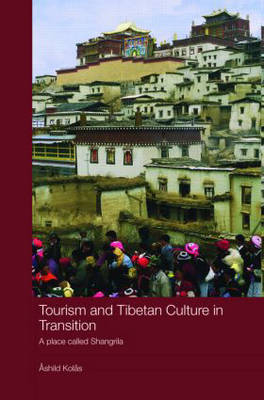
Tourism and Tibetan Culture in Transition (eBook)
176 Seiten
Taylor and Francis (Verlag)
978-0-203-93994-9 (ISBN)
This book explores the relationship between tourism, culture and ethnic identity in Tibet in , focusing in particular on Shangrila, a Tibetan region in Southwest China, to show how local 'Tibetan culture' is reconstructed as a marketable commodity for tourists. It analyses the socio-economic effects of Shangrila tourism in Tibet, investigating who benefits economically, whilest also considering its political implications and the ways in which tourism might be linked to the negotiation and reassertion of ethnic identity. It goes on to examine the spatial re-imagining provoked by the development of tourism, and asks whether a tourist destination inevitably becomes a 'pseudo-community' for the visited. Can a fictitious name, invented for the sake of tourists, still provide the 'natives' of a place with a sense of identity? This book argues that conceptions of place are closely linked to notions of social identity, and in the case of Shangrila particularly to ethnic identity. Viewing the spatial as socially constructed, and place-making as vital to social organisation, this is a study of how place is constructed and contested. It describes how local villagers and monastic elites have negotiated the area's religious geography, how agents of the Communist state have redefined it as a minority area, and how tourism developers are now marketing the region as Shangrila for tourist consumption. It outlines the different 'place-making' strategies utilised by the various social actors, including local villagers to create the communities in which they live, monastic elites to invent a Buddhist Tibetan realm of 'religious geography', agents of the People's Republic of China to define the area as part of the communist state, and tourism developers to market the region as 'Shangrila' for tourist consumption. Overall, this book is an insightful account of the complex links between tourism, culture and Tibetanethnic identity in Tibet, and will be of interest to a wide range of disciplines including social anthropology, sociology, human geography, tourism and development studies.
This book explores the relationship between tourism, culture and ethnic identity in Tibet in , focusing in particular on Shangrila, a Tibetan region in Southwest China, to show how local 'Tibetan culture' is reconstructed as a marketable commodity for tourists. It analyses the socio-economic effects of Shangrila tourism in Tibet, investigating who benefits economically, whilest also considering its political implications and the ways in which tourism might be linked to the negotiation and reassertion of ethnic identity. It goes on to examine the spatial re-imagining provoked by the development of tourism, and asks whether a tourist destination inevitably becomes a 'pseudo-community' for the visited. Can a fictitious name, invented for the sake of tourists, still provide the 'natives' of a place with a sense of identity? This book argues that conceptions of place are closely linked to notions of social identity, and in the case of Shangrila particularly to ethnic identity. Viewing the spatial as socially constructed, and place-making as vital to social organisation, this is a study of how place is constructed and contested. It describes how local villagers and monastic elites have negotiated the area's religious geography, how agents of the Communist state have redefined it as a minority area, and how tourism developers are now marketing the region as Shangrila for tourist consumption. It outlines the different 'place-making' strategies utilised by the various social actors, including local villagers to create the communities in which they live, monastic elites to invent a Buddhist Tibetan realm of 'religious geography', agents of the People's Republic of China to define the area as part of the communist state, and tourism developers to market the region as 'Shangrila' for tourist consumption. Overall, this book is an insightful account of the complex links between tourism, culture and Tibetanethnic identity in Tibet, and will be of interest to a wide range of disciplines including social anthropology, sociology, human geography, tourism and development studies.
| Erscheint lt. Verlag | 31.8.2007 |
|---|---|
| Sprache | englisch |
| Themenwelt | Sachbuch/Ratgeber ► Sport |
| Naturwissenschaften ► Geowissenschaften ► Geografie / Kartografie | |
| Sozialwissenschaften ► Ethnologie | |
| Sozialwissenschaften ► Politik / Verwaltung | |
| Sozialwissenschaften ► Soziologie ► Makrosoziologie | |
| Sozialwissenschaften ► Soziologie ► Spezielle Soziologien | |
| Wirtschaft | |
| ISBN-10 | 0-203-93994-8 / 0203939948 |
| ISBN-13 | 978-0-203-93994-9 / 9780203939949 |
| Informationen gemäß Produktsicherheitsverordnung (GPSR) | |
| Haben Sie eine Frage zum Produkt? |
 PDF (Adobe DRM)
Kopierschutz: Adobe-DRM
Adobe-DRM ist ein Kopierschutz, der das eBook vor Mißbrauch schützen soll. Dabei wird das eBook bereits beim Download auf Ihre persönliche Adobe-ID autorisiert. Lesen können Sie das eBook dann nur auf den Geräten, welche ebenfalls auf Ihre Adobe-ID registriert sind.
Details zum Adobe-DRM
Dateiformat: PDF (Portable Document Format)
Mit einem festen Seitenlayout eignet sich die PDF besonders für Fachbücher mit Spalten, Tabellen und Abbildungen. Eine PDF kann auf fast allen Geräten angezeigt werden, ist aber für kleine Displays (Smartphone, eReader) nur eingeschränkt geeignet.
Systemvoraussetzungen:
PC/Mac: Mit einem PC oder Mac können Sie dieses eBook lesen. Sie benötigen eine
eReader: Dieses eBook kann mit (fast) allen eBook-Readern gelesen werden. Mit dem amazon-Kindle ist es aber nicht kompatibel.
Smartphone/Tablet: Egal ob Apple oder Android, dieses eBook können Sie lesen. Sie benötigen eine
Geräteliste und zusätzliche Hinweise
Buying eBooks from abroad
For tax law reasons we can sell eBooks just within Germany and Switzerland. Regrettably we cannot fulfill eBook-orders from other countries.
aus dem Bereich