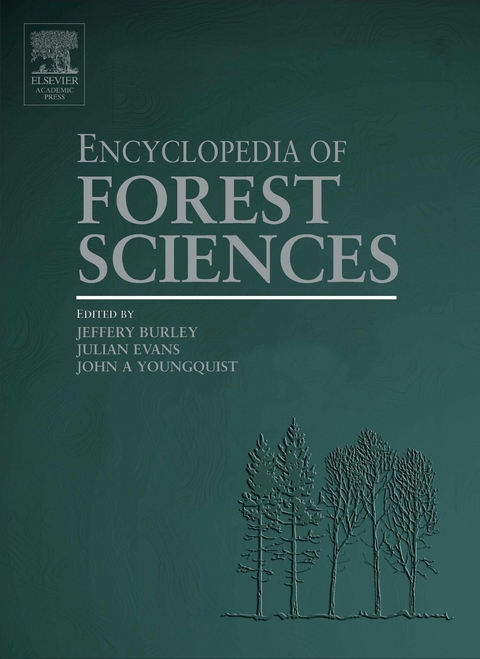
Encyclopedia of Forest Sciences (eBook)
2400 Seiten
Elsevier Science (Verlag)
978-0-08-054801-2 (ISBN)
B
BIODIVERSITY
Contents
Biodiversity in Forests
H G Lund, Forest Information Services, Gainesville, VA, USA
F Dallmeier and A Alonso, Smithsonian Institution, Washington, DC, USA
© 2004, Elsevier Ltd. All Rights Reserved.
Introduction
Interest in biodiversity began in the mid-1980s with the Biodiversity Symposium, held in Washington, DC, sponsored by the National Academy of Science. Within increasing human populations and rising demands for resources and living space, the need to conserve biological diversity rose to the forefront with the development of the Convention of Biological Diversity (CBD) in 1992. The purpose of the Convention is to conserve biological diversity, promote the sustainable use of its components, and encourage equitable sharing of the benefits arising out of the utilization of genetic resources. Biodiversity inventories provide the building blocks upon which to carry out the intent of CBD and to meet local needs. Using inventories as the base, industry and other development opportunities should incorporate biodiversity within their management practices.
The concept of biological diversity is defined in Article 2 of the CBD as follows:
‘Biological diversity’ means the variability among living organisms from all sources including, inter alia, terrestrial, marine and other aquatic ecosystems and the ecological complexes of which they are part; this includes diversity within species, between species and of ecosystems.
It is widely recognized that the earth’s biodiversity is poorly known. Although 1.75 million species have been discovered and described, the number will be much greater once we include bacteria, viruses, most of the marine species, and most of the arthropods. There is no doubt that we are now destroying this diversity at an alarming rate. No one knows exactly what the current extinction rate is, but recent calculations put it at between 1000 and 10 000 times greater than it would naturally be. The rate of extinction also appears to be increasing. Species are threatened in every habitat on every continent, though the severity of threat varies from place to place. A vital question is how badly this loss affects ecosystem functioning and our eventual well-being. Although current studies are impressive, they are tiny in comparison to the amount of unknown diversity and the urgency and importance of finding out what are available and taking steps to preserve and sustainably use the remaining.
The CBD obliges signatory nations to undertake an inventory of their biological diversity to provide basic information about the distribution and abundance of biodiversity. Such data are necessary for the long-term sustainable management, use, and conservation of biodiverse areas. Parties are to monitor the elements of biological diversity, determine the nature of the urgency required in the protection of each category, and sample them in terms of the risks to which they are exposed. They are to report on the biotic wealth and national capacity, the goals and gaps, strategic recommendations, and characteristics of the action. Specifically, under Article 7. Identification and Monitoring, nations are to:
• Identify components of biological diversity important for its conservation and sustainable use
• Monitor components of biological diversity, paying particular attention to those requiring urgent conservation measures or which offer the greatest potential for sustainable use
• Identify processes and categories of activities which have adverse impacts on the conservation and sustainable use of biological diversity, and monitor their effects
• Maintain and organize data derived from identification and monitoring activities.
Forest certification systems resulting from agreements in the United Nations Conference on Environment and Development (UNCED), Agenda 21, include criteria, indicators, or principles that address biodiversity as a critical component to sustainable development.
In order to meet the above requirements, parties need inventories of biological diversity. The objectives of biological diversity inventories may be to:
• Identify priority conservation areas
• Provide the necessary baseline data for monitoring the effects of anthropogenic disturbance or climate change on the biota
• Detect changes in ecological diversity that exceed the range of natural variation, across a range of spatial and temporal scales
• Provide an ‘early warning’ of impending irreversible changes
• Provide reports to the public on the status of ecological diversity in a timely and accessible manner
• Meet national and international commitments for monitoring biodiversity
• Provide data consistent with the requirements of forest certification programs.
Biodiversity Types
CBD addresses three types of diversity: genetic, species, and landscape or ecosystem. Each has special features and challenges for inventory.
Genetic Diversity
Genetic diversity is the degree of variability of the genetic material of an organism. Assessment of genetic diversity is time-consuming and prohibitively expensive, requiring modern laboratories and expensive chemicals. Species are defined by the differences in their genes. Therefore, one often uses species diversity to estimate genetic diversity.
Species Diversity
Species diversity encompasses the number, types, and distribution of organisms found in a given area. Species diversity is the standard unit of measurement in most biodiversity surveys. The advantage of inventorying species is the advantage of being natural biological divisions and that they are easily identifiable. Many people already know high-interest organisms such as flowers and birds so identification of these organisms is relatively easy.
However, there are a very large number of species. A high proportion of them, particularly invertebrates, are as yet undescribed. Moreover, the identification of described species often requires a high level of expertise. Identifying all species in even a limited area is generally impracticable.
A common solution is to select certain taxa as indicator groups to act as surrogates for the whole biological diversity. Using indicator species can reduce the cost of the survey. The following options for indicators are in order of preference.
1. Best estimates: using genealogy to predict genetic or character richness.
2. Popular estimates: using species richness.
3. Practical estimates: using higher taxa or environmental variables as surrogates.
4. Relationship among estimates: a scale of surrogacy for mapping more of biodiversity value at lower cost.
To be effective, indicators should be:
• readily quantifiable
• easily assessed in the field
• repeatable and subject to minimal observer bias, and cost-effective
• ecologically meaningful – that is, to be representative of the taxic variation, microhabitats, and trophic diversity in the area and in close association with, and identification of, the conditions and responses of other species.
Scarce and less familiar species with short mean generation times may respond most rapidly to environmental deterioration. Thus these may make better indicators for environmental monitoring than the larger, better-known organisms.
Landscape Diversity
Landscape diversity refers to the spatial heterogeneity of the various land uses and ecosystems within a larger area. Surveys of landscapes are useful for locating and prioritizing areas to protect. The natural environment is a highly variable continuum and is difficult to divide into a series of discrete, discontinuous units. Remote sensing and geographic information systems (GIS) obviate the need to develop the complex habitat and ecosystem classifications. Different, measurable attributes of the environment can be stored in separate layers within a GIS, such as soil characteristics, altitude, rainfall, percent canopy cover, mean height of dominant vegetation, and distributions of individual species. These can then be played back in any number of ways.
Inventory Challenges
When compared to traditional forest surveys, the challenges for biodiversity inventories include the number of species, their mobility and/or seasonality, and time and resources available.
There are between 10 and 20 million species on earth. This is about 10 times as many as have been formally described by taxonomists in the past 250 years or so. Most species occur in the tropics, where taxonomic resources are scarcest. When considering all the species that may be present in an area – from insects to mammals, and from fungi to trees – it is generally impossible to enumerate and count each and every species in a given area. Consequently, taxonomically complete inventories are rarely conducted unless the area is very small.
Because of the vast differences in goals and areas to be surveyed, there are no well-defined rules as to how to perform biodiversity surveys. Unlike trees, fauna are mobile. Some flora and fauna may only be found during certain times of the year. Selecting the time to do an inventory is a major challenge.
Lastly, inventories take time – for planning, execution, and analysis – and time is running out for many species. Any inventory is costly....
| Erscheint lt. Verlag | 2.4.2004 |
|---|---|
| Mitarbeit |
Chef-Herausgeber: Jeffery Burley |
| Sprache | englisch |
| Themenwelt | Sachbuch/Ratgeber ► Natur / Technik ► Natur / Ökologie |
| Naturwissenschaften ► Biologie | |
| Technik ► Umwelttechnik / Biotechnologie | |
| Wirtschaft ► Betriebswirtschaft / Management ► Unternehmensführung / Management | |
| Weitere Fachgebiete ► Land- / Forstwirtschaft / Fischerei | |
| ISBN-10 | 0-08-054801-6 / 0080548016 |
| ISBN-13 | 978-0-08-054801-2 / 9780080548012 |
| Informationen gemäß Produktsicherheitsverordnung (GPSR) | |
| Haben Sie eine Frage zum Produkt? |
 EPUB (Adobe DRM)
Kopierschutz: Adobe-DRM
Adobe-DRM ist ein Kopierschutz, der das eBook vor Mißbrauch schützen soll. Dabei wird das eBook bereits beim Download auf Ihre persönliche Adobe-ID autorisiert. Lesen können Sie das eBook dann nur auf den Geräten, welche ebenfalls auf Ihre Adobe-ID registriert sind.
Details zum Adobe-DRM
Dateiformat: EPUB (Electronic Publication)
EPUB ist ein offener Standard für eBooks und eignet sich besonders zur Darstellung von Belletristik und Sachbüchern. Der Fließtext wird dynamisch an die Display- und Schriftgröße angepasst. Auch für mobile Lesegeräte ist EPUB daher gut geeignet.
Systemvoraussetzungen:
PC/Mac: Mit einem PC oder Mac können Sie dieses eBook lesen. Sie benötigen eine
eReader: Dieses eBook kann mit (fast) allen eBook-Readern gelesen werden. Mit dem amazon-Kindle ist es aber nicht kompatibel.
Smartphone/Tablet: Egal ob Apple oder Android, dieses eBook können Sie lesen. Sie benötigen eine
Geräteliste und zusätzliche Hinweise
Buying eBooks from abroad
For tax law reasons we can sell eBooks just within Germany and Switzerland. Regrettably we cannot fulfill eBook-orders from other countries.
aus dem Bereich