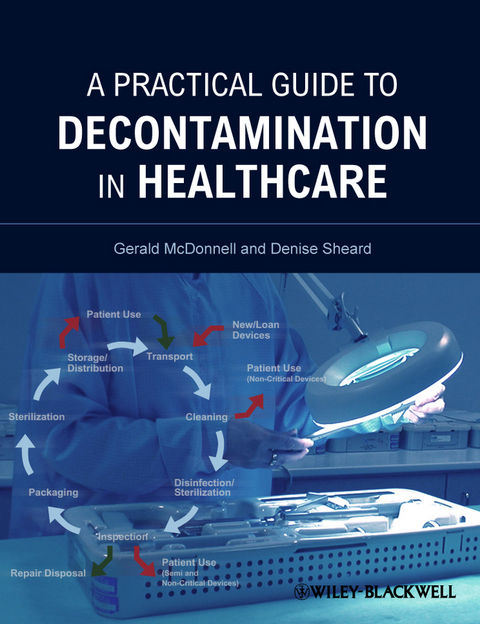

Written by highly experienced professionals, A Practical Guide to Decontaminationin Healthcare comprises a systematic review of decontamination methods, with uses and advantages outlined for each. Up-to-date regulations, standards and guidelines are incorporated throughout, to better equip healthcare professionals with the information they need to meet the technical and operational challenges of medical decontamination.
A Practical Guide to Decontaminationin Healthcare is an important new volume on state-of-the-art decontamination processes and a key reference source for all healthcare professionals working in infectious diseases, infection control/prevention and decontamination services.
Prevention is the first line of defence in the fight against infection. As antibiotics and other antimicrobials encounter increasing reports of microbial resistance, the field of decontamination science is undergoing a major revival. A Practical Guide to Decontamination in Healthcare is a comprehensive training manual, providing practical guidance on all aspects of decontamination including: microbiology and infection control; regulations and standards; containment, transportation, handling, cleaning, disinfection and sterilization of patient used devices; surgical instrumentation; endoscopes; and quality management systems. Written by highly experienced professionals, A Practical Guide to Decontaminationin Healthcare comprises a systematic review of decontamination methods, with uses and advantages outlined for each. Up-to-date regulations, standards and guidelines are incorporated throughout, to better equip healthcare professionals with the information they need to meet the technical and operational challenges of medical decontamination. A Practical Guide to Decontaminationin Healthcare is an important new volume on state-of-the-art decontamination processes and a key reference source for all healthcare professionals working in infectious diseases, infection control/prevention and decontamination services.
Gerald McDonnell, STERIS Limited, Basingstoke, UK Denise Sheard, Sterile Services Training Consultant, Cape Town, South Africa
A Practical Guide to Decontamination in Healthcare 5
Contents 7
Foreword 8
Glossary of terms 9
Acknowledgements 15
1 Introduction 17
What is decontamination? 17
A brief history of decontamination 18
Goals of decontamination and the Spaulding classification 22
The decontamination process 24
The design of a decontamination area 25
Where to start 28
2 Basic anatomy, physiology and biochemistry 34
Anatomy terminology 36
Introduction 34
The anatomical systems of the human body 39
Cardiovascular 39
Digestive 47
Endocrine 49
Integumentary 52
Lymphatic 54
Muscular 55
Nervous 56
Reproductive 58
Respiratory 59
Skeletal (including dental) 60
Urinary 64
Additional structures 65
3 Medical and surgical procedures and facilities 68
Introduction 68
Procedures and techniques 70
Medical disciplines and common procedures 70
The medical team 70
Types of medical disciplines 71
Medical and diagnostic equipment 72
Surgical procedures 72
Surgical team members 75
Surgical techniques 75
Surgical disciplines and common procedures 75
Introduction to endoscopic procedures 76
The operating/procedure room 79
Operating room set-up 79
Principles of aseptic (or “sterile”) technique 81
4 Instrumentation 86
Introduction 86
Single-use and re-use instrumentation definition 87
Materials used in the manufacture of instruments 88
Device manufacturers and suppliers 89
Introduction and quality standards 89
Manufacturing process 90
Instrument marking 91
Surgical instrument types and descriptions 91
Basic, everyday instruments 92
Instrument classification 93
Instruments for cutting and dissecting 94
Instruments used for grasping and holding 97
Instruments used for clamping and occluding 100
Instruments used for exposing and retracting 100
Instruments used for suturing or stapling 103
Instruments used for general viewing 104
Instruments used for suction and aspiration 104
Instruments used for dilation 105
Instruments used for measuring or positioning 105
Powered instruments/tools 106
Other miscellaneous surgical instruments 106
Microsurgery 106
Robotic surgery 107
Devices used in dental surgery 108
Tattooing 108
Endoscopy 109
Miscellaneous devices used medically 114
Blood pressure (BP) monitors 114
Reflex hammer 114
Medical thermometers 114
Stethoscopes 116
5 Microbiology and infection control/prevention 117
Introduction 117
Microorganism types 117
The microbial world: an introduction 117
Prions and other infectious proteins 118
Viruses 119
Bacteria 122
Fungi 130
Protozoa 133
Helminths 135
An introduction to infection prevention and control 137
Microorganisms are everywhere 138
Sources of contamination 138
The role of infection prevention and control 140
Infection control and prevention strategies 141
Reprocessing role in infection control and prevention 143
6 Chemistry and physics 146
Introduction 146
Solids, liquids, gases and plasmas 147
Mixtures, formulations and solutions 150
Weights, measures and other physical considerations 152
The pH scale: defining acids and bases 154
Other common chemical measurement methods 155
An introduction to sampling 155
Titration 156
Conductivity 156
Total dissolved solids 156
Total organic carbon 157
Inductively coupled plasma mass spectrometry 157
Light, radiation and the electromagnetic spectrum 157
Safety considerations 158
How to choose and use a chemical product 159
Introduction to cleaning and accessory chemistries 160
Patient soil 160
Classification of cleaning chemistries 160
Enzyme-based cleaners 162
Non-enzyme-based cleaners 163
Introduction to antimicrobial (disinfection/sterilization) chemistries 163
Classification of biocides 164
Antiseptics 166
Disinfectants, including preservatives 168
Chemical sterilization 171
7 Post-procedure handling, containment and transport 174
Introduction 174
Post-procedure sorting 175
Point of use cleaning 178
“Wet” and “dry” handling of instruments post-procedure 178
Guidelines on point of use cleaning and/or preparation for transport 179
Transportation post-procedure 181
Transportation systems 183
Container and containment systems 184
Transport trolleys 185
External/road transport 185
Care of trolleys and containers 186
Tracking and traceability 187
8 Cleaning 189
Introduction 189
Receiving and sorting 190
Disassembly and preparation for cleaning 193
Basic principles of cleaning 195
Manual cleaning 199
Automated cleaning 203
Immersion, including ultrasonic baths 207
Automated washers/washer-disinfectors 210
Tunnel (or continuous process) washers 213
Multi-chamber washers 214
Single-chamber washers 215
Special cleaning considerations 218
Microsurgical, including ophthalmological devices 218
Loan devices and device sets (including orthopedic sets) 218
Electrical and robotic systems 219
Endoscopy 220
Devices known or suspected to be contaminated with prion material 224
Textiles and laundry 224
Cleaning guidelines, standards and testing 227
Troubleshooting cleaning problems 232
9 Disinfection 235
Introduction 235
Basic principles of disinfection 239
Physical disinfection 241
Moist/wet heat disinfection 241
Dry heat 243
Radiation 244
Filtration 245
Chemical disinfection 247
Alcohols 247
Aldehydes 248
Halogens 251
Peroxygens 253
Phenols 257
Quaternary ammonium compounds 258
Other biocides 258
Disinfection guidelines and standards 259
Special considerations 264
Flexible endoscopes 265
Laundry 270
Antiseptics 270
Environmental disinfection 270
Prion disinfection 272
Troubleshooting disinfection problems 273
10 Inspection, packaging and loading for sterilization 275
Introduction 275
Inspection and packaging area design considerations 275
Area design 275
Maintenance 276
Personal attire and other material consideration 276
Further guidance 277
Inspection 277
Cleanliness 277
Functionality testing 279
General guidelines on device inspection 280
Examples of specific device inspections 281
Maintenance, repairs and replacements 285
Device and tray assembling 287
General considerations 287
Instrument trays and pouches (supplementary devices) 290
Assembling a tray 290
Examples of different procedure device sets and prepared trays 291
Medical grade packaging systems 291
Selection of packaging materials 294
Types of packaging 295
Wrapping and sealing methods 298
Standards and guidelines for sterilization packaging systems 301
Label identification of packaged devices 301
Loading and unloading sterilizers 302
Loading the sterilizer 303
Unloading a sterilizer 306
11 Sterilization 307
Introduction 307
Basic principles of sterilization 309
Physical sterilization 316
Steam (moist heat) sterilization 316
Dry heat sterilization 338
Radiation 343
Filtration 343
Chemical sterilization 344
Ethylene oxide gas 344
Formaldehyde gas 352
Liquid peracetic acid 364
Other processes 369
Process monitoring 372
Troubleshooting 374
12 Storage and distribution 376
Introduction 376
Handling of non-packaged or non-sterilized devices 377
Sterile storage environment and layout 378
Storage and handling of sterile, packaged devices 379
Inventory control 381
Transport of sterile packaged items 381
Hand transport 381
Trolley systems 381
Dedicated lifts (elevators) 382
Transport to another facility 383
Guidance at the point of use 384
Standards and guidelines 385
13 Safety 386
Introduction 386
Types of workplace safety hazards 386
Microbiological risks 387
Chemical risks 388
Device and equipment risks 391
Physical and emotional health 392
Reducing safety risks and risk analysis 395
Specific safety considerations 396
Waste management 396
Accidental spillages/leakages 403
Fire 403
Disaster planning and management 405
14 Management principles 406
Introduction 406
Personnel management 407
Personnel organization 407
Skills and knowledge requirements 408
Personnel management tips 409
Teamwork 409
Introduction 409
Team leadership 410
Team communication 411
Change management 411
Conflict management 412
Effective teamwork 412
Ethics and legal responsibility 413
Process management 414
Introduction 414
Process improvement 414
Process risk analysis 415
Recall 415
Materials management 416
Inventory management 416
Tracking and traceability 417
Quality management 419
Monitoring cleaning 421
Monitoring disinfection 425
Monitoring sterilization 426
15 Special interest topics 434
Water quality/purity 434
Endoscopes and other lumened devices 440
Single-use devices (SUDs) 443
Loan devices, sets and implants 445
Surgical and medical laundry 447
Devices known or suspected to be contaminated with prion material 450
Index 453
| Erscheint lt. Verlag | 18.5.2012 |
|---|---|
| Sprache | englisch |
| Themenwelt | Medizin / Pharmazie ► Allgemeines / Lexika |
| Medizin / Pharmazie ► Gesundheitswesen | |
| Naturwissenschaften ► Biologie | |
| Schlagworte | Antibiotics • antimicrobials • Decontamination • decontamination science • Defence • encounter increasing • Field • Fight • First • Guide • Healthcare • Infection • Infectious Disease & Microbiology • Infektionskrankheit • Infektionskrankheiten u. Mikrobiologie • line • major revival • Manual • Medical Science • Medizin • microbial • Practical • prevention • Reports • resistance |
| ISBN-13 | 9781118321324 / 9781118321324 |
| Informationen gemäß Produktsicherheitsverordnung (GPSR) | |
| Haben Sie eine Frage zum Produkt? |
 PDF (Adobe DRM)
Kopierschutz: Adobe-DRM
Adobe-DRM ist ein Kopierschutz, der das eBook vor Mißbrauch schützen soll. Dabei wird das eBook bereits beim Download auf Ihre persönliche Adobe-ID autorisiert. Lesen können Sie das eBook dann nur auf den Geräten, welche ebenfalls auf Ihre Adobe-ID registriert sind.
Details zum Adobe-DRM
Dateiformat: PDF (Portable Document Format)
Mit einem festen Seitenlayout eignet sich die PDF besonders für Fachbücher mit Spalten, Tabellen und Abbildungen. Eine PDF kann auf fast allen Geräten angezeigt werden, ist aber für kleine Displays (Smartphone, eReader) nur eingeschränkt geeignet.
Systemvoraussetzungen:
PC/Mac: Mit einem PC oder Mac können Sie dieses eBook lesen. Sie benötigen eine
eReader: Dieses eBook kann mit (fast) allen eBook-Readern gelesen werden. Mit dem amazon-Kindle ist es aber nicht kompatibel.
Smartphone/Tablet: Egal ob Apple oder Android, dieses eBook können Sie lesen. Sie benötigen eine
Geräteliste und zusätzliche Hinweise
Buying eBooks from abroad
For tax law reasons we can sell eBooks just within Germany and Switzerland. Regrettably we cannot fulfill eBook-orders from other countries.
aus dem Bereich