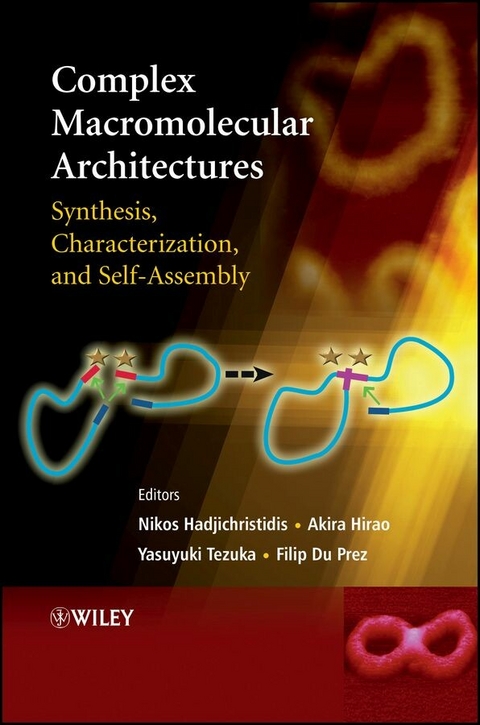
Complex Macromolecular Architectures (eBook)
856 Seiten
John Wiley & Sons (Verlag)
978-0-470-82514-3 (ISBN)
The architectural polymers, including bio-conjugated hybrid polymers with poly(amino acid)s and gluco-polymers, star-branched and dendrimer-like hyperbranched polymers, cyclic polymers, dendrigraft polymers, rod-coil and helix-coil block copolymers, are introduced chapter by chapter in the book. In particular, the book also emphasizes the topic of synthetic breakthroughs by living/controlled polymerization since 2000.
Furthermore, renowned authors contribute on special topics such as helical polyisocyanates, metallopolymers, stereospecific polymers, hydrogen-bonded supramolecular polymers, conjugated polymers, and polyrotaxanes, which have attracted considerable interest as novel polymer materials with potential future applications. In addition, recent advances in reactive blending achieved with well-defined end-functionalized polymers are discussed from an industrial point of view. Topics on polymer-based nanotechnologies, including self-assembled architectures and suprastructures, nano-structured materials and devices, nanofabrication, surface nanostructures, and their AFM imaging analysis of hetero-phased polymers are also included.
* Provides comprehensive coverage of recently developed advanced architectural materials
* Covers hot new areas such as: click chemistry; chain walking; polyhomologation; ADMET
* Edited by highly regarded scientists in the field
* Contains contributions from 26 leading experts from Europe, North America, and Asia
Researchers in academia and industry specializing in polymer chemistry will find this book to be an ideal survey of the most recent advances in the area. The book is also suitable as supplementary reading for students enrolled in Polymer Synthetic Chemistry, Polymer Synthesis, Polymer Design, Advanced Polymer Chemistry, Soft Matter Science, and Materials Science courses.
Color versions of selected figures can be found at www.wiley.com/go/hadjichristidis
Nikos Hadjichristidis is a Professor of Polymer at University of Athens, Greece, where he is the Chairman of the Chemistry Department. He also worked as an adjunct professor at the Royal Institute of Technology in Stockholm, the Technical University of Denmark, Institute of Chemical Engineering of the National Research Council of Argentina, and the Simon Bolivar University, Venezuela. He holds considerable honors including the ACS PMSE A. K. Doolittle Award (2003) and the International Award of the Society of Polymer Science, Japan (SPSJ, 2007). He is also a very active with the editorial boards of Polymer journals. He has published more than 340 papers and 23 reviews in referred scientific journals, 4 patents, two books. Yasuyuki Tezuka is a Professor of Polymer at the Tokyo Institute of Technology. His research has focused on topological polymer chemistry, in particular on designing topologically unique macromolecular architectures by developing the electrostatic self-assembly and covalent fixation process. He was an associate editor of Polymer Journal published by The Society of Polymer Science, Japan from 2002-2006, and has been an Asian Editor of Reactive and Functional Polymers since 2006. He received a M.S. from The University of Tokyo in synthetic chemistry and a Ph.D. from Ghent University (Belgium) in polymers. Akira Hiraois a Professor of Polymer at the Tokyo Institute of Technology, where he was the Chairman of Polymeric and Organic Materials Department four times and Vice-Dean of Chemistry Division, undergraduate course (2004-2006). He is currently Members of the Editorial Board of Macromolecules, Polymer Journal, Macromolecular Research, and European Polymer Journal.
List of Contributors.
Preface.
About the Editors.
PART ONE SYNTHESIS.
1 Cyclic and Multicyclic Topological Polymers (Takuya
Yamamoto and Yasuyuki Tezuka).
2 Ultrarapid Approaches to Mild Macromolecular Conjugation
(Andrew J. Inglis and Christopher Barner-Kowollik).
3 Synthesis and Self-Assembly of Hydrogen-Bonded Supramolecular
Polymers (Wolfgang H. Binder, Claudia Enders, Florian Herbst and
Katharina Hackethal).
4 Recent Synthetic Developments in Miktoarm Star Polymers with
More than Three Different Arms (Akira Hirao, Mayumi Hayashi,
Tomoya Higashihara and Nikos Hadjichristidis).
5 Precise Synthesis of Dendrimer-Like Star-Branched Polymers, a
New Class of Well-Defined Hyperbranched Polymers (Hee-Soo Yoo
and Akira Hirao).
6 Arborescent Polymers with a Mesoscopic Scale (Toufic Nabil
Aridi and Mario Gauthier).
7 Hyperbranched Glyco-Conjugated Polymers (Toshifumi Satoh
and Toyoji Kakuchi).
8 Highly Branched Functional Polymer Architectures by
Click-Chemistry Strategies (Mieke Lammens and Filip Du
Prez).
9 Living Alkene Polymerization for Polyolefin Architectures
(Amelia M. Anderson-Wile, Joseph B. Edson and Geoffrey W.
Coates).
10 Precision Polyolefins (Erik B. Berda and Kenneth B.
Wagener).
11 Polyhomologation: The Living Polymerization of Ylides (Jun
Luo and Kenneth J. Shea).
12 Phenylenevinylene Homopolymers and Block Copolymers via
Ring-Opening Metathesis Polymerization (Chin-Yang Yu and Michael
L. Turner).
13 Block Copolymers Containing Rod Segments (Tomoya
Higashihara and Mitsuru Ueda).
14 Synthesis of Well-Defined Poly(meth)acrylamides with Varied
Stereoregularity by Living Anionic Polymerization (Takashi
Ishizone).
15 Complex Macromolecular Chimeras (Hermis Iatrou, Marinos
Pitsikalis, Georgios Sakellariouand Nikos Hadjichristidis).
PART TWO CHARACTERIZATION AND SELF-ASSEMBLY.
16 Self-Assembly and Applications of Polyferrocenylsilane Block
Copolymers (George R. Whittell, Jessica Gwyther, David A. Rider
and Ian Manners).
17 Functional Polymeric Nanostructures Prepared by Self-Assembly
and Beyond (Rachel K. O'Reilly).
18 Morphologies of Block and Star-Branched Polymers with Three
Components (Hirokazu Hasegawa).
19 Morphologies and Photophysical Properties of Conjugated
Rod-Coil Block Copolymers (Chi-Ching Kuo, Cheng-Liang Liu
and Wen-Chang Chen).
20 Bulk Self-Assembly of Linear Hybrid Polypeptide-Based Diblock
and Triblock Copolymers (Sebastien Lecommandoux).
21 AFM Study of Comb (Co)Polymers with Complex Chain
Architecture (Michel Schappacher and Alain Deffieux).
22 Tunable Thermoresponsive Polymers by Molecular Design
(Richard Hoogenboom).
23 Fluorine-Containing Block Copolymers: Synthesis and
Application as a Template for Nanocellular and Porous Structures
Using Supercritical Carbon Dioxide (Hideaki Yokoyama and Kenji
Sugiyama).
24 Architectural Polymers, Nanostructures, and Hierarchical
Structures from Block Copolymers (Ian Wyman and Guojun
Liu).
25 Block Copolymer Nanostructured Thin Films for Advanced
Patterning (Michelle A. Chavis, Evan L. Schwartz and Christopher
K. Ober).
26 Ring Polymers: Effective Isolation and Unique Properties
(Haskell W. Beckham).
Acknowledgments.
References.
Index.
"Though appealing to specialists, the material is presented with
adequate description to be accessible to researchers in other
fields." (Book News, 1 August 2011)
| Erscheint lt. Verlag | 4.4.2011 |
|---|---|
| Sprache | englisch |
| Themenwelt | Naturwissenschaften ► Chemie ► Organische Chemie |
| Technik | |
| Schlagworte | Chemie • Chemistry • Organic Chemistry • Organische Chemie |
| ISBN-10 | 0-470-82514-6 / 0470825146 |
| ISBN-13 | 978-0-470-82514-3 / 9780470825143 |
| Informationen gemäß Produktsicherheitsverordnung (GPSR) | |
| Haben Sie eine Frage zum Produkt? |
 PDF (Adobe DRM)
Kopierschutz: Adobe-DRM
Adobe-DRM ist ein Kopierschutz, der das eBook vor Mißbrauch schützen soll. Dabei wird das eBook bereits beim Download auf Ihre persönliche Adobe-ID autorisiert. Lesen können Sie das eBook dann nur auf den Geräten, welche ebenfalls auf Ihre Adobe-ID registriert sind.
Details zum Adobe-DRM
Dateiformat: PDF (Portable Document Format)
Mit einem festen Seitenlayout eignet sich die PDF besonders für Fachbücher mit Spalten, Tabellen und Abbildungen. Eine PDF kann auf fast allen Geräten angezeigt werden, ist aber für kleine Displays (Smartphone, eReader) nur eingeschränkt geeignet.
Systemvoraussetzungen:
PC/Mac: Mit einem PC oder Mac können Sie dieses eBook lesen. Sie benötigen eine
eReader: Dieses eBook kann mit (fast) allen eBook-Readern gelesen werden. Mit dem amazon-Kindle ist es aber nicht kompatibel.
Smartphone/Tablet: Egal ob Apple oder Android, dieses eBook können Sie lesen. Sie benötigen eine
Geräteliste und zusätzliche Hinweise
Buying eBooks from abroad
For tax law reasons we can sell eBooks just within Germany and Switzerland. Regrettably we cannot fulfill eBook-orders from other countries.
aus dem Bereich