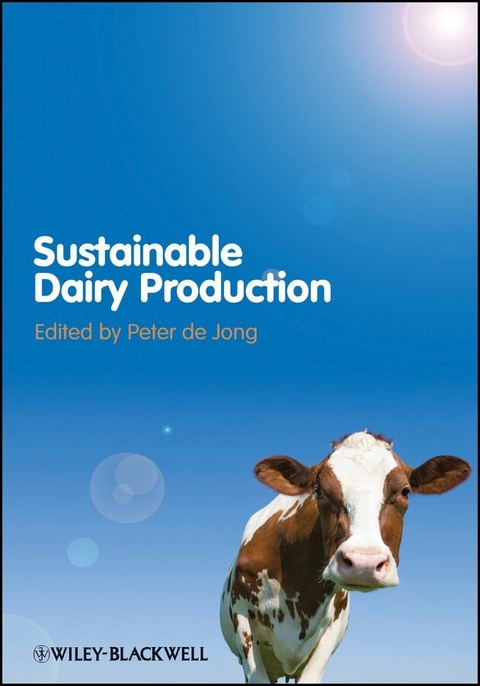
Sustainable Dairy Production (eBook)
John Wiley & Sons (Verlag)
978-1-118-48946-8 (ISBN)
- How to set up a sustainable production line
- How to quantify the carbon foot print of a dairy product by using life cycle analysis
- Current technologies to improve the carbon foot print
- What measures can be taken to reduce the global warming potential of the farm
- Reduction of water use in dairy production
- Marketing sustainable dairy products
- Bench marking of dairy products against other food products
- Potential future technological developments to improve the carbon foot print for the following decades
Dr Peter de Jong is Head of Processing Research at NIZO, a well-known food production research institute in the Netherlands which has a focus on dairy science. Peter has been active in sustainable dairy processing for more than 20 years and has written more than 140 scientific and technical papers on the subject.
This book offers a comprehensive overview of the state of the art in sustainable dairy production, helping the industry to develop more sustainable dairy products, through new technologies, implementing life cycle analysis, and upgrading and optimization of their current production lines. It aims to stimulate process innovations, taking into account environmental, economic and public relations benefits for companies. Topics covered include: How to set up a sustainable production line How to quantify the carbon foot print of a dairy product by using life cycle analysis Current technologies to improve the carbon foot print What measures can be taken to reduce the global warming potential of the farm Reduction of water use in dairy production Marketing sustainable dairy products Bench marking of dairy products against other food products Potential future technological developments to improve the carbon foot print for the following decades
Dr Peter de Jong is Head of Processing Research at NIZO, a well-known food production research institute in the Netherlands which has a focus on dairy science. Peter has been active in sustainable dairy processing for more than 20 years and has written more than 140 scientific and technical papers on the subject.
Preface ix
Contributors xi
1 Introduction 1
Peter de Jong
1.1 Sustainability and the dairy industry: hype or trend? 2
1.2 Quantifying the issue: measuring footprints 4
1.3 Communication: telling the whole story 5
1.4 Structure of this book 6
References 8
2 Greenhouse gas emissions from global dairy production9
Theun V. Vellinga, Pierre Gerber and Carolyn Opio
2.1 Introduction 9
2.2 Methods for calculating emissions 11
2.3 Total emissions of the dairy sector 14
2.4 Discussion 26
References 28
3 Life cycle assessment 31
Maartje N. Sevenster
3.1 Introduction 31
3.2 Current life cycle assessment 32
3.3 Life cycle assessment in application 37
3.4 Life cycle assessment of dairy products 41
3.5 Life cycle assessment in strategy and policy 50
Acknowledgements 51
References 52
4 Sustainability and resilience of the dairy sector in achanging world: a farm economic and EU perspective 55
Roel Jongeneel and Louis Slangen
4.1 Introduction 56
4.2 Dairy economics and sustainability 62
4.3 Sustainability evaluation of the EU dairy sector 71
4.4 Agricultural policy 79
4.5 Conclusion 83
References 85
5 Dairy processing 87
Arjan J. van Asselt and Michael G. Weeks
5.1 Introduction 87
5.2 Key unit operations and their water and energy use 89
5.3 Possibilities for optimisation 101
5.4 Revisiting dairy processing: breakthrough technologies114
References 117
6 The role of packaging in a sustainable dairy chain119
Erika Mink
6.1 Introduction 120
6.2 Packaging sustainability: a growing market expectation123
6.3 Packaging's contribution to dairy sustainability130
6.4 Global alignment of packaging requirements: implications fordairy 139
6.5 A company response: the example of Tetra Pak 150
6.6 Outlook: growing importance of economic and social pillarsof sustainability 158
References 160
7 The business case for sustainable dairy products163
Jaap Petraeus
7.1 Introduction 163
7.2 From a process-driven to a product-driven approach 164
7.3 Success factors for creating more sustainable processes andproducts 169
7.4 Implementation of sustainability within the company 175
7.5 The business case for sustainability 180
7.6 Policy and strategy adopted by different dairy companies183
7.7 Looking to the future 183
7.8 Conclusion 184
References 186
Appendix: Overview of the sustainability policy and strategy ofvarious companies 187
8 A case study of marketing sustainability 191
Grietsje Hoekstra, Corine Kroft and Klaas Jan van Calker
8.1 Introduction 191
8.2 What is sustainability? 193
8.3 Motivations for sustainability 196
8.4 Choose your battles: sustainability strategy issues 198
8.5 Getting to work 203
8.6 Communicating sustainability 212
8.7 Conclusion 217
Acknowledgement 218
References 219
9 Cradle to Cradle for innovations in the dairy industry221
Wil A.M. Duivenvoorden
9.1 Introduction 222
9.2 A tool for C2C®-driven innovation (PROPER model)229
9.3 Cradle to Cradle for the dairy industry 232
9.4 Conclusion 238
References 241
10 The future of sustainable dairy production 243
Peter de Jong
10.1 Future relevance of sustainable dairy 243
10.2 Next steps in chain innovation 244
10.3 Communication and marketing 247
10.4 Business case: people, planet and profit 247
10.5 Conclusion 249
References 250
Index 251
"In summary, a very worth-while addition to the series
that provides an excellent source for those working with this
technology." (International Journal of Dairy
Technology, 16 July 2013)
| Erscheint lt. Verlag | 9.1.2013 |
|---|---|
| Sprache | englisch |
| Themenwelt | Naturwissenschaften ► Biologie |
| Technik | |
| Weitere Fachgebiete ► Land- / Forstwirtschaft / Fischerei | |
| Schlagworte | Dairy Food • dairy production and life cycle analysis, current dairy production technologies, global warming and dairy production, reducing water use in dairy production • Food Management • Food Processing, Production & Manufacture • Food Science & Technology • Herstellung u. Verarbeitung von Lebensmitteln • Lebensmittelforschung u. -technologie • Lebensmittel-Management • Lebensmitteltechnik • marketing sustainable dairy products, benchmarking dairy products • Milcherzeugnis • Milchprodukte • Nachhaltigkeit • Sustainable dairy production, sustainable dairy production line |
| ISBN-10 | 1-118-48946-2 / 1118489462 |
| ISBN-13 | 978-1-118-48946-8 / 9781118489468 |
| Informationen gemäß Produktsicherheitsverordnung (GPSR) | |
| Haben Sie eine Frage zum Produkt? |
 PDF (Adobe DRM)
Kopierschutz: Adobe-DRM
Adobe-DRM ist ein Kopierschutz, der das eBook vor Mißbrauch schützen soll. Dabei wird das eBook bereits beim Download auf Ihre persönliche Adobe-ID autorisiert. Lesen können Sie das eBook dann nur auf den Geräten, welche ebenfalls auf Ihre Adobe-ID registriert sind.
Details zum Adobe-DRM
Dateiformat: PDF (Portable Document Format)
Mit einem festen Seitenlayout eignet sich die PDF besonders für Fachbücher mit Spalten, Tabellen und Abbildungen. Eine PDF kann auf fast allen Geräten angezeigt werden, ist aber für kleine Displays (Smartphone, eReader) nur eingeschränkt geeignet.
Systemvoraussetzungen:
PC/Mac: Mit einem PC oder Mac können Sie dieses eBook lesen. Sie benötigen eine
eReader: Dieses eBook kann mit (fast) allen eBook-Readern gelesen werden. Mit dem amazon-Kindle ist es aber nicht kompatibel.
Smartphone/Tablet: Egal ob Apple oder Android, dieses eBook können Sie lesen. Sie benötigen eine
Geräteliste und zusätzliche Hinweise
Buying eBooks from abroad
For tax law reasons we can sell eBooks just within Germany and Switzerland. Regrettably we cannot fulfill eBook-orders from other countries.
aus dem Bereich