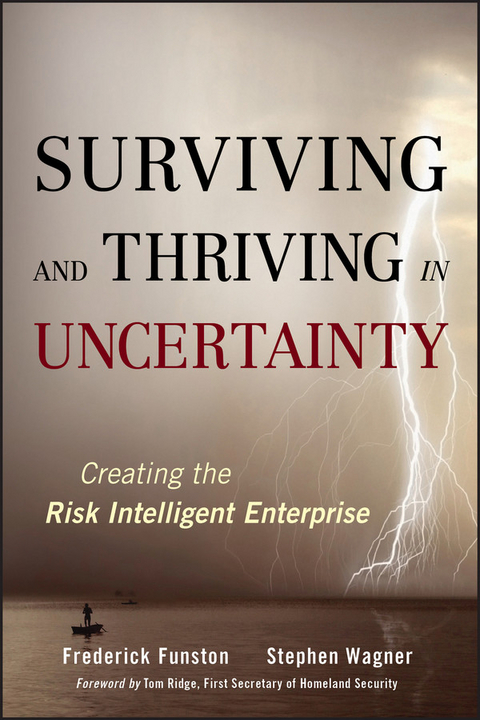
Surviving and Thriving in Uncertainty (eBook)
John Wiley & Sons (Verlag)
978-0-470-61747-2 (ISBN)
FREDERICK FUNSTON is a principal with Deloitte & Touche LLP and has more than thirty years of experience working with leaders of numerous global companies. In 2000, Rick created the concept of risk intelligence for value creation and value protection. He is a frequent speaker and writer on leveraging risk intelligence for competitive advantage in complex, global organizations. STEPHEN WAGNER is a nationally recognized thought leader on corporate governance. In 2009, Steve retired as the managing partner of Deloitte LLP's Center for Corporate Governance, where he led the firm's integrated strategy for governance services. He is a frequent speaker at governance conferences and directors' colleges and has authored or contributed to numerous articles on governance and risk.
Acknowledgments.
Foreword.
Preface.
Introduction.
Conventional Risk Management.
A Risk Intelligent Approach.
The Approach of This Book.
The Structure of This Book.
PART I WHEN RISKS BECOME BRUTAL REALITIES.
CHAPTER 1 To Survive and Thrive: A Matter ofJudgment.
The Revolving Door to the Corner Office.
Barriers to Board Effectiveness.
The Imperatives of the Enterprise.
CHAPTER 2 Conventional Risk Management Has Failed.
What Goes Up Must Come Down.
The Evolution of Finance, Market, and Risk ManagementTheory.
Taking a (Random) Walk.
CHAPTER 3 An Unconventional Approach to RiskManagement.
Calculated Risk Taking Creates Value.
Calculated Risk Taking and Risk Aversion.
Risk Intelligence: An Unconventional Approach.
PART II TEN ESSENTIAL RISK INTELLIGENCE SKILLS.
CHAPTER 4 Check Your Assumptions at the Door.
Fatal Flaw #1: Failing to Challenge Your Assumptions.
Risk Intelligence Skill #1: Check Your Assumptions at theDoor.
CHAPTER 5 Maintain Constant Vigilance.
Fatal Flaw #2: Lack of Vigilance.
Risk Intelligence Skill #2: Maintain Constant Vigilance.
CHAPTER 6 Factor in Velocity and Momentum.
Fatal Flaw # 3: Failure to Consider Velocity and Momentum.
Risk Intelligence Skill #3: Factor in Velocity and Momentum.
CHAPTER 7 Manage the Key Connections.
Fatal Flaw #4: Failure to Make Key Connections and ManageComplexity.
Risk Intelligence Skill #4: Manage Your Key Connections.
CHAPTER 8 Anticipate Causes of Failure.
Fatal Flaw #5: Failure to Anticipate Failure.
Risk Intelligence Skill #5: Anticipate Causes of Failure.
CHAPTER 9 Verify Sources and Corroborate Information.
Fatal Flaw #6: Failure to Verify Sources and CorroborateInformation.
Risk Intelligence Skill # 6: Verify Sources and CorroborateInformation.
CHAPTER 10 Maintain a Margin of Safety.
Fatal Flaw #7: Failing to Maintain a Margin of Safety.
Risk Intelligence Skill #7: Maintain a Margin of Safety.
CHAPTER 11 Set Your Enterprise Time Horizons.
Fatal Flaw #8: Short-Termism.
Risk Intelligence Skill #8: Set Your Enterprise TimeHorizons.
CHAPTER 12 Take Enough of the Right Risks.
Fatal Flaw #9: Failure to Take Enough of the Right Risks.
Risk Intelligence Skill #9: Taking Enough of the RightRisks.
CHAPTER 13 Sustain Operational Discipline.
Case Example: The U.S. Submarine Force.
Fatal Flaw #10: Lack of Operational Discipline.
Risk Intelligence Skill #10: Develop and Sustain OperationalDiscipline.
PART III CREATING THE RISK INTELLIGENT ENTERPRISE.
CHAPTER 14 Risk Intelligence Is Free.
A Closer Look at Costs.
The Rewards of Risk Intelligence.
CHAPTER 15 Risk Intelligent Governance.
The Risk Intelligent Board.
Committees of the Board and Risk Intelligence.
Where Does Risk Oversight End and Risk Management Begin?.
CHAPTER 16 Risk Intelligent Enterprise Management.
ERM and Risk Intelligence.
Developing Risk Intelligent Enterprise Management.
Act as One.
A New Way of Doing Business.
CHAPTER 17 The Way Forward: Creating the Risk IntelligentEnterprise.
The Benefits of Improved Risk Intelligence.
What's Your Enterprise Risk IQ?
Making the Transformation.
Conclusion.
Notes.
About the Authors.
Index.
"The authors propose a more holistic approach of "risk intelligence," in which leaders acknowledge and prepare for a wide range of potential threats. The authors isolate ten essential risk intelligence skills-such as abandoning familiar assumptions, anticipating causes of failure, and sustaining operational discipline-and provide in-depth guidelines for how executives and board members can hone these skills. They understand that there is no reward without risk - but only if the risks are properly managed." (BizEd, July/August 2010)
| Erscheint lt. Verlag | 9.6.2010 |
|---|---|
| Zusatzinfo | Drawings: 15 B&W, 0 Color; Tables: 19 B&W, 0 Color |
| Sprache | englisch |
| Themenwelt | Naturwissenschaften |
| Wirtschaft ► Betriebswirtschaft / Management ► Allgemeines / Lexika | |
| Wirtschaft ► Betriebswirtschaft / Management ► Finanzierung | |
| Schlagworte | 2008 Credit Crisis • Accounting • Analytics • Assessment • book recommendations • calibrated probabilities • CISSP • Compliance • Corporate Finance • Credit Crisis • Decision Analysis • Disaster Recovery • exposure mitigation • Frederick Funston • isc2 • logic engineering • Measurement • metrics • natural disaster • natural disasters • Outsourcing • Portfolio • Probability • Public Value • qualified decision management • Quantitative risk analysis • Rechnungswesen • Risk • risk analysis • risk assessment • risk intelligence • Risk Management • Shareholder Value • Stephen Wagner |
| ISBN-10 | 0-470-61747-0 / 0470617470 |
| ISBN-13 | 978-0-470-61747-2 / 9780470617472 |
| Informationen gemäß Produktsicherheitsverordnung (GPSR) | |
| Haben Sie eine Frage zum Produkt? |
 PDF (Adobe DRM)
Kopierschutz: Adobe-DRM
Adobe-DRM ist ein Kopierschutz, der das eBook vor Mißbrauch schützen soll. Dabei wird das eBook bereits beim Download auf Ihre persönliche Adobe-ID autorisiert. Lesen können Sie das eBook dann nur auf den Geräten, welche ebenfalls auf Ihre Adobe-ID registriert sind.
Details zum Adobe-DRM
Dateiformat: PDF (Portable Document Format)
Mit einem festen Seitenlayout eignet sich die PDF besonders für Fachbücher mit Spalten, Tabellen und Abbildungen. Eine PDF kann auf fast allen Geräten angezeigt werden, ist aber für kleine Displays (Smartphone, eReader) nur eingeschränkt geeignet.
Systemvoraussetzungen:
PC/Mac: Mit einem PC oder Mac können Sie dieses eBook lesen. Sie benötigen eine
eReader: Dieses eBook kann mit (fast) allen eBook-Readern gelesen werden. Mit dem amazon-Kindle ist es aber nicht kompatibel.
Smartphone/Tablet: Egal ob Apple oder Android, dieses eBook können Sie lesen. Sie benötigen eine
Geräteliste und zusätzliche Hinweise
Buying eBooks from abroad
For tax law reasons we can sell eBooks just within Germany and Switzerland. Regrettably we cannot fulfill eBook-orders from other countries.
aus dem Bereich