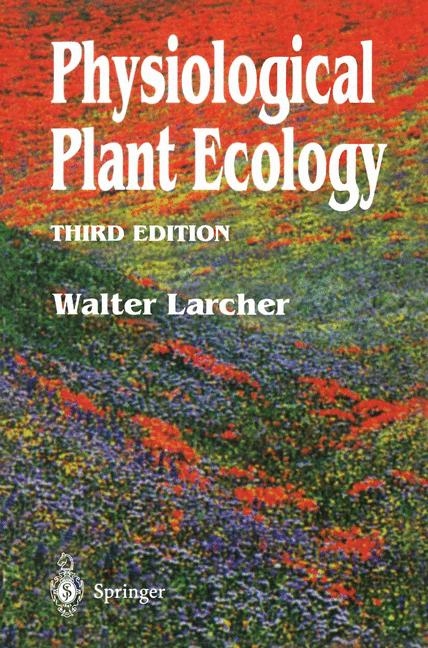
Physiological Plant Ecology
Springer Berlin (Verlag)
978-3-642-87853-4 (ISBN)
1 The Environment of Plants.- 1.1 The Surroundings of Plants.- 1.1.1 The Atmosphere.- 1.1.2 The Hydrosphere.- 1.1.3 The Lithosphere and the Soil.- 1.1.4 The Phytosphere — a Part of the Ecosphere.- 1.2 Radiation and Climate.- 1.2.1 Radiation.- 1.2.2 Climate.- 2 Carbon Utilization and Dry Matter Production.- 2.1 Carbon Metabolism in the Cell.- 2.1.1 Photosynthesis.- 2.1.2 Photorespiration: the Glycolate Pathway.- 2.1.3 Release of Energy by Catabolic Processes.- 2.2 Gas Exchange in Plants.- 2.2.1 The Exchange of Carbon Dioxide and Oxygen.- 2.2.2 Specific Capacity of Net Photosynthesis.- 2.2.3 Specific Activity of Mitochondrial Respiration.- 2.2.4 The Influence of Stage of Development and State of Activity on Respiration and Photosynthesis.- 2.2.5 The Effect of External Factors on CO2 Exchange.- 2.3 The Carbon Budget of the Whole Plant.- 2.3.1 The Gas-Exchange Balance.- 2.3.2 Dry Matter Production.- 2.3.3 Utilization of Photosynthates and the Rate of Growth.- 2.4 The Carbon Budget of Plant Communities.- 2.4.1 The Productivity of Stands of Plants.- 2.4.2 The Net Primary Production of the Vegetation of the Earth.- 2.4.3 The Carbon Balance of Plant Communities.- 2.5 Energy Conversion by the Plant Cover.- 2.5.1 Energy Conversion by Photosynthesis.- 2.5.2 The Energy Content of Plant Matter.- 2.5.3 Energy Efficiency of the Primary Production of Plant Communities.- 3 The Utilization of Mineral Elements.- 3.1 The Soil as a Nutrient Source for Plants.- 3.1.1 Mineral Nutrients in the Soil.- 3.1.2 Adsorption and Exchange of Ions in the Soil.- 3.2 The Uptake of Mineral Nutrients.- 3.2.1 The Uptake of Mineral Nutrients from the Soil.- 3.2.2 Ion Uptake into the Cell.- 3.2.3 Supplying the Root with Ions.- 3.2.4 The Transport of Ions in Roots.- 3.2.5 Long-Distance Transport of Minerals in the Plant.- 3.3 Utilization and Deposition of Minerals in the Plant.- 3.3.1 The Ash Content of Dry Matter and the Composition of Plant Ash.- 3.3.2 Nutrient Requirements and the Incorporation of Mineral Substances.- 3.3.3 Mineral Nutrient Status.- 3.4 The Elimination of Minerals.- 3.5 Nitrogen Metabolism.- 3.5.1 Nitrogen Uptake by the Plant.- 3.5.2 Nitrogen Assimilation.- 3.5.3 Nitrogen Partitioning in the Plant.- 3.5.4 Nitrogen Fixation by Microorganisms.- 3.6 Habitat-Related Aspects of Mineral Metabolism.- 3.6.1 Plants Growing on Acidic and Basic Substrates.- 3.6.2 Calcicole and Calcifuge Plants.- 3.6.3 Plants Growing in Oligotrophic Habitats.- 3.7 Mineral Cycling in Plant Communities.- 3.7.1 The Mineral Balance of a Plant Community.- 3.7.2 The Cycling of Minerals.- 4 Water Relations.- 4.1 Poikilohydric and Homoiohydric Plants.- 4.2 Water Relations of the Plant Cell.- 4.2.1 The Water in the Cell.- 4.2.2 The Water Potential of Plant Cells.- 4.2.3 The Dynamic Equilibrium of Cellular Water.- 4.3 Water Relations of the Whole Plant.- 4.3.1 Water Uptake.- 4.3.2 The Plant in the Water-Potential Gradient Between Soil and Atmosphere (Soil-Plant-Atmosphere Continuum).- 4.3.3 Water Loss from Plants.- 4.3.4 The Water Balance of a Plant.- 4.3.5 Water Relations in Different Plant Types.- 4.4 Water Economy in Plant Communities.- 4.4.1 The Water Balance of Stands of Plants.- 5 Environmental Influences on Growth and Development.- 5.1 Regulation of Growth and Development.- 5.1.1 The Role of Phytohormones.- 5.1.2 The Effect of External Factors.- 5.2 Stages in the Life of a Plant.- 5.2.1 The Embryonic Phase: Imprinting by the Mother Plant.- 5.2.2 Germination and Establishment: to Be or not to Be.- 5.2.3 The Vegetative Phase: Period of Greatest Growth.- 5.2.4 The Reproductive Phase: Flowering and Fruiting.- 5.2.5 The Phase of Senescence: Orderly Withdrawal.- 5.3 The Seasonality of Growth and Development.- 5.3.1 Different Patterns of Life History.- 5.3.2 Synchronization of Growth and Climatic Rhythms.- 5.3.3 Winter Dormancy in Cold Regions.- 5.3.4 Phenology: an Indicator of Weather Characteristics and Changes of Climate.- 6 Plants Under Stress.- 6.1 Stress: Disturbance and Syndrome.- 6.1.1 What is Stress?.- 6.1.2 What Happens During Stress?.- 6.1.3 How to Recognize Stress.- 6.1.4 Stress and Plant Life.- 6.2 Natural Environmental Constraints.- 6.2.1 Radiation Stress.- 6.2.2 Stress Due to Extreme Temperatures.- 6.2.3 Oxygen Deficiency in the Soil.- 6.2.4 Drought.- 6.2.5 Salt Stress.- 6.3 Anthropogenic Stress.- 6.3.1 Man-Made Pollutants and Their Impact on the Phytosphere.- 6.3.2 Pollution Injury.- 6.3.3 The Effects of Atmospheric Pollutants on the Ecosystem and at the Global Level.- References in the Text.- References in the Tables and Figures.
| Erscheint lt. Verlag | 14.4.2014 |
|---|---|
| Verlagsort | Berlin |
| Sprache | englisch |
| Maße | 155 x 235 mm |
| Einbandart | Paperback |
| Themenwelt | Naturwissenschaften ► Biologie ► Ökologie / Naturschutz |
| Schlagworte | Pflanzenökologie |
| ISBN-10 | 3-642-87853-9 / 3642878539 |
| ISBN-13 | 978-3-642-87853-4 / 9783642878534 |
| Zustand | Neuware |
| Informationen gemäß Produktsicherheitsverordnung (GPSR) | |
| Haben Sie eine Frage zum Produkt? |
aus dem Bereich