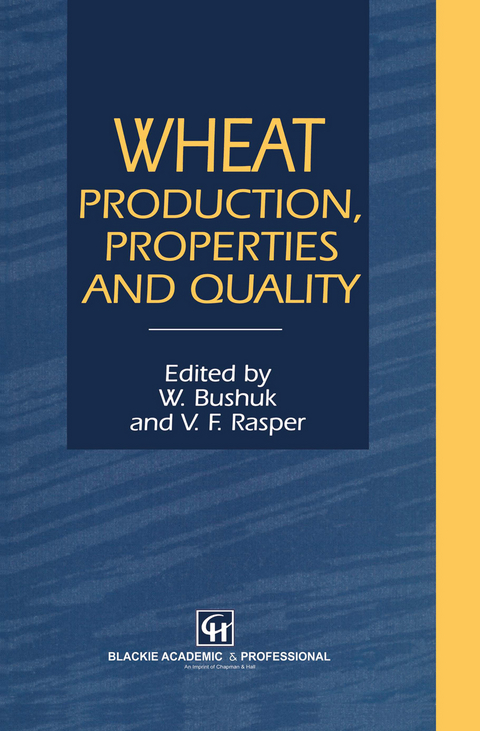
Wheat
Springer-Verlag New York Inc.
978-1-4613-6148-0 (ISBN)
1 World wheat production, utilization and trade.- 1.1 Introduction.- 1.2 Wheat: a brief overview.- 1.3 Wheat classes/grades.- 1.4 Wheat production.- 1.5 Wheat producers.- 1.6 Wheat utilization.- 1.7 Wheat stocks.- 1.8 World wheat trade.- 1.9 Wheat prices.- 1.10 Long term factors.- 1.11 Concluding comment.- References.- 2 Wheat: contribution to world food supply and human nutrition.- 2.1 Introduction.- 2.2 Utilization of wheat.- 2.3 Nutritional profile.- 2.4 Conclusions.- References.- 3 Bread-wheat quality defined.- 3.1 Introduction.- 3.2 Bread.- 3.3 Wheat quality.- 3.4 Methodology and approaches used to evaluate bread and bread-wheat quality.- 3.5 Bread-wheat quality — from whose point of view?.- References.- 4 Classification and grading.- 4.1 Introduction.- 4.2 Why grade grain?.- 4.3 Canadian grading system.- 4.4 Grade definitions and standards.- 4.5 Grading factors.- 4.6 Grading consistency.- 4.7 Classification.- 4.8 Cleanliness standards.- 4.9 Quality averaging.- 4.10 Objective versus subjective measurements.- 5 Recent developments in flour milling.- 5.1 Introduction.- 5.2 General requirements.- 5.3 Developments in equipment and processes.- 5.4 Summary.- 6 Recent research progress in bread baking technology.- 6.1 Historical overview.- 6.2 Nutritional recommendations.- 6.3 Processing techniques.- 6.4 Labeling of bread.- 6.5 Quality assurance standards — sensory evaluation.- 6.6 Convenience products.- 6.7 Summary.- References.- 7 Wheat proteins: structure and functionality in milling and breadmaking.- 7.1 Introduction.- 7.2 The importance of gluten proteins to breadmaking quality.- 7.3 Classification of gluten proteins.- 7.4 The nature of gliadin and glutenin polypeptides.- 7.5 Conformational structures of gliadins and glutenin subunits.- 7.6 The polymericstructure of glutenin.- 7.7 Gluten proteins in relation to breadmaking performance.- 7.8 Technological importance of wheat grain endosperm texture.- 7.9 Possible mechanisms of endosperm texture variation.- 7.10 Involvement of a starch granule surface-associated protein in endosperm texture variation.- 7.11 Hypothesis for the molecular basis of endosperm texture variation in wheat.- 7.12 Application of the knowledge base concerning friabilin.- 7.13 Concluding remarks.- References.- 8 Wheat carbohydrates: structure and functionality.- 8.1 Introduction.- 8.2 Chemical composition and structure.- 8.3 Gelatinization and pasting properties.- 8.4 Differential scanning calorimetry.- 8.5 Nuclear magnetic resonance (NMR).- 8.6 Electron spin resonance (ESR) spectroscopy.- 8.7 Interactions.- 8.8 Functionality as related to bread products.- 8.9 Effects of gamma irradiation on processing.- 8.10 Summary.- References.- 9 Wheat lipids: structure and functionality.- 9.1 Composition and distribution.- 9.2 Functionality.- 9.3 Summary.- References.- 10 Enzymes of sprouted wheat and their possible technological significance.- 10.1 Introduction.- 10.2 Western-style breads.- 10.3 Hearth and flat breads.- 10.4 Chinese steamed bread.- 10.5 Spaghetti.- 10.6 Noodles.- 10.7 Conclusions.- References.- 11 Soft wheat quality in production of cookies and crackers.- 11.1 Introduction.- 11.2 Evaluation of soft wheat flour.- 11.3 Factors affecting soft wheat quality.- 11.4 Critical factors in soft wheat quality for commercial bakers.- 11.5 Textural properties of cookies and crackers.- References.- 12 Durum wheat: its unique pasta-making properties.- 12.1 Introduction.- 12.2 Durum wheat production area.- 12.3 Uses of durum.- 12.4 Durum wheat quality.- 12.5 Mineral constituents.- 12.6 Stickiness and cookingloss of spaghetti.- References.- 13 Wheat utilization for the production of starch, gluten and extruded products.- 13.1 Introduction and overview.- 13.2 Physical characteristics of gluten proteins and starch fractions.- 13.3 Starch production from wheat flours.- 13.4 Extrusion cooking of wheat starches and wheat flours.- References.- 14 Genetics of wheat quality and its improvement by conventional and biotechnological breeding.- 14.1 Breadmaking, pasta making and nutritional quality of wheat.- 14.2 The endosperm proteins of wheat.- 14.3 Genetics of wheat endosperm proteins.- 14.4 Protein composition and gluten quality for breadmaking.- 14.5 Protein composition and nutritional quality.- 14.6 New technologies for the improvement of wheat quality.- References.- 15 Quality and safety implications of genetic manipulations of food crops.- 15.1 Introduction.- 15.2 Safety of genetically engineered foods.- 15.3 Transposable elements.- 15.4 US government regulations.- 15.5 IFBC report.- References.
| Zusatzinfo | XV, 239 p. |
|---|---|
| Verlagsort | New York, NY |
| Sprache | englisch |
| Maße | 155 x 235 mm |
| Themenwelt | Naturwissenschaften ► Biologie ► Ökologie / Naturschutz |
| Technik ► Lebensmitteltechnologie | |
| Weitere Fachgebiete ► Land- / Forstwirtschaft / Fischerei | |
| ISBN-10 | 1-4613-6148-6 / 1461361486 |
| ISBN-13 | 978-1-4613-6148-0 / 9781461361480 |
| Zustand | Neuware |
| Informationen gemäß Produktsicherheitsverordnung (GPSR) | |
| Haben Sie eine Frage zum Produkt? |
aus dem Bereich