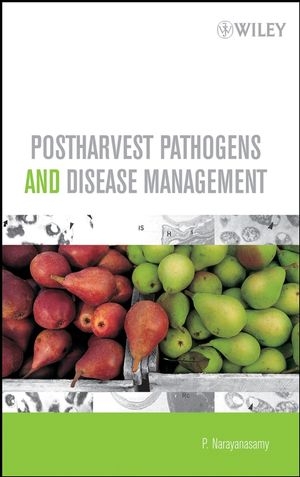
Postharvest Pathogens and Disease Management (eBook)
592 Seiten
John Wiley & Sons (Verlag)
978-0-471-75197-7 (ISBN)
Postharvest diseases caused by microbial pathogens account for
millions of dollars in losses of both durable and perishable
produce products every year. Moreover, with consumers increasingly
demanding minimally processed vegetables and fruits--which can be
invaded by human pathogens--there is an imperative need for
suitable protective measures to provide pathogen-free commodities
that are free from, or contain only acceptable levels of, chemical
residues.
Providing details of both conventional and modern molecular
techniques applicable for the detection, identification, and
differentiation of field and storage microbial pathogens,
Postharvest Pathogens and Disease Management:
* Discusses diseases of both durables and perishables during
transit and storage
* Provides a basic understanding of the effects of handling and
storage practices as well as field conditions and product
susceptibility on the development of postharvest diseases
* Reveals, as a cautionary note, the potential hazards of
mycotoxins with carcinogenic properties that can contaminate fruits
and vegetables
* Contains detailed information derived from elucidative evidence
and disease data in order to explain the infection process and
subsequent stages of disease development
* Helps readers to avoid conditions that favor disease incidence
and spread
* Includes real life examples of disease management strategies to
help readers develop effective disease management systems suitable
for different ecosystems
* Emphasizes the importance of integrating several different
effective methods in tandem, including the development of cultivars
with resistance to postharvest diseases; the selection of suitable
analytical methods; and the effective use of biocontrol agents and
chemicals
* Presents protocols for numerous techniques and basic methods,
making the book a distinctive and highly useful teaching and
research tool
Postharvest Pathogens and Disease Management offers readers insight
into the principles and methods of avoiding and managing
postharvest diseases of fruit and vegetable products in an
efficient, economical, and environmentally feasible manner,
allowing producers to sell safer, higher-quality produce to the
public and prevent the losses associated with postharvest disease.
P. NARAYANASAMY, PhD, is a former department head and professor of plant pathology at Tamil Nadu Agricultural University in Coimbatore, India. He is the author of four other books on plant pathology.
Preface.
Acknowledgments.
PART I: CAUSES AND EFFECTS.
1. Introduction.
1.1 Importance of postharvest diseases.
1.2 Factors favoring development of postharvest diseases.
1.3 Development of disease management strategies.
Summary.
References.
2. Detection and Identification of Postharvest Microbial
Pathogens.
2.1 Microbial pathogens in seeds.
2.2 Microbial pathogens in propagative plant materials.
2.3 Microbial pathogens in fruits.
2.4 Microbial pathogens in vegetables.
Summary.
Appendix.
References.
3. Ecology of Postharvest Microbial Plant Pathogens.
3.1 Seed microflora.
3.2 Fruit microflora.
3.3 Vegetable microflora.
Summary.
References.
4. Disease Development and Symptom Expression.
4.1 Seed infection.
4.2 Seed deterioration.
4.3 Infection of fruits and vegetables.
Summary.
Appendix.
References.
PART II: FACTORS INFLUENCING DISEASE DEVELOPMENT IN
STORAGE.
5. Influence of Cultivation Practices and Harvesting
Methods.
5.1 Cultivation practices.
5.2 Harvest-related operations.
Summary.
References.
6. Influence of Postharvest Handling and Storage
Conditions.
6.1 Postharvest handling.
6.2 Storage conditions.
Summary.
References.
PART III: PRINCIPLES AND PRACTICES OF POSTHARVEST DISEASE
MANAGEMENT.
7. Preventive and Physical Methods of Disease
Management.
7.1 Seeds and propagative materials.
7.2 Fruits and vegetables.
Summary.
References.
8. Genetic Resistance of Host Plants for Disease
Management.
8.1 Molecular biology of host plant resistance.
8.2 Resistance to seed infection.
8.3 Development of disease resistant cultivars.
Summary.
Appendix.
References.
9. Biocontrol Agents for Disease Management.
9.1 Biological control of postharvest diseases of fruits.
9.2 Biological control of postharvest diseases of
vegetables.
9.3 Biocontrol of seed spoilage.
9.4 Mechanisms of biocontrol.
9.5 Enhancement of efficiency of biocontrol agents.
9.6 Formulation of biocontrol agents.
9.7 Natural compounds.
Summary.
Appendix.
References.
10. Biotechnology for Improvement of Resistance to
Postharvest Diseases.
10.1 Genetic manipulation.
10.2 Activation of natural host defense mechanisms.
10.3 Mycotoxin management through transformation.
Summary.
Appendix.
References.
11. Postharvest Disease Management through Chemicals.
11.1 Fumigants.
11.2 Chemicals used as dips.
11.3 Chemicals applied as sprays or dusts.
11.4 Assessment of fungicidal activity.
11.5 Chemicals as alternative to fungicides.
11.6 Seed treatment with chemicals.
11.7 Development of resistance to fungicides.
11.8 Assessment of fungicide residues.
11.9 Control of fresh-cut produce-borne pathogens.
Summary.
Appendix.
References.
12. Integrated Systems of Management of Postharvest
Diseases.
12.1 Seedborne diseases.
12.2 Postharvest diseases of perishables.
Summary.
References.
Addendum: Basic Methods .
References.
Index.
"This book will be useful for researchers, teachers, and students
in plant pathology and food microbiology." (The Quarterly Review
of Biology, September 2006)
"...efficient, economical and environmentally
friendly..."(Food Science and Technology Abstracts,January
2007)
| Erscheint lt. Verlag | 28.11.2005 |
|---|---|
| Sprache | englisch |
| Themenwelt | Naturwissenschaften ► Chemie |
| Technik | |
| Weitere Fachgebiete ► Land- / Forstwirtschaft / Fischerei | |
| Schlagworte | Biotechnologie • Biotechnologie i. d. Chemie • Biotechnology • Biowissenschaften • Botanik • Chemie • Chemistry • Food Science & Technology • Lebensmittelforschung u. -technologie • Life Sciences • plant science |
| ISBN-10 | 0-471-75197-9 / 0471751979 |
| ISBN-13 | 978-0-471-75197-7 / 9780471751977 |
| Informationen gemäß Produktsicherheitsverordnung (GPSR) | |
| Haben Sie eine Frage zum Produkt? |
 PDF (Adobe DRM)
Kopierschutz: Adobe-DRM
Adobe-DRM ist ein Kopierschutz, der das eBook vor Mißbrauch schützen soll. Dabei wird das eBook bereits beim Download auf Ihre persönliche Adobe-ID autorisiert. Lesen können Sie das eBook dann nur auf den Geräten, welche ebenfalls auf Ihre Adobe-ID registriert sind.
Details zum Adobe-DRM
Dateiformat: PDF (Portable Document Format)
Mit einem festen Seitenlayout eignet sich die PDF besonders für Fachbücher mit Spalten, Tabellen und Abbildungen. Eine PDF kann auf fast allen Geräten angezeigt werden, ist aber für kleine Displays (Smartphone, eReader) nur eingeschränkt geeignet.
Systemvoraussetzungen:
PC/Mac: Mit einem PC oder Mac können Sie dieses eBook lesen. Sie benötigen eine
eReader: Dieses eBook kann mit (fast) allen eBook-Readern gelesen werden. Mit dem amazon-Kindle ist es aber nicht kompatibel.
Smartphone/Tablet: Egal ob Apple oder Android, dieses eBook können Sie lesen. Sie benötigen eine
Geräteliste und zusätzliche Hinweise
Buying eBooks from abroad
For tax law reasons we can sell eBooks just within Germany and Switzerland. Regrettably we cannot fulfill eBook-orders from other countries.
aus dem Bereich