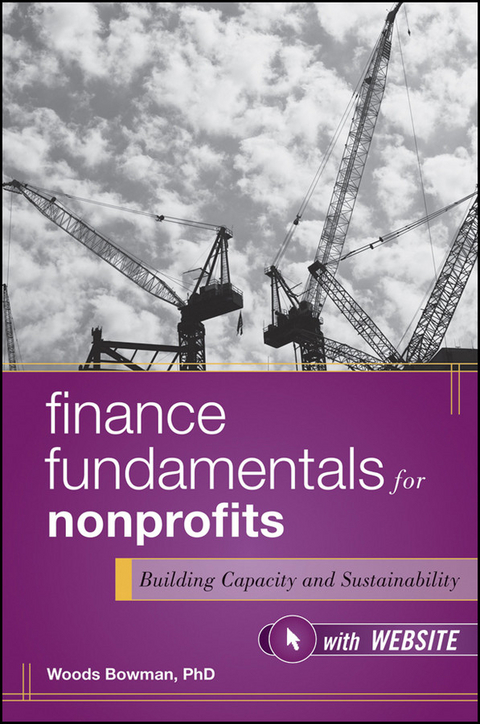
Finance Fundamentals for Nonprofits (eBook)
224 Seiten
John Wiley & Sons (Verlag)
978-1-118-11398-1 (ISBN)
organization must follow to indefinitely maintain the volume and
quality of their services
An organization may have plenty of capacity in the long run, but
in the short run, donor restrictions and limited financing options
are constraining. Here-and-now liquid assets are the only resources
available. Finance Fundamentals for Nonprofits: Building Capacity
and Sustainability shows how to measure a nonprofit organization's
financial capacity in different time frames and how to measure its
ability to sustain capacity in each case.
* Explains how nonprofits differ from businesses and how they
promote values-centered management
* Reveals how to improve financial capacity and
sustainability
* Written by a nonprofit scholar
Filled with real-world case studies and actionable advice
relating financial health to financial capacity and sustainability,
this book is essential reading for every nonprofit
professional.
WOODS BOWMAN, PHD, is a Professor of Public Service at DePaul University who brings to the classroom a range of experience in public finance and a passion for ethical governance. He is the former CFO of Cook County, a former member of the House of Representatives, Illinois General Assembly, from 1977-1990, and former chair of the Appropriations II Committee. He is a board member of the Association for Research on Nonprofit Organizations and Voluntary Action. He received the Chairman's Award from Goodwill Industries International for his service to a local affiliate. His articles have appeared in Nonprofit Management and Leadership and Nonprofit and Voluntary Sector Quarterly. In addition, Dr. Bowman writes a column on ethics for the Nonprofit Quarterly.
Preface ix
Acknowledgments xi
Chapter 1 Introduction: How Nonprofits are (and are Not) Like Businesses 1
What are Nonprofits? 2
Why are There Nonprofits? 4
Nonprofits as Businesses 5
Advantages and Disadvantages of Being Nonprofit 8
This Book's Agenda 11
Concluding Thoughts 14
Chapter 2 Accounting: Measuring Past Performance 15
Basis of Accounting and Audits 16
Statement of Financial Position 17
Statement of Activities 20
Other Statements and Notes 26
What to Look For 27
IRS Form 990 30
Concluding Thoughts 31
Chapter 3 Investing: Looking to the Future 33
Investing 33
Endowment 39
Values-Centered Investing 42
Concluding Thoughts 46
Appendix 47
Chapter 4 Budgeting: Taking Control of the Present 49
Budgeting Practices 49
Budget Structure 53
Reconciling Budgets and Financial Statements 55
Reconciling Budgets and IRS Form 990 63
Concluding Thoughts 64
Chapter 5 Nonprofits in History and Tax Law: Why Nonprofits Do What They Do 65
Classification 66
Unrelated Business Income Tax 75
Intermediate Sanctions 76
Lobbying and Political Action 78
State Law 79
Concluding Thoughts 80
Chapter 6 Ordinary Service Providers: Serving the Public Today 81
Long-Term Objective: Maintaining Services 82
Short-Term Objective: Resilience 85
Current Objective: Paying Bills 89
Application 90
Benchmarking 91
Concluding Thoughts 94
Appendix 94
Chapter 7 Membership Associations: Serving People with a Common Purpose 97
Membership Associations 98
Cooperatives 101
Capacity and Sustainability 103
Two Applications 104
Concluding Thoughts 105
Appendix: ASAE/CAL Metrics of Financial Capacity for Membership Associations 106
Chapter 8 Endowed Service Providers: Serving the Next Generation, Too 107
Introduction 108
Long-Term Objective: Maintaining Services 111
Short-Term Objective: Resilience 113
Current Objective: Paying Bills 115
Application: Famous University 116
Building an Endowment 117
Concluding Thoughts 119
Chapter 9 Grantmaking Organizations: Serving Service Providers 121
Foundation Types 122
Financing Models 123
Capacity and Sustainability 126
Illustrations 131
Concluding Thoughts 131
Appendix: S&P Metrics of Financial Capacity for Grantmakers 133
Chapter 10 Beyond Sustainability: Managing Revenue to Maximize Growth 135
Revenue Sources 135
Theories of Revenue Compensation 139
Application 144
Unfair Competition 145
Concluding Thoughts 146
Chapter 11 The Nonprofit Difference: Doing Good Well 149
Control Environment 150
Being Businesslike 153
Concluding Thoughts 158
Notes 159
Glossary 173
References 187
About the Web Site 201
About the Author 203
Index 205
| Erscheint lt. Verlag | 5.7.2011 |
|---|---|
| Reihe/Serie | Wiley Nonprofit Authority | Wiley Nonprofit Authority |
| Sprache | englisch |
| Themenwelt | Naturwissenschaften ► Biologie ► Ökologie / Naturschutz |
| Wirtschaft ► Betriebswirtschaft / Management ► Finanzierung | |
| Wirtschaft ► Betriebswirtschaft / Management ► Planung / Organisation | |
| Schlagworte | Business & Management • Gemeinnützige Einrichtung • Gemeinnützige Organisationen / Finanz- u. Rechnungswesen • Gemeinnützige Einrichtung • Gemeinnützige Organisationen / Finanz- u. Rechnungswesen • Non-Profit Organizations / Finance & Accounting • Wirtschaft u. Management |
| ISBN-10 | 1-118-11398-5 / 1118113985 |
| ISBN-13 | 978-1-118-11398-1 / 9781118113981 |
| Informationen gemäß Produktsicherheitsverordnung (GPSR) | |
| Haben Sie eine Frage zum Produkt? |
 EPUB (Adobe DRM)
Größe: 1,1 MB
Kopierschutz: Adobe-DRM
Adobe-DRM ist ein Kopierschutz, der das eBook vor Mißbrauch schützen soll. Dabei wird das eBook bereits beim Download auf Ihre persönliche Adobe-ID autorisiert. Lesen können Sie das eBook dann nur auf den Geräten, welche ebenfalls auf Ihre Adobe-ID registriert sind.
Details zum Adobe-DRM
Dateiformat: EPUB (Electronic Publication)
EPUB ist ein offener Standard für eBooks und eignet sich besonders zur Darstellung von Belletristik und Sachbüchern. Der Fließtext wird dynamisch an die Display- und Schriftgröße angepasst. Auch für mobile Lesegeräte ist EPUB daher gut geeignet.
Systemvoraussetzungen:
PC/Mac: Mit einem PC oder Mac können Sie dieses eBook lesen. Sie benötigen eine
eReader: Dieses eBook kann mit (fast) allen eBook-Readern gelesen werden. Mit dem amazon-Kindle ist es aber nicht kompatibel.
Smartphone/Tablet: Egal ob Apple oder Android, dieses eBook können Sie lesen. Sie benötigen eine
Geräteliste und zusätzliche Hinweise
Buying eBooks from abroad
For tax law reasons we can sell eBooks just within Germany and Switzerland. Regrettably we cannot fulfill eBook-orders from other countries.
 PDF (Adobe DRM)
Kopierschutz: Adobe-DRM
Adobe-DRM ist ein Kopierschutz, der das eBook vor Mißbrauch schützen soll. Dabei wird das eBook bereits beim Download auf Ihre persönliche Adobe-ID autorisiert. Lesen können Sie das eBook dann nur auf den Geräten, welche ebenfalls auf Ihre Adobe-ID registriert sind.
Details zum Adobe-DRM
Dateiformat: PDF (Portable Document Format)
Mit einem festen Seitenlayout eignet sich die PDF besonders für Fachbücher mit Spalten, Tabellen und Abbildungen. Eine PDF kann auf fast allen Geräten angezeigt werden, ist aber für kleine Displays (Smartphone, eReader) nur eingeschränkt geeignet.
Systemvoraussetzungen:
PC/Mac: Mit einem PC oder Mac können Sie dieses eBook lesen. Sie benötigen eine
eReader: Dieses eBook kann mit (fast) allen eBook-Readern gelesen werden. Mit dem amazon-Kindle ist es aber nicht kompatibel.
Smartphone/Tablet: Egal ob Apple oder Android, dieses eBook können Sie lesen. Sie benötigen eine
Geräteliste und zusätzliche Hinweise
Buying eBooks from abroad
For tax law reasons we can sell eBooks just within Germany and Switzerland. Regrettably we cannot fulfill eBook-orders from other countries.
aus dem Bereich