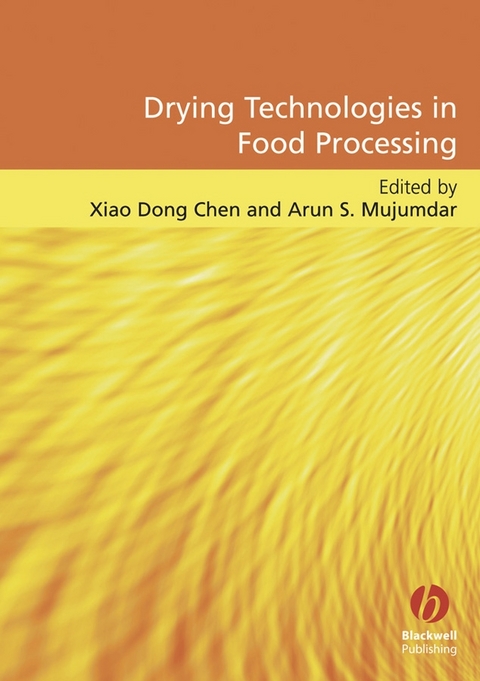
Drying Technologies in Food Processing (eBook)
352 Seiten
John Wiley & Sons (Verlag)
978-1-4443-0942-3 (ISBN)
keeping solid foods safe for long periods of time, and is of
fundamental importance in most sectors of food processing. Drying
operations need to be precisely controlled and optimized in order
to produce a good quality product that has the highest level of
nutrient retention and flavor whilst maintaining microbial safety.
This volume provides an up to date account of all the major
drying technologies employed in the food industry and their
underlying scientific principles and effects. Various equipment
designs are classified and described. The impact of drying on food
properties is covered, and the micro-structural changes caused by
the process are examined, highlighting their usefulness in process
analysis and food design. Key methods for assessing food properties
of dried products are described, and pre-concentration and drying
control strategies are reviewed. Thermal hazards and fire/explosion
detection and prevention for dryers are discussed in a dedicated
chapter. Where appropriate, sample calculations are included for
engineers and technologists to follow. The book is directed at food
scientists and technologists in industry and research, food
engineers and drying equipment manufacturers.
Professor Xiao Dong Chen, Department of Chemical Engineering, Monash University, Victoria, Australia Professor Arun S. Mujumdar, Department of Mechanical Engineering, National University of Singapore, Singapore
Preface.
Xiao Dong Chen and Arun Mujumdar.
Images of foods and dried products.
Xiao Dong Chen.
1. Food drying fundamentals.
Xiao Dong Chen.
2. Water activity of foods.
Bhesh Bhandari and Benu P. Adhikari.
3. Food biological changes during drying processes.
Xiao Dong Chen and Kamlesh C. Patel.
4. Spray drying of liquid foods.
Bhesh Bhandari, Kamlesh C. Patel, Xiao Dong Chen.
5. Low-pressure superheated steam drying of food products.
Sakamon Devahastin and Peamsuk Suvarnakuta.
6. Heat-pump aided drying.
Raisul Islam and Arun Mujumdar.
7. Freeze and vacuum drying of foods.
Cristina Ratti.
8. Post-drying aspects for meat and horticultural products.
Mohammad Shafiur Rahman.
9. Food dryer process control.
Brent R. Young.
10. Fire and explosion protection in food dryers.
Xiao Dong Chen
"This book is aimed at the post-graduate market. Indeed, it will
probably find its natural audience among those already working in
the food industry who wants insights into their industry." (BTS
Newsletter, Summer 2009)
"This volume provides an up-to-date account of all major drying
technologies employed in the food industry and their underlying
scientific principles and effects.... The micrograph photos
depicted are the best I have ever seen." (Food & Beverage
Reporter, June 2009)
"The volume provides an account of the major drying technologies
employed by food industry and their underlying scientific
principles." (Food Manufacture, November 2008)
| Erscheint lt. Verlag | 16.3.2009 |
|---|---|
| Sprache | englisch |
| Themenwelt | Naturwissenschaften ► Chemie |
| Technik ► Lebensmitteltechnologie | |
| Weitere Fachgebiete ► Land- / Forstwirtschaft / Fischerei | |
| Schlagworte | Food Science & Technology • Lebensmittelforschung u. -technologie • Lebensmitteltechnik |
| ISBN-10 | 1-4443-0942-0 / 1444309420 |
| ISBN-13 | 978-1-4443-0942-3 / 9781444309423 |
| Informationen gemäß Produktsicherheitsverordnung (GPSR) | |
| Haben Sie eine Frage zum Produkt? |
 PDF (Adobe DRM)
Kopierschutz: Adobe-DRM
Adobe-DRM ist ein Kopierschutz, der das eBook vor Mißbrauch schützen soll. Dabei wird das eBook bereits beim Download auf Ihre persönliche Adobe-ID autorisiert. Lesen können Sie das eBook dann nur auf den Geräten, welche ebenfalls auf Ihre Adobe-ID registriert sind.
Details zum Adobe-DRM
Dateiformat: PDF (Portable Document Format)
Mit einem festen Seitenlayout eignet sich die PDF besonders für Fachbücher mit Spalten, Tabellen und Abbildungen. Eine PDF kann auf fast allen Geräten angezeigt werden, ist aber für kleine Displays (Smartphone, eReader) nur eingeschränkt geeignet.
Systemvoraussetzungen:
PC/Mac: Mit einem PC oder Mac können Sie dieses eBook lesen. Sie benötigen eine
eReader: Dieses eBook kann mit (fast) allen eBook-Readern gelesen werden. Mit dem amazon-Kindle ist es aber nicht kompatibel.
Smartphone/Tablet: Egal ob Apple oder Android, dieses eBook können Sie lesen. Sie benötigen eine
Geräteliste und zusätzliche Hinweise
Buying eBooks from abroad
For tax law reasons we can sell eBooks just within Germany and Switzerland. Regrettably we cannot fulfill eBook-orders from other countries.
aus dem Bereich