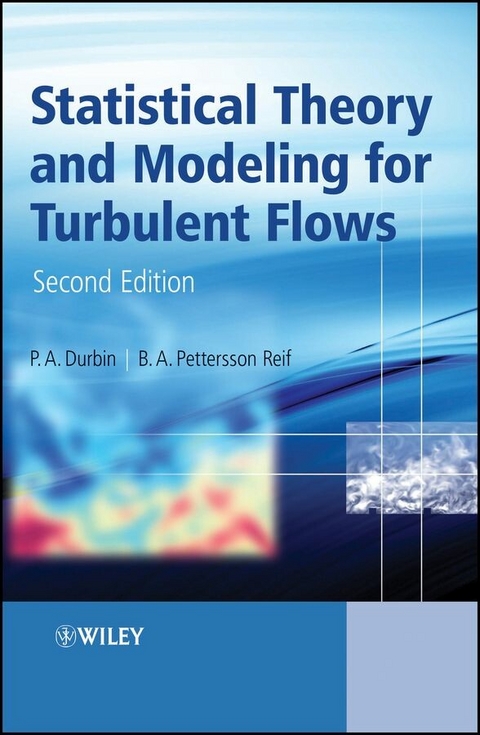
Statistical Theory and Modeling for Turbulent Flows (eBook)
John Wiley & Sons (Verlag)
978-0-470-97206-9 (ISBN)
In addition to its role as a guide for students, Statistical Theory and Modeling for Turbulent Flows also is a valuable reference for practicing engineers and scientists in computational and experimental fluid dynamics, who would like to broaden their understanding of fundamental issues in turbulence and how they relate to turbulence model implementation.
- Provides an excellent foundation to the fundamental theoretical concepts in turbulence.
- Features new and heavily revised material, including an entire new section on eddy resolving simulation.
- Includes new material on modeling laminar to turbulent transition.
- Written for students and practitioners in aeronautical and mechanical engineering, applied mathematics and the physical sciences.
- Accompanied by a website housing solutions to the problems within the book.
P. A. Durbin, Stanford University, USA and B. A. Pettersson Reif, Norwegian Defence Research Establishment, Norway
Paul Durbin is a research professor within the flow physics and computational engineering department at Stanford University. He and his students carry out computational and modeling research on turbulent and transitional flows, exploring new analytical formulations and testing models in a wide range of applications with the practical aim of improving existing methods for computing engineering flows.
Björn Anders Pettersson Reif spent 4 years post-doc working as an R&D engineer at Kongsberg Defence and Aerospace (Norway) until he started his present position as a senior scientist at the Norwegian Defence Research Establishment. He was also appointed Adjunct Professor in Turbulence Modeling between 2003 and 2009. His research has mainly been dedicated to numerical fluid mechanics, turbulence physics and single-point turbulence modeling.
Providing a comprehensive grounding in the subject of turbulence, Statistical Theory and Modeling for Turbulent Flows develops both the physical insight and the mathematical framework needed to understand turbulent flow. Its scope enables the reader to become a knowledgeable user of turbulence models; it develops analytical tools for developers of predictive tools. Thoroughly revised and updated, this second edition includes a new fourth section covering DNS (direct numerical simulation), LES (large eddy simulation), DES (detached eddy simulation) and numerical aspects of eddy resolving simulation. In addition to its role as a guide for students, Statistical Theory and Modeling for Turbulent Flows also is a valuable reference for practicing engineers and scientists in computational and experimental fluid dynamics, who would like to broaden their understanding of fundamental issues in turbulence and how they relate to turbulence model implementation. Provides an excellent foundation to the fundamental theoretical concepts in turbulence. Features new and heavily revised material, including an entire new section on eddy resolving simulation. Includes new material on modeling laminar to turbulent transition. Written for students and practitioners in aeronautical and mechanical engineering, applied mathematics and the physical sciences. Accompanied by a website housing solutions to the problems within the book.
P. A. Durbin, Stanford University, USA and B. A. Pettersson Reif, Norwegian Defence Research Establishment, Norway Paul Durbin is a research professor within the flow physics and computational engineering department at Stanford University. He and his students carry out computational and modeling research on turbulent and transitional flows, exploring new analytical formulations and testing models in a wide range of applications with the practical aim of improving existing methods for computing engineering flows. Björn Anders Pettersson Reif spent 4 years post-doc working as an R&D engineer at Kongsberg Defence and Aerospace (Norway) until he started his present position as a senior scientist at the Norwegian Defence Research Establishment. He was also appointed Adjunct Professor in Turbulence Modeling between 2003 and 2009. His research has mainly been dedicated to numerical fluid mechanics, turbulence physics and single-point turbulence modeling.
Statistical Theory and Modeling for Turbulent Flows 3
Contents 9
Preface 13
Preface to second edition 13
Preface to first edition 13
Motivation 14
Epitome 15
Acknowledgements 15
Part I FUNDAMENTALS OF TURBULENCE 17
1 Introduction 19
1.1 The turbulence problem 20
1.2 Closure modeling 25
1.3 Categories of turbulent flow 26
Exercises 30
2 Mathematical and statistical background 31
2.1 Dimensional analysis 31
2.1.1 Scales of turbulence 34
2.2 Statistical tools 35
2.2.1 Averages and probability density functions 35
2.2.2 Correlations 41
2.3 Cartesian tensors 50
2.3.1 Isotropic tensors 52
2.3.2 Tensor functions of tensors Cayley–Hamilton theorem
Exercises 58
3 Reynolds averaged Navier–Stokes equations 61
3.1 Background to the equations 62
3.2 Reynolds averaged equations 64
3.3 Terms of kinetic energy and Reynolds stress budgets 65
3.4 Passive contaminant transport 70
Exercises 72
4 Parallel and self-similar shear flows 73
4.1 Plane channel flow 74
4.1.1 Logarithmic layer 77
4.1.2 Roughness 79
4.2 Boundary layer 81
4.2.1 Entrainment 85
4.3 Free-shear layers 86
4.3.1 Spreading rates 92
4.3.2 Remarks on self-similar boundary layers 92
4.4 Heat and mass transfer 93
4.4.1 Parallel flow and boundary layers 94
4.4.2 Dispersion from elevated sources 98
Exercises 102
5 Vorticity and vortical structures 107
5.1 Structures 109
5.1.1 Free-shear layers 109
5.1.2 Boundary layers 113
5.1.3 Non-random vortices 118
5.2 Vorticity and dissipation 118
5.2.1 Vortex stretching and relative dispersion 120
5.2.2 Mean-squared vorticity equation 122
Exercises 124
Part II SINGLE-POINT CLOSURE MODELING 125
6 Models with scalar variables 127
6.1 Boundary-layer methods 128
6.1.1 Integral boundary-layer methods 129
6.1.2 Mixing length model 131
6.2 The k –å model 137
6.2.1 Analytical solutions to the k –å model 139
6.2.2 Boundary conditions and near-wall modifications 144
6.2.3 Weak solution at edges of free-shear flow free-stream sensitivity
6.3 The k –ù model 152
6.4 Stagnation-point anomaly 155
6.5 The question of transition 157
6.5.1 Reliance on the turbulence model 160
6.5.2 Intermittency equation 161
6.5.3 Laminar fluctuations 163
6.6 Eddy viscosity transport models 164
Exercises 168
7 Models with tensor variables 171
7.1 Second-moment transport 171
7.1.1 A simple illustration 172
7.1.2 Closing the Reynolds stress transport equation 173
7.1.3 Models for the slow part 175
7.1.4 Models for the rapid part 178
7.2 Analytic solutions to SMC models 185
7.2.1 Homogeneous shear flow 185
7.2.2 Curved shear flow 188
7.2.3 Algebraic stress approximation and nonlinear eddy viscosity 192
7.3 Non-homogeneity 195
7.3.1 Turbulent transport 196
7.3.2 Near-wall modeling 197
7.3.3 No-slip condition 198
7.3.4 Nonlocal wall effects 200
7.4 Reynolds averaged computation 210
7.4.1 Numerical issues 211
7.4.2 Examples of Reynolds averaged computation 214
Exercises 229
8 Advanced topics 233
8.1 Further modeling principles 233
8.1.1 Galilean invariance and frame rotation 235
8.1.2 Realizability 237
8.2 Second-moment closure and Langevin equations 240
8.3 Moving equilibrium solutions of SMC 242
8.3.1 Criterion for steady mean flow 243
8.3.2 Solution in two-dimensional mean flow 244
8.3.3 Bifurcations 247
8.4 Passive scalar flux modeling 251
8.4.1 Scalar diffusivity models 251
8.4.2 Tensor diffusivity models 252
8.4.3 Scalar flux transport 254
8.4.4 Scalar variance 257
8.5 Active scalar flux modeling: effects of buoyancy 258
8.5.1 Second-moment transport models 261
8.5.2 Stratified shear flow 262
Exercises 263
Part III THEORY OF HOMOGENEOUS TURBULENCE 265
9 Mathematical representations 267
9.1 Fourier transforms 268
9.2 Three-dimensional energy spectrum of homogeneous turbulence 270
9.2.1 Spectrum tensor and velocity covariances 271
9.2.2 Modeling the energy spectrum 273
Exercises 282
10 Navier–Stokes equations in spectral space 285
10.1 Convolution integrals as triad interaction 285
10.2 Evolution of spectra 287
10.2.1 Small-k behavior and energy decay 287
10.2.2 Energy cascade 289
10.2.3 Final period of decay 292
Exercises 293
11 Rapid distortion theory 297
11.1 Irrotational mean flow 298
11.1.1 Cauchy form of vorticity equation 298
11.1.2 Distortion of a Fourier mode 301
11.1.3 Calculation of covariances 303
11.2 General homogeneous distortions 307
11.2.1 Homogeneous shear 309
11.2.2 Turbulence near a wall 312
Exercises 316
Part IV TURBULENCE SIMULATION 319
12 Eddy-resolving simulation 321
12.1 Direct numerical simulation 322
12.1.1 Grid requirements 322
12.1.2 Numerical dissipation 324
12.1.3 Energy-conserving schemes 326
12.2 Illustrations 329
12.3 Pseudo-spectral method 334
Exercises 338
13 Simulation of large eddies 341
13.1 Large eddy simulation 341
13.1.1 Filtering 342
13.1.2 Subgrid models 346
13.2 Detached eddy simulation 355
Exercises 359
References 361
Index 369
| Erscheint lt. Verlag | 20.8.2010 |
|---|---|
| Sprache | englisch |
| Themenwelt | Naturwissenschaften ► Physik / Astronomie ► Strömungsmechanik |
| Technik ► Maschinenbau | |
| Schlagworte | Aeronautic & Aerospace Engineering • Analytical • Angewandte Mathematik • Applied mathematics • Comprehensive • Developers • flow • fluid mechanics • Framework • insight • knowledgeable user • Luftfahrttechnik • Luft- u. Raumfahrttechnik • Maschinenbau • Mathematical • Mathematics • Mathematik • mechanical engineering • Physical • Predictive • Reader • Scope • Simulation • Statistical • Strömungsmechanik • Strömungsmechanik • Subject • theory • Tools • Turbulence • Turbulence Models • turbulent • turbulent flows |
| ISBN-10 | 0-470-97206-8 / 0470972068 |
| ISBN-13 | 978-0-470-97206-9 / 9780470972069 |
| Informationen gemäß Produktsicherheitsverordnung (GPSR) | |
| Haben Sie eine Frage zum Produkt? |
 PDF (Adobe DRM)
Kopierschutz: Adobe-DRM
Adobe-DRM ist ein Kopierschutz, der das eBook vor Mißbrauch schützen soll. Dabei wird das eBook bereits beim Download auf Ihre persönliche Adobe-ID autorisiert. Lesen können Sie das eBook dann nur auf den Geräten, welche ebenfalls auf Ihre Adobe-ID registriert sind.
Details zum Adobe-DRM
Dateiformat: PDF (Portable Document Format)
Mit einem festen Seitenlayout eignet sich die PDF besonders für Fachbücher mit Spalten, Tabellen und Abbildungen. Eine PDF kann auf fast allen Geräten angezeigt werden, ist aber für kleine Displays (Smartphone, eReader) nur eingeschränkt geeignet.
Systemvoraussetzungen:
PC/Mac: Mit einem PC oder Mac können Sie dieses eBook lesen. Sie benötigen eine
eReader: Dieses eBook kann mit (fast) allen eBook-Readern gelesen werden. Mit dem amazon-Kindle ist es aber nicht kompatibel.
Smartphone/Tablet: Egal ob Apple oder Android, dieses eBook können Sie lesen. Sie benötigen eine
Geräteliste und zusätzliche Hinweise
Buying eBooks from abroad
For tax law reasons we can sell eBooks just within Germany and Switzerland. Regrettably we cannot fulfill eBook-orders from other countries.
aus dem Bereich