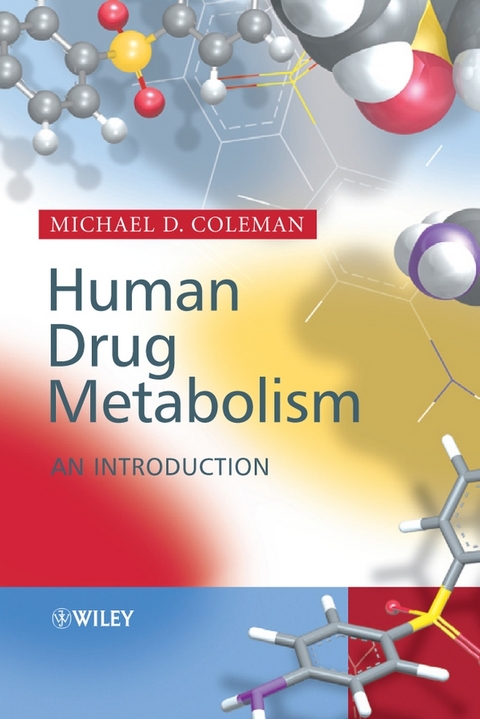
Human Drug Metabolism (eBook)
John Wiley & Sons (Verlag)
978-0-470-86354-1 (ISBN)
This new text provides a concise, user-friendly introduction to drug metabolism that is ideal for undergraduates. Focusing on a conceptual understanding of the drug metabolism system, the book illustrates the basic mechanisms on how xenobiotics are detected, chemically modified and then eliminated from human systems.
Michael D. Coleman, DSc is a Senior Lecturer in Toxicology at Aston University. His award of the degree ofDoctor of Science from Aston University in 2005 reflects his substantial and original contribution to knowledge of Biochemical Pharmacology and Toxicology of Antiparasitic Drugs.
Drug metabolism is a core area of pharmacology. Before any drug can be licensed it is essential to know how the body metabolises the drug, and the short and long-term effects it has on the body. It is an area of rapid advancement, which brings together the fields of pharmacy, pharmacology and medicine. This new text provides a concise, user-friendly introduction to drug metabolism that is ideal for undergraduates. Focusing on a conceptual understanding of the drug metabolism system, the book illustrates the basic mechanisms on how xenobiotics are detected, chemically modified and then eliminated from human systems.
Michael D. Coleman, DSc is a Senior Lecturer in Toxicology at Aston University. His award of the degree ofDoctor of Science from Aston University in 2005 reflects his substantial and original contribution to knowledge of Biochemical Pharmacology and Toxicology of Antiparasitic Drugs.
Human Drug Metabolism 3
Contents 9
Preface 13
1 Introduction 15
1.1 Therapeutic window 15
1.2 Consequences of drug concentration changes 18
1.3 Clearance 20
1.4 Hepatic extraction and intrinsic clearance 22
1.5 First pass and plasma drug levels 23
1.6 Drug and xenobiotic metabolism 25
2 Drug Biotransformational Systems – Origins and Aims 27
2.1 Biotransforming enzymes 27
2.2 Threat of lipophilic hydrocarbons 28
2.3 Cell communication 28
2.4 Potential food toxins 31
2.5 Sites of biotransforming enzymes 32
2.6 Biotransformation 33
3 How Phase I Systems Metabolize Substrates 37
3.1 Introduction 37
3.2 Capture of lipophilic molecules 37
3.3 Cytochrome P450s classification and basic structure 38
3.4 CYPs – main and associated structures 40
3.5 CYP substrate specificity and regulation 44
3.6 Main human CYP families 44
3.7 Cytochrome P450 catalytic cycle 50
3.8 Real-life operations 53
3.9 How CYP isoforms operate in vivo 54
3.10 Aromatic ring hydroxylation 56
3.11 Alkyll oxidations 58
3.12 ‘Rearrangement’ reactions 62
3.13 Other oxidation processes 67
3.14 Reduction reactions 69
3.15 Control of CYP metabolic function 70
4 Induction of Phase I Systems 71
4.1 Introduction 71
4.2 Causes of accelerated clearance 74
4.3 Enzyme induction 75
4.4 Mechanisms of enzyme induction 76
4.5 Induction – general clinical aspects 84
5 Phase I Enzyme Inhibition 89
5.1 Introduction 89
5.2 Inhibition of metabolism – general aspects 92
5.3 Mechanisms of inhibition 93
5.4 Cell transport systems and CYP3A inhibitors 103
5.5 Clinical consequences of drug inhibition 105
5.6 Use of inhibitors for positive clinical intervention 109
6 Phase II and III Processes 115
6.1 Introduction 115
6.2 Glucuronidation 117
6.3 Sulphation 127
6.4 The GSH system 130
6.5 Glutathione S-transferases 133
6.6 Epoxide hydrolases 137
6.7 Acetylation 138
6.8 Methylation 140
6.9 Esterases/amidases 140
6.10 Amino acid conjugation (glycine or glutamate) 141
6.11 Phase III transport processes 141
7 Factors Affecting Drug Metabolism 145
7.1 Introduction 145
7.2 Genetic polymorphisms 146
7.3 Effects of age on drug metabolism 162
7.4 Effects of diet on drug metabolism 165
7.5 Gender effects 168
7.6 Smoking 169
7.7 Effects of ethanol on drug metabolism 170
7.8 Effects of disease on drug metabolism 175
7.9 Summary 175
8 Role of Metabolism in Drug Toxicity 177
8.1 Adverse drug reactions: definitions 177
8.2 Reversible drug adverse effects: Type A 178
8.3 Irreversible toxicity (Type B) 185
8.4 Type B1 necrotic reactions 190
8.5 Type B2 reactions: immunotoxicity 201
8.6 Type B3 reactions: role of metabolism in cancer 212
8.7 Summary of biotransformational toxicity 228
Appendix A Methods in Drug Metabolism 229
A.1 Introduction 229
A.2 Human liver microsomes 230
A.3 Human hepatocytes 232
A.4 Heterologous systems 232
A.5 Toxicological metabolism-based assays 233
A.6 In silico studies 236
Appendix B Metabolism of Major Illicit Drugs 239
B.1 Introduction 239
B.2 Opiates 239
B.3 Cocaine 244
B.4 Hallucinogens 246
B.5 Amphetamines: ecstasy (MDMA) 250
B.6 Cannabis 254
B.7 PCP 257
Appendix C Examination Techniques 261
C.1 Introduction 261
C.2 A first-class answer 261
C.3 Preparation 262
C.4 The day of reckoning 265
Appendix D Summary of Major CYP Isoforms and Their Substrates, Inhibitors and Inducers 267
Suggested Further Reading 269
Index 277
"...a useful introductory text for the intended audience ofstudents studying pharmacology and toxicology..."(Veterinary Pathology, November 2006)
"The author has certainly achieved his goal of providing anaccessible introduction to human drug metabolism." (The Annalsof Pharmacotherapy, June 2006)
" ... for many who are just beginning to learn about drugmetabolism because it deals with all of the relevant aspects."(Journal of Medicinal Chemistry, Vol. 49, No. 8, May2006)
"Armed with the knowledge contained in this book, we should allbe well on the way" (Pharmaceutical Physician, May2006)
"...useful for many who are just beginning to learn aboutdrug metabolism...a good addition to many personal and schoollibraries." (Journal of Medicinal Chemistry, April 20,2006)
"...thumbs up for ambition." (Chemistry World, 1st March2006)
"Overall this is an interesting book that provides a rathercomprehensive overview of drug metabolism in humans" (Journal ofMedicinal Chemistry, 2006 Volume 49. No 8)
| Erscheint lt. Verlag | 22.2.2006 |
|---|---|
| Sprache | englisch |
| Themenwelt | Medizin / Pharmazie ► Gesundheitsfachberufe |
| Medizin / Pharmazie ► Medizinische Fachgebiete | |
| Naturwissenschaften ► Biologie ► Genetik / Molekularbiologie | |
| Naturwissenschaften ► Chemie | |
| Schlagworte | accessible • Arzneimittel • Biowissenschaften • Book • CASE • changes • Chemical • Chemie • Chemistry • Clinical • Concentration • Consequences • Drug • Drug metabolism • Essential • Factors • Histories • Inhibition • Introduction • Life Sciences • medical genetics • Medical Science • Medizin • Medizinische Genetik • metabolising • operate • Patient • Pharmacology & Pharmaceutical Medicine • Pharmakologie u. Pharmazeutische Medizin • polymorphisms • Relationship • Stoffwechsel • Systems • Toxicology • Toxikologie • Understanding |
| ISBN-10 | 0-470-86354-4 / 0470863544 |
| ISBN-13 | 978-0-470-86354-1 / 9780470863541 |
| Informationen gemäß Produktsicherheitsverordnung (GPSR) | |
| Haben Sie eine Frage zum Produkt? |
 PDF (Adobe DRM)
Kopierschutz: Adobe-DRM
Adobe-DRM ist ein Kopierschutz, der das eBook vor Mißbrauch schützen soll. Dabei wird das eBook bereits beim Download auf Ihre persönliche Adobe-ID autorisiert. Lesen können Sie das eBook dann nur auf den Geräten, welche ebenfalls auf Ihre Adobe-ID registriert sind.
Details zum Adobe-DRM
Dateiformat: PDF (Portable Document Format)
Mit einem festen Seitenlayout eignet sich die PDF besonders für Fachbücher mit Spalten, Tabellen und Abbildungen. Eine PDF kann auf fast allen Geräten angezeigt werden, ist aber für kleine Displays (Smartphone, eReader) nur eingeschränkt geeignet.
Systemvoraussetzungen:
PC/Mac: Mit einem PC oder Mac können Sie dieses eBook lesen. Sie benötigen eine
eReader: Dieses eBook kann mit (fast) allen eBook-Readern gelesen werden. Mit dem amazon-Kindle ist es aber nicht kompatibel.
Smartphone/Tablet: Egal ob Apple oder Android, dieses eBook können Sie lesen. Sie benötigen eine
Geräteliste und zusätzliche Hinweise
Buying eBooks from abroad
For tax law reasons we can sell eBooks just within Germany and Switzerland. Regrettably we cannot fulfill eBook-orders from other countries.
aus dem Bereich