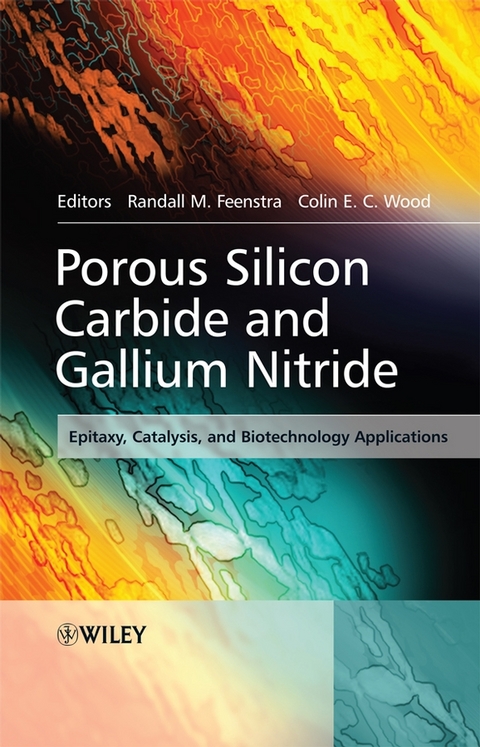
Porous Silicon Carbide and Gallium Nitride (eBook)
John Wiley & Sons (Verlag)
978-0-470-75182-4 (ISBN)
Randall M. Feenstra is professor in the Department of Physics at Carnegie Mellon University Pittsburgh (USA). He gained his PhD in applied physics at the California Institute of Technology (USA). His research interests include atomic structure, electronic spectroscopy of semiconductor materials and heterostructures, growth of semiconductor thin films by molecular beam epitaxy, and scanning probe microscopy. He has received awards from the Alexander von Humboldt Foundation, the Peter Mark Memorial Award of the American Vacuum Society and the IBM Outstanding Innovation Award. He has also been the co-organizer of the symposium on GaN and Related Alloys at the MRS Fall Meeting, has been part of the organizing committee for the Electronic Materials Conference, has been a member of the Organizing Committee and Conference Chair for the Conference on the Physics and Chemistry of Semiconductor Interfaces.
Dr. Colin E. C. Wood has a PhD in physical chemistry from Nottingham University (UK). He has substantial industrial and academic experience including as senior physicist at the Philips Research Laboratory in Salford (UK), Senior Research Associate at Cornell University (USA), Assistant Director at GEC Hirst Research Centre Wembley (UK), COO at Northeast Semiconductor Inc., Ithaca (USA) and Research Professor at University of Maryland (USA). He is a Founder Member of the Cornell Sub-Micron Center (NRRFS now NNF) and a Founder Member of the UK Low-Dimensional Solids Programme. His awards include the Patterson Medal from the Institute of Physics (UK).
Porous Silicon Carbide and Gallium Nitride: Epitaxy, Catalysis, and Biotechnology Applications presents the state-of-the-art in knowledge and applications of porous semiconductor materials having a wide band gap. This comprehensive reference begins with an overview of porous wide-band-gap technology, and describes the underlying scientific basis for each application area. Additional chapters cover preparation, characterization, and topography; processing porous SiC; medical applications; magnetic ion behavior, and many more
Randall M. Feenstra is professor in the Department of Physics at Carnegie Mellon University Pittsburgh (USA). He gained his PhD in applied physics at the California Institute of Technology (USA). His research interests include atomic structure, electronic spectroscopy of semiconductor materials and heterostructures, growth of semiconductor thin films by molecular beam epitaxy, and scanning probe microscopy. He has received awards from the Alexander von Humboldt Foundation, the Peter Mark Memorial Award of the American Vacuum Society and the IBM Outstanding Innovation Award. He has also been the co-organizer of the symposium on GaN and Related Alloys at the MRS Fall Meeting, has been part of the organizing committee for the Electronic Materials Conference, has been a member of the Organizing Committee and Conference Chair for the Conference on the Physics and Chemistry of Semiconductor Interfaces. Dr. Colin E. C. Wood has a PhD in physical chemistry from Nottingham University (UK). He has substantial industrial and academic experience including as senior physicist at the Philips Research Laboratory in Salford (UK), Senior Research Associate at Cornell University (USA), Assistant Director at GEC Hirst Research Centre Wembley (UK), COO at Northeast Semiconductor Inc., Ithaca (USA) and Research Professor at University of Maryland (USA). He is a Founder Member of the Cornell Sub-Micron Center (NRRFS now NNF) and a Founder Member of the UK Low-Dimensional Solids Programme. His awards include the Patterson Medal from the Institute of Physics (UK).
Preface.
1. Porous SiC Preparation, Characterization and Morphology
1.1 Introduction
1.2 Triangular Porous Morphology in n-type 4H-SiC.
1.3 Nano-columnar Pore Formation in 6H SiC.
1.4 Summary.
Acknowledgements.
References.
2. Processing Porous SiC: Diffusion, Oxidation, Contact Formation.
2.1 Introduction.
2.2 Formation of Porous Layer.
2.3 Diffusion in Porous SiC.
2.4 Oxidation.
2.5 Contacts to Porous SiC.
Acknowledgments.
References.
3. Growth of SiC on Porous SiC Buffer Layers.
3.1 Introduction.
3.2 SiC CVD Growth.
3.3 Growth of 3C-SiC on porous Si via Cold-Wall Epitaxy.
3.4 Growth of 3C-SiC on Porous 3C-SiC.
3.5 Growth of 4H-SiC on Porous 4H-SiC.
3.6 Conclusion.
Acknowledgements.
References.
4. Preparation and Properties of Porous GaN Fabricated by Metal-Assisted Electroless Etching.
4.1 Introduction.
4.2 Creation of Porous GaN by Electroless Etching.
4.3 Morphology Characterization.
4.4 Luminescence of Porous GaN.
4.5 Raman Spectroscopy of Porous GaN.
4.6 Summary and Conclusions.
Acknowledgments.
References.
5. Growth of GaN on Porous SiC by Molecular Beam Epitaxy.
5.1 Introduction.
5.2 Morphology and Preparation of Porous SiC Substrates.
5.3 MBE Growth of GaN on Porous SiC Substrates.
5.4 Summary.
Acknowledgments.
References.
6. GaN Lateral Epitaxy Growth Using Porous SiNx, TiNx and SiC.
6.1 Introduction.
6.2 Epitaxy of GaN on Porous SiNx Network.
6.3 Epitaxial Lateral Overgrowth of GaN on Porous TiN.
6.4 Growth of GaN on Porous SiC.
Acknowledgements.
References.
7. HVPE Growth of GaN on Porous SiC Substrates.
7.1 Introduction.
7.2 PSC Substrate Fabrication and Properties.
7.3 Epitaxial Growth of GaN Films on PSC.
Summary.
References.
8. Dislocation Mechanisms in GaN Films Grown on Porous Substrates or Interlayers.
8.1 Introduction.
8.2 Extended Defects In Epitaxially Grown GaN Thin Layers.
8.3 Dislocation Mechanisms in Conventional Lateral Epitaxy Overgrowth of GaN.
8.4 Growth of GaN on Porous SiC Substrates.
8.5 Growth of GaN on Porous SiN and TiN Interlayers.
8.6 Summary.
Acknowledgments.
References.
9. Electrical Properties of Porous SiC.
9.1 Introduction.
9.2 Resistivity and Hall Effect.
9.3 Deep Level Transient Spectroscopy.
9.4 Sample Considerations.
9.5 Potential Energy Near a Pore.
9.6 DLTS Data and Analysis.
Acknowledgements.
References.
10. Magnetism of Doped GaN Nanostructures.
10.1 Introduction.
10. 2 Mn-Doped GaN Crystal.
10. 3 Mn-Doped GaN Thin Films.
10.4 Mn- and Cr-Doped GaN One-Dimensional Structures.
10.5 N-Doped Mn and Cr Clusters.
10.6 Summary.
Acknowledgments
References.
11 SiC Catalysis Technology.
11.1 Introduction.
11.2 Silicon Carbide Support.
11.3 Heat Effects During Reaction.
11.4 Reactions on SiC as Catalytic Supports.
11.5 Examples of SiC Catalyst Applications.
11.6 Prospects and Conclusions.
References.
12. Nanoporous SiC as a Semi-Permeable Biomembrane for Medical Use: Practical and Theoretical Considerations.
12. 1. The Rationale for Implantable Semi-Permeable Materials.
12. 2. The Biology of Soluble Signaling Proteins in Tissue.
12. 3. Measuring Cytokine Secretion In Living Tissues and Organs.
12.4. Creating a Biocompatible Tissue - Device Interface: Advantages of SiC.
12.5. The Testing of SiC Membranes for Permeability of Proteins.
12.6. Improving the Structure of SiC Membranes for Biosensor Interfaces.
12.7. Theoretical Considerations: Modeling Diffusion through a Porous Membrane.
12.8. Future Development: Marriage of Membrane and Microchip.
12.9. Conclusions
Acknowledgments.
References.
| Erscheint lt. Verlag | 15.4.2008 |
|---|---|
| Sprache | englisch |
| Themenwelt | Naturwissenschaften ► Chemie |
| Naturwissenschaften ► Physik / Astronomie | |
| Technik ► Elektrotechnik / Energietechnik | |
| Technik ► Maschinenbau | |
| Schlagworte | Applications • Band • Blue • Carbide • Electrical & Electronics Engineering • electron • Electronic • Elektrotechnik u. Elektronik • Energy • GAP • Gaps • Halbleiter • high bond • highpower • hightemperature applications • levels • lightemitting • Materials • Materials Science • Materialwissenschaften • normally • Novel • Number • Poröse Materialien • Poröse Materialien • Porous Materials • semiconductors • SiC • Strengths • suitable • Ultraviolet • wide |
| ISBN-10 | 0-470-75182-7 / 0470751827 |
| ISBN-13 | 978-0-470-75182-4 / 9780470751824 |
| Informationen gemäß Produktsicherheitsverordnung (GPSR) | |
| Haben Sie eine Frage zum Produkt? |
 PDF (Adobe DRM)
Kopierschutz: Adobe-DRM
Adobe-DRM ist ein Kopierschutz, der das eBook vor Mißbrauch schützen soll. Dabei wird das eBook bereits beim Download auf Ihre persönliche Adobe-ID autorisiert. Lesen können Sie das eBook dann nur auf den Geräten, welche ebenfalls auf Ihre Adobe-ID registriert sind.
Details zum Adobe-DRM
Dateiformat: PDF (Portable Document Format)
Mit einem festen Seitenlayout eignet sich die PDF besonders für Fachbücher mit Spalten, Tabellen und Abbildungen. Eine PDF kann auf fast allen Geräten angezeigt werden, ist aber für kleine Displays (Smartphone, eReader) nur eingeschränkt geeignet.
Systemvoraussetzungen:
PC/Mac: Mit einem PC oder Mac können Sie dieses eBook lesen. Sie benötigen eine
eReader: Dieses eBook kann mit (fast) allen eBook-Readern gelesen werden. Mit dem amazon-Kindle ist es aber nicht kompatibel.
Smartphone/Tablet: Egal ob Apple oder Android, dieses eBook können Sie lesen. Sie benötigen eine
Geräteliste und zusätzliche Hinweise
Buying eBooks from abroad
For tax law reasons we can sell eBooks just within Germany and Switzerland. Regrettably we cannot fulfill eBook-orders from other countries.
aus dem Bereich