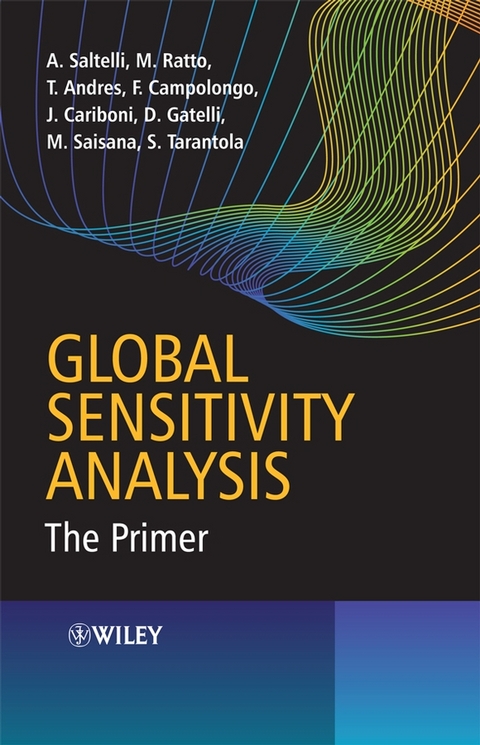
Mathematical models are good at mapping assumptions into inferences. A modeller makes assumptions about laws pertaining to the system, about its status and a plethora of other, often arcane, system variables and internal model settings. To what extent can we rely on the model-based inference when most of these assumptions are fraught with uncertainties? Global Sensitivity Analysis offers an accessible treatment of such problems via quantitative sensitivity analysis, beginning with the first principles and guiding the reader through the full range of recommended practices with a rich set of solved exercises. The text explains the motivation for sensitivity analysis, reviews the required statistical concepts, and provides a guide to potential applications.
The book:
- Provides a self-contained treatment of the subject, allowing readers to learn and practice global sensitivity analysis without further materials.
- Presents ways to frame the analysis, interpret its results, and avoid potential pitfalls.
- Features numerous exercises and solved problems to help illustrate the applications.
- Is authored by leading sensitivity analysis practitioners, combining a range of disciplinary backgrounds.
Postgraduate students and practitioners in a wide range of subjects, including statistics, mathematics, engineering, physics, chemistry, environmental sciences, biology, toxicology, actuarial sciences, and econometrics will find much of use here. This book will prove equally valuable to engineers working on risk analysis and to financial analysts concerned with pricing and hedging.
Andrea Saltelli, Francesca Campolongo, Jessica Cariboni, Debora Gatelli, Fulvia Pennoni, Marco Ratto, Michaela Saisana, Stefano Tarantola - Joint Research Centre of the European Commission, Ispra, Unit of Applied Statistics and Econometrics.
Presently leading the Econometric and Applied Statistics Unit of the Joint Research Centre, lead author Professor Saltelli has published many articles in numerous journals over the last 30 years. He is also the main author and main editor of two previous books (both for Wiley).
Terry Andres - Department of Computer Science, University of Manitoba.
Dr Andres is one of the few people to successfully develop a graduate level sensitivity analysis course. He has delivered numerous courses to both students and practitioners and is an expert in experimental design.
Complex mathematical and computational models are used in all areas of society and technology and yet model based science is increasingly contested or refuted, especially when models are applied to controversial themes in domains such as health, the environment or the economy. More stringent standards of proofs are demanded from model-based numbers, especially when these numbers represent potential financial losses, threats to human health or the state of the environment. Quantitative sensitivity analysis is generally agreed to be one such standard. Mathematical models are good at mapping assumptions into inferences. A modeller makes assumptions about laws pertaining to the system, about its status and a plethora of other, often arcane, system variables and internal model settings. To what extent can we rely on the model-based inference when most of these assumptions are fraught with uncertainties? Global Sensitivity Analysis offers an accessible treatment of such problems via quantitative sensitivity analysis, beginning with the first principles and guiding the reader through the full range of recommended practices with a rich set of solved exercises. The text explains the motivation for sensitivity analysis, reviews the required statistical concepts, and provides a guide to potential applications. The book: Provides a self-contained treatment of the subject, allowing readers to learn and practice global sensitivity analysis without further materials. Presents ways to frame the analysis, interpret its results, and avoid potential pitfalls. Features numerous exercises and solved problems to help illustrate the applications. Is authored by leading sensitivity analysis practitioners, combining a range of disciplinary backgrounds. Postgraduate students and practitioners in a wide range of subjects, including statistics, mathematics, engineering, physics, chemistry, environmental sciences, biology, toxicology, actuarial sciences, and econometrics will find much of use here. This book will prove equally valuable to engineers working on risk analysis and to financial analysts concerned with pricing and hedging.
Andrea Saltelli, Francesca Campolongo, Jessica Cariboni, Debora Gatelli, Fulvia Pennoni, Marco Ratto, Michaela Saisana, Stefano Tarantola - Joint Research Centre of the European Commission, Ispra, Unit of Applied Statistics and Econometrics. Presently leading the Econometric and Applied Statistics Unit of the Joint Research Centre, lead author Professor Saltelli has published many articles in numerous journals over the last 30 years. He is also the main author and main editor of two previous books (both for Wiley). Terry Andres - Department of Computer Science, University of Manitoba. Dr Andres is one of the few people to successfully develop a graduate level sensitivity analysis course. He has delivered numerous courses to both students and practitioners and is an expert in experimental design.
"This is one of the few books to take on the problem head on and provide techniques in a very simple way." (Technometrics, November 2008)
| Erscheint lt. Verlag | 28.2.2008 |
|---|---|
| Sprache | englisch |
| Themenwelt | Mathematik / Informatik ► Mathematik ► Angewandte Mathematik |
| Mathematik / Informatik ► Mathematik ► Statistik | |
| Mathematik / Informatik ► Mathematik ► Wahrscheinlichkeit / Kombinatorik | |
| Naturwissenschaften | |
| Technik | |
| Schlagworte | Angew. Wahrscheinlichkeitsrechn. u. Statistik / Modelle • Applied • Applied Probability & Statistics - Models • Areas • Computational • controversial themes • demanded • domains • economy • Environment • Finanz- u. Wirtschaftsstatistik • Health • losses • modelbased numbers • Models • Numbers • potential financial • proofs • Represent • Science • Sensitivitätsanalyse • Sensitivitätsanalyse • Society • Standards • State • Statistics • Statistics for Finance, Business & Economics • Statistik • Stringent • threats |
| ISBN-13 | 9780470725177 / 9780470725177 |
| Informationen gemäß Produktsicherheitsverordnung (GPSR) | |
| Haben Sie eine Frage zum Produkt? |
 PDF (Adobe DRM)
Kopierschutz: Adobe-DRM
Adobe-DRM ist ein Kopierschutz, der das eBook vor Mißbrauch schützen soll. Dabei wird das eBook bereits beim Download auf Ihre persönliche Adobe-ID autorisiert. Lesen können Sie das eBook dann nur auf den Geräten, welche ebenfalls auf Ihre Adobe-ID registriert sind.
Details zum Adobe-DRM
Dateiformat: PDF (Portable Document Format)
Mit einem festen Seitenlayout eignet sich die PDF besonders für Fachbücher mit Spalten, Tabellen und Abbildungen. Eine PDF kann auf fast allen Geräten angezeigt werden, ist aber für kleine Displays (Smartphone, eReader) nur eingeschränkt geeignet.
Systemvoraussetzungen:
PC/Mac: Mit einem PC oder Mac können Sie dieses eBook lesen. Sie benötigen eine
eReader: Dieses eBook kann mit (fast) allen eBook-Readern gelesen werden. Mit dem amazon-Kindle ist es aber nicht kompatibel.
Smartphone/Tablet: Egal ob Apple oder Android, dieses eBook können Sie lesen. Sie benötigen eine
Geräteliste und zusätzliche Hinweise
Buying eBooks from abroad
For tax law reasons we can sell eBooks just within Germany and Switzerland. Regrettably we cannot fulfill eBook-orders from other countries.
aus dem Bereich