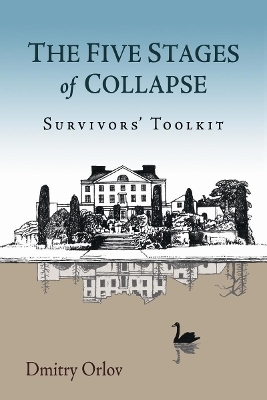
The Five Stages of Collapse
New Society Publishers (Verlag)
978-0-86571-736-7 (ISBN)
In the face of political impotence, resource depletion, and catastrophic climate change, many of us have become reconciled to an uncertain future. However, popular perception of how this future might actually unfold varies wildly from "a severe and prolonged recession," to James Howard Kunstler's "long emergency," to the complete breakdown of civilization. In The Five Stages of Collapse, Dmitry Orlov posits a taxonomy of collapse, offering a surprisingly optimistic perspective on surviving the sweeping changes of the day with health and sanity intact. Arguing that it is during periods of disruption and extreme uncertainty that broad cultural change becomes possible, Orlov steers the reader through the challenges of financial, commercial, and political collapse. He suggests that if the first three stages are met with the appropriate responses, further breakdown may be arrested before the extremes of social and cultural collapse are reached.
Drawing on a detailed examination of post-collapse societies, including the Somali people of Africa, the Pashtuns of Afghanistan, the Roma of Central and Eastern Europe, and even the Russian mafia, The Five Stages of Collapse describes successful adaptations in areas such as finance, self-governance, and social and cultural organization. These fascinating case studies provide a unique perspective on the characteristics that determine highly resilient communities. Shot through with Orlov's trademark dark humor, this is an invaluable toolkit for creating workable post-collapse solutions. Dmitry Orlov was born in Leningrad, Russia, and immigrated to the United States. He is the author of Reinventing Collapse and maintains the phenomenally popular blog Club Orlov.
Dmitry Orlov is a Russian-American engineer and writer who was born in Leningrad and immigrated to the United States at the age of 12. He was an eyewitness to the collapse of the Soviet Union over several extended visits to his Russian homeland between the late eighties and mid-nineties. Orlov lives off the grid, sailing his boat up and down the Eastern Seaboard and commuting by bicycle. He believes that, given appropriate technology, we can greatly reduce personal resource consumption while remaining perfectly civilized. He is the author of Reinventing Collapse and blogs regularly at Club Orlov (www.cluborlov.com).
Introduction: Collapses in General
What is collapse?
When will collapse occur?
What are the stages of collapse?
1. Financial Collapse
The root of the problem
The wrong math
Defaults big and small
The end of money
Options for cashing out
Alternatives to money
How we did it
Chits, specie and stock-in-trade
A likely endgame
Cold-starting instructions
Beware financial despotism
Monetary mysticism
The untrustworthy and the trustful
Götterdämmerung
Case Study: Iceland
2. Commercial Collapse
Cascaded failure
Liar word: efficiency
Life upside down
The many advantages of gift
Money corrupts
Opportunities for gift-giving
Meanwhile in Soviet Russia
The new normal
A cultural flip
Case Study: The Russian Mafia
3. Political Collapse
Anarchy's charms
The nation-state fades out
National language
Taking care of your own
State religion
Life after the nation-state
The problem of excessive scale
The proliferation of defunct states
Government services disappear
Denationalization of currency
What governments are good at
Warfare becomes self-defeating
The end of law and order
The end of the welfare state
Virtualized politics
Case Study: The Pashtuns
4. Social Collapse
The limits of community planning
The new rules
Social reclamation
Religion as organizing principle
Charitable giving and taking
What society?
Case Study: The Roma
5. Cultural Collapse
Humans and other animals
The limits of language
Spoken memory
The isolated human
The primacy of family
Case Study: The Ik
Afterword
Endnotes
Bibliography
Index
About the Author
| Verlagsort | Gabriola Island |
|---|---|
| Sprache | englisch |
| Maße | 152 x 229 mm |
| Gewicht | 399 g |
| Themenwelt | Naturwissenschaften ► Biologie ► Ökologie / Naturschutz |
| Sozialwissenschaften ► Politik / Verwaltung ► Staat / Verwaltung | |
| Sozialwissenschaften ► Soziologie | |
| Wirtschaft ► Volkswirtschaftslehre | |
| ISBN-10 | 0-86571-736-2 / 0865717362 |
| ISBN-13 | 978-0-86571-736-7 / 9780865717367 |
| Zustand | Neuware |
| Informationen gemäß Produktsicherheitsverordnung (GPSR) | |
| Haben Sie eine Frage zum Produkt? |
aus dem Bereich