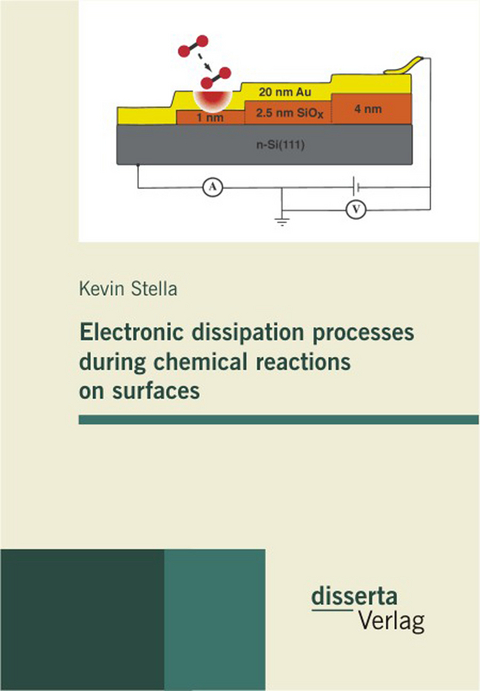
Electronic dissipation processes during chemical reactions on surfaces (eBook)
256 Seiten
disserta Verlag
978-3-942109-89-5 (ISBN)
Kevin Stella (born 1984) studied chemistry at the University of Duisburg-Essen and performed a research stay at the University of Liverpool (Electrochemistry project). He accumulated practical experiences in an analytic lab Celanese Chemicals Europe GmbH (Oberhausen). After his pre-diploma (sehr gut) his effort was awarded with a scholarship from the German National Academic Foundation (Studienstiftung des deutschen Volkes) and the pre-diploma prize of the chemistry department. After having earned his pre-diploma he started an extracurricular research project in the field of Physical Chemistry (with Prof. Dr. Eckart Hasselbrink and Dr. Detlef Diesing) which he researched on during his further studies. He finished his chemistry studies with the highest grade (Mit Auszeichnung) and was awarded with the diploma theses prize of the chemistry department. To perform his PhD theses in the lab of Prof. Dr. Eckart Hasselbrink on “Electronic dissipation processes during chemical reactions on surfaces” he was awarded with a scholarship of the German National Academic Foundation and a scholarship of the Fond of the German Chemical Industry (Fonds der Chemischen Industrie). Despite all his dedication for his research and extracurricular business lectures, he mastered to be head of the local chemistry graduate union (GDCh Jungchemikerforum Essen-Duisburg), a competitive swimmer and being a swim coach for kids. To acquire more insight into business and its connection with science he joined an intensive MBA programme at the Collège des Ingénieurs in September 2011. In the remaining spare time he enjoys doing more sports, traveling around the world, juggling and playing the Scottish bagpipe.
| Zusatzinfo | 110 Abb. |
|---|---|
| Sprache | deutsch |
| Themenwelt | Naturwissenschaften ► Chemie |
| Schlagworte | amorphous tantalum films • anodic oxide films • charge transport • cyclic voltammetry and • internal photoemission • molecular beams • Non-adiabatic reactions |
| ISBN-10 | 3-942109-89-1 / 3942109891 |
| ISBN-13 | 978-3-942109-89-5 / 9783942109895 |
| Informationen gemäß Produktsicherheitsverordnung (GPSR) | |
| Haben Sie eine Frage zum Produkt? |
 PDF (Ohne DRM)
Digital Rights Management: ohne DRM
Dieses eBook enthält kein DRM oder Kopierschutz. Eine Weitergabe an Dritte ist jedoch rechtlich nicht zulässig, weil Sie beim Kauf nur die Rechte an der persönlichen Nutzung erwerben.
Dateiformat: PDF (Portable Document Format)
Mit einem festen Seitenlayout eignet sich die PDF besonders für Fachbücher mit Spalten, Tabellen und Abbildungen. Eine PDF kann auf fast allen Geräten angezeigt werden, ist aber für kleine Displays (Smartphone, eReader) nur eingeschränkt geeignet.
Systemvoraussetzungen:
PC/Mac: Mit einem PC oder Mac können Sie dieses eBook lesen. Sie benötigen dafür einen PDF-Viewer - z.B. den Adobe Reader oder Adobe Digital Editions.
eReader: Dieses eBook kann mit (fast) allen eBook-Readern gelesen werden. Mit dem amazon-Kindle ist es aber nicht kompatibel.
Smartphone/Tablet: Egal ob Apple oder Android, dieses eBook können Sie lesen. Sie benötigen dafür einen PDF-Viewer - z.B. die kostenlose Adobe Digital Editions-App.
Buying eBooks from abroad
For tax law reasons we can sell eBooks just within Germany and Switzerland. Regrettably we cannot fulfill eBook-orders from other countries.
aus dem Bereich