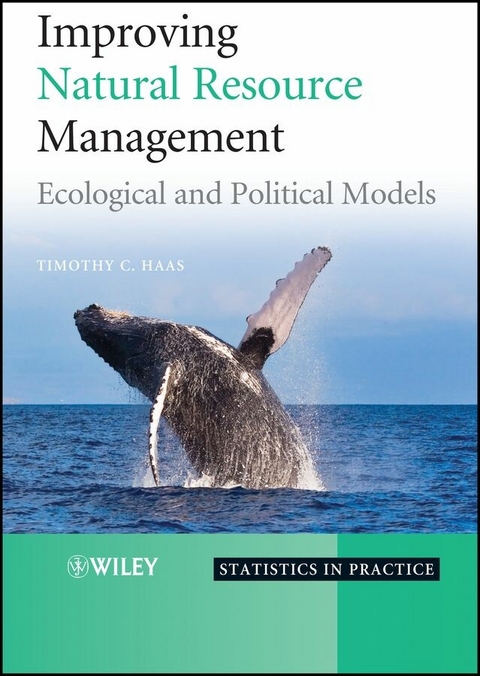
Improving Natural Resource Management (eBook)
John Wiley & Sons (Verlag)
978-0-470-97955-6 (ISBN)
Key features:
- Explores politically feasible ways to manage at-risk ecosystems.
- Gives agent-based models of how social groups affect ecosystems through time.
- Demonstrates how to fit models of population dynamics to mixtures of wildlife data.
- Presents statistical methods for fitting models of group behaviour to political action data.
- Supported by an accompanying website featuring datasets and JAVA code.
This book will be useful to managers and analysts working in organizations charged with finding practical ways to sustain biodiversity or the physical environment. Furthermore this book also provides a political roadmap to help lawmakers and administrators improve institutional environmental management decision making.
Timothy C. Haas, Lubar School of Business Administration, University of Wisconsin at Milwaukee. Timothy Haas is involved in teaching undergraduate and graduate courses in statistical methods, pursuing decision making and environmental statistics research, and collaborating with faculty on application of statistics to Marketing and Economics.
The decision to implement environmental protection options is a political one. These, and other political and social decisions affect the balance of the ecosystem and how the point of equilibrium desired is to be reached. This book develops a stochastic, temporal model of how political processes influence and are influenced by ecosystem processes and looks at how to find the most politically feasible plan for managing an at-risk ecosystem. Finding such a plan is accomplished by first fitting a mechanistic political and ecological model to a data set composed of observations on both political actions that impact an ecosystem and variables that describe the ecosystem. The parameters of this fitted model are perturbed just enough to cause human behaviour to change so that desired ecosystem states occur. This perturbed model gives the ecosystem management plan needed to reach desired ecosystem states. To construct such a set of interacting models, topics from political science, ecology, probability, and statistics are developed and explored. Key features: Explores politically feasible ways to manage at-risk ecosystems. Gives agent-based models of how social groups affect ecosystems through time. Demonstrates how to fit models of population dynamics to mixtures of wildlife data. Presents statistical methods for fitting models of group behaviour to political action data. Supported by an accompanying website featuring datasets and JAVA code. This book will be useful to managers and analysts working in organizations charged with finding practical ways to sustain biodiversity or the physical environment. Furthermore this book also provides a political roadmap to help lawmakers and administrators improve institutional environmental management decision making.
Timothy C. Haas, Lubar School of Business Administration, University of Wisconsin at Milwaukee. Timothy Haas is involved in teaching undergraduate and graduate courses in statistical methods, pursuing decision making and environmental statistics research, and collaborating with faculty on application of statistics to Marketing and Economics.
"This said, I acknowledge that the goal that stands behind this
book was very challenging and that the EMT model can represent a
good starting point." (Journal of Artificial Societies and Social
Simulation, 2011)
| Erscheint lt. Verlag | 13.1.2011 |
|---|---|
| Sprache | englisch |
| Themenwelt | Mathematik / Informatik ► Mathematik ► Angewandte Mathematik |
| Mathematik / Informatik ► Mathematik ► Wahrscheinlichkeit / Kombinatorik | |
| Naturwissenschaften ► Biologie ► Ökologie / Naturschutz | |
| Technik | |
| Schlagworte | accomplished • Balance • Book • Data • Decision • Ecological • ecosystem • environmental • Environmental Economics & Politics • Environmental Management, Policy & Planning • Environmental Studies • Equilibrium • First • implement • Influence • mechanistic • One • Plan • Point • Political • processes • protection • SET • Social • Statistics • Statistics for Social Sciences • Statistik • Statistik in den Sozialwissenschaften • temporal model • Umweltökonomie u. -politik • Umweltforschung • Umweltmanagement, Politik u. -Planung • Umweltökonomie u. -politik • Umweltstatistik |
| ISBN-10 | 0-470-97955-0 / 0470979550 |
| ISBN-13 | 978-0-470-97955-6 / 9780470979556 |
| Informationen gemäß Produktsicherheitsverordnung (GPSR) | |
| Haben Sie eine Frage zum Produkt? |
 EPUB (Adobe DRM)
Kopierschutz: Adobe-DRM
Adobe-DRM ist ein Kopierschutz, der das eBook vor Mißbrauch schützen soll. Dabei wird das eBook bereits beim Download auf Ihre persönliche Adobe-ID autorisiert. Lesen können Sie das eBook dann nur auf den Geräten, welche ebenfalls auf Ihre Adobe-ID registriert sind.
Details zum Adobe-DRM
Dateiformat: EPUB (Electronic Publication)
EPUB ist ein offener Standard für eBooks und eignet sich besonders zur Darstellung von Belletristik und Sachbüchern. Der Fließtext wird dynamisch an die Display- und Schriftgröße angepasst. Auch für mobile Lesegeräte ist EPUB daher gut geeignet.
Systemvoraussetzungen:
PC/Mac: Mit einem PC oder Mac können Sie dieses eBook lesen. Sie benötigen eine
eReader: Dieses eBook kann mit (fast) allen eBook-Readern gelesen werden. Mit dem amazon-Kindle ist es aber nicht kompatibel.
Smartphone/Tablet: Egal ob Apple oder Android, dieses eBook können Sie lesen. Sie benötigen eine
Geräteliste und zusätzliche Hinweise
Buying eBooks from abroad
For tax law reasons we can sell eBooks just within Germany and Switzerland. Regrettably we cannot fulfill eBook-orders from other countries.
aus dem Bereich