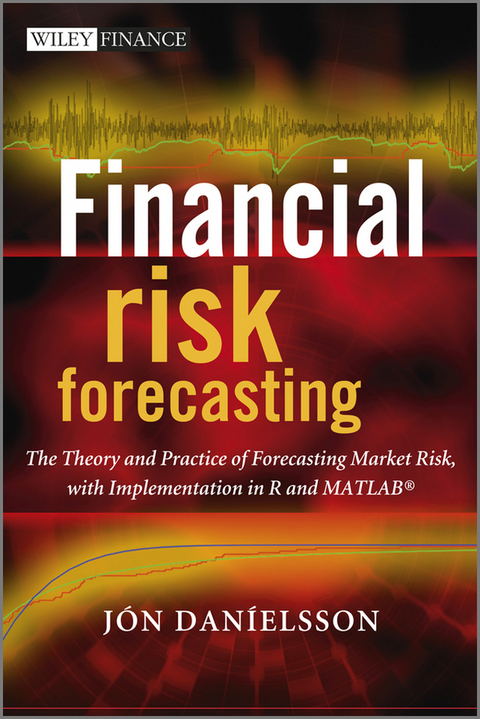
Financial Risk Forecasting (eBook)
296 Seiten
John Wiley & Sons (Verlag)
978-1-119-97711-7 (ISBN)
practical quantitative risk management, with a focus on market
risk. Derived from the authors teaching notes and years spent
training practitioners in risk management techniques, it brings
together the three key disciplines of finance, statistics and
modeling (programming), to provide a thorough grounding in risk
management techniques.
Written by renowned risk expert Jon Danielsson, the book begins
with an introduction to financial markets and market prices,
volatility clusters, fat tails and nonlinear dependence. It then
goes on to present volatility forecasting with both univatiate and
multivatiate methods, discussing the various methods used by
industry, with a special focus on the GARCH family of models. The
evaluation of the quality of forecasts is discussed in detail.
Next, the main concepts in risk and models to forecast risk are
discussed, especially volatility, value-at-risk and expected
shortfall. The focus is both on risk in basic assets such as stocks
and foreign exchange, but also calculations of risk in bonds and
options, with analytical methods such as delta-normal VaR and
duration-normal VaR and Monte Carlo simulation. The book then moves
on to the evaluation of risk models with methods like backtesting,
followed by a discussion on stress testing. The book concludes by
focussing on the forecasting of risk in very large and uncommon
events with extreme value theory and considering the underlying
assumptions behind almost every risk model in practical use -
that risk is exogenous - and what happens when those
assumptions are violated.
Every method presented brings together theoretical discussion
and derivation of key equations and a discussion of issues in
practical implementation. Each method is implemented in both MATLAB
and R, two of the most commonly used mathematical programming
languages for risk forecasting with which the reader can implement
the models illustrated in the book.
The book includes four appendices. The first introduces basic
concepts in statistics and financial time series referred to
throughout the book. The second and third introduce R and MATLAB,
providing a discussion of the basic implementation of the software
packages. And the final looks at the concept of maximum likelihood,
especially issues in implementation and testing.
The book is accompanied by a website - href="http://www.financialriskforecasting.com/">www.financialriskforecasting.com
- which features downloadable code as used in the book.
Jón Daníelsson has a PhD in the economics of financial markets and is a reader in finance at the London School of Economics. His research interests include financial stability, extreme market movements, risk, market liquidity and financial crisis. He has published extensively in both academic and practitioner journals, has consulted with a variety of private sector and public institutions, frequently gives executive education courses and has presented his work in a number of universities and institutions. In addition, he has been a frequent commentator of issues in financial markets in the media, appearing on CNN, the BBC, and many other TV and radio stations, with comments and op-ed pieces in newspapers like the Financial Times.
Preface.
Acknowledgments.
Abbreviations.
Notation.
1 Financial markets, prices and risk.
1.2 S&P 500 returns.
1.3 The stylized facts of financial returns.
1.4 Volatility.
1.5 Nonnormality and fat tails.
1.6 Identification of fat tails.
1.7 Nonlinear dependence.
1.8 Copulas.
1.9 Summary.
2 Univariate volatility modeling.
2.1 Modeling volatility.
2.2 Simple volatility models.
2.3 GARCH and conditional volatility.
2.4 Maximum likelihood estimation of volatility models.
2.5 Diagnosing volatility models.
2.6 Application of ARCH and GARCH.
2.7 Other GARCH-type models.
2.8 Alternative volatility models.
2.9 Summary.
3 Multivariate volatility models.
3.1 Multivariate volatility forecasting.
3.2 EWMA.
3.3 Orthogonal GARCH.
3.4 CCC and DCC models.
3.5 Estimation comparison.
3.6 Multivariate extensions of GARCH.
3.7 Summary.
4 Risk measures.
4.1 Defining and measuring risk.
4.2 Volatility.
4.3 Value-at-risk.
4.4 Issues in applying VaR.
4.5 Expected shortfall.
4.6 Holding periods, scaling and the square root of time.
4.7 Summary.
5 Implementing risk forecasts.
5.1 Application.
5.2 Historical simulation.
5.3 Risk measures and parametric methods.
5.4 What about expected returns?
5.5 VaR with time-dependent volatility.
5.6 Summary.
6 Analytical value-at-risk for options and bonds.
6.1 Bonds.
6.2 Options.
6.3 Summary.
7 Simulation methods for VaR for options and bonds.
7.1 Pseudo random number generators.
7.2 Simulation pricing.
7.3 Simulation of VaR for one asset.
7.4 Simulation of portfolio VaR.
7.5 Issues in simulation estimation.
7.6 Summary.
8 Backtesting and stress testing.
8.1 Backtesting.
8.2 Backtesting the S&P 500.
8.3 Significance of backtests.
8.4 Expected shortfall backtesting.
8.5 Problems with backtesting.
8.6 Stress testing.
8.7 Summary.
9 Extreme value theory.
9.1 Extreme value theory.
9.2 Asset returns and fat tails.
9.3 Applying EVT.
9.4 Aggregation and convolution.
9.5 Time dependence.
9.6 Summary.
10 Endogenous risk.
10.1 The Millennium Bridge.
10.2 Implications for financial risk management.
10.3 Endogenous market prices.
10.4 Dual role of prices.
10.5 Summary.
APPENDICES.
A Financial time series.
A.1 Random variables and probability density functions.
A.2 Expectations and variance.
A.3 Higher order moments.
A.4 Examples of distributions.
A.5 Basic time series concepts.
A.6 Simple time series models.
A.7 Statistical hypothesis testing.
B An introduction to R.
B.1 Inputting data.
B.2 Simple operations.
B.3 Distributions.
B.4 Time series.
B.5 Writing functions in R.
B.6 Maximum likelihood estimation.
B.7 Graphics.
C An introduction to Matlab.
C.1 Inputting data.
C.2 Simple operations.
C.3 Distributions.
C.3.1 Normality tests.
C.4 Time series.
C.5 Basic programming and M-files.
C.6 Maximum likelihood.
C.7 Graphics.
D Maximum likelihood.
D.1 Likelihood functions.
D.2 Optimizers.
D.3 Issues in ML estimation.
D.4 Information matrix.
D.5 Properties of maximum likelihood estimators.
D.6 Optimal testing procedures.
Bibliography.
Index.
| Erscheint lt. Verlag | 20.4.2011 |
|---|---|
| Reihe/Serie | Wiley Finance Series | Wiley Finance Series |
| Sprache | englisch |
| Themenwelt | Naturwissenschaften |
| Wirtschaft ► Betriebswirtschaft / Management ► Allgemeines / Lexika | |
| Wirtschaft ► Betriebswirtschaft / Management ► Finanzierung | |
| Schlagworte | Finance & Investments • Finanz- u. Anlagewesen • Insurance & Risk Management • Risikomanagement • Versicherungswesen u. Risikomanagement |
| ISBN-10 | 1-119-97711-8 / 1119977118 |
| ISBN-13 | 978-1-119-97711-7 / 9781119977117 |
| Informationen gemäß Produktsicherheitsverordnung (GPSR) | |
| Haben Sie eine Frage zum Produkt? |
 EPUB (Adobe DRM)
Kopierschutz: Adobe-DRM
Adobe-DRM ist ein Kopierschutz, der das eBook vor Mißbrauch schützen soll. Dabei wird das eBook bereits beim Download auf Ihre persönliche Adobe-ID autorisiert. Lesen können Sie das eBook dann nur auf den Geräten, welche ebenfalls auf Ihre Adobe-ID registriert sind.
Details zum Adobe-DRM
Dateiformat: EPUB (Electronic Publication)
EPUB ist ein offener Standard für eBooks und eignet sich besonders zur Darstellung von Belletristik und Sachbüchern. Der Fließtext wird dynamisch an die Display- und Schriftgröße angepasst. Auch für mobile Lesegeräte ist EPUB daher gut geeignet.
Systemvoraussetzungen:
PC/Mac: Mit einem PC oder Mac können Sie dieses eBook lesen. Sie benötigen eine
eReader: Dieses eBook kann mit (fast) allen eBook-Readern gelesen werden. Mit dem amazon-Kindle ist es aber nicht kompatibel.
Smartphone/Tablet: Egal ob Apple oder Android, dieses eBook können Sie lesen. Sie benötigen eine
Geräteliste und zusätzliche Hinweise
Buying eBooks from abroad
For tax law reasons we can sell eBooks just within Germany and Switzerland. Regrettably we cannot fulfill eBook-orders from other countries.
aus dem Bereich