


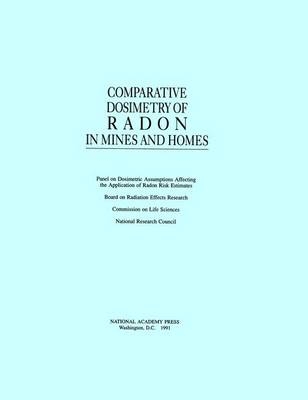
Comparative Dosimetry of Radon in Mines and Homes
Seiten
1991
National Academies Press (Verlag)
978-0-309-04484-4 (ISBN)
National Academies Press (Verlag)
978-0-309-04484-4 (ISBN)
Uses a dosimetric model to extrapolate to the home environment the risk relationships found in the miner studies. Various important scaling factors are developed for applying risk estimates based on miner data to men, women, and children in domestic environments. This book also includes discussions of radon dosimetry.
Studies of underground miners have provided a wealth of data about the risk of lung cancer from exposure to radon's progeny elements, but the application of the miner data to the home environment is not straightforward.
In Comparative Dosimetry of Radon in Mines and Homes, an expert committee uses a new dosimetric model to extrapolate to the home environment the risk relationships found in the miner studies. Important new scaling factors are developed for applying risk estimates based on miner data to men, women, and children in domestic environments. The book includes discussions of radon dosimetry and the uncertainties concerning other risk factors such as age and smoking habits.
The book also contains a thorough technical discussion of the characteristics of radioactive aerosols in domestic environments, the dose of inhaled radon progeny to different age groups, identification of respiratory tract cells at the greatest risk of carcinogenesis, and a complete description of the new lung dose model being developed by the International Commission on Radiological Protection as modified by this committee.
Studies of underground miners have provided a wealth of data about the risk of lung cancer from exposure to radon's progeny elements, but the application of the miner data to the home environment is not straightforward.
In Comparative Dosimetry of Radon in Mines and Homes, an expert committee uses a new dosimetric model to extrapolate to the home environment the risk relationships found in the miner studies. Important new scaling factors are developed for applying risk estimates based on miner data to men, women, and children in domestic environments. The book includes discussions of radon dosimetry and the uncertainties concerning other risk factors such as age and smoking habits.
The book also contains a thorough technical discussion of the characteristics of radioactive aerosols in domestic environments, the dose of inhaled radon progeny to different age groups, identification of respiratory tract cells at the greatest risk of carcinogenesis, and a complete description of the new lung dose model being developed by the International Commission on Radiological Protection as modified by this committee.
Panel on Dosimetric Assumptions Affecting the Application of Radon Risk Estimates, Board on Radiation Effects Research, National Research Council
1 Front Matter; 2 Summary and Recommendations; 3 Introduction; 4 Assessment of Exposure to the Decay Products of 222Rn in Mines and Homes; 5 Extrapolation of Doses and Risk per Unit Exposure from Mines to Homes; 6 Other Considerations; 7 Dosimetry and Dosimetric Models for Inhaled Radon and Progeny; 8 Aerosols in Homes and Mines; 9 Breathing, Deposition, and Clearance; 10 Cells of Origin for Lung Cancer; 11 The Committee's Dosimetric Model for Radon and Thoron Progeny; 12 Index
| Erscheint lt. Verlag | 1.2.1991 |
|---|---|
| Verlagsort | Washington |
| Sprache | englisch |
| Maße | 152 x 229 mm |
| Themenwelt | Naturwissenschaften ► Biologie ► Ökologie / Naturschutz |
| Technik ► Bauwesen | |
| Technik ► Umwelttechnik / Biotechnologie | |
| ISBN-10 | 0-309-04484-7 / 0309044847 |
| ISBN-13 | 978-0-309-04484-4 / 9780309044844 |
| Zustand | Neuware |
| Informationen gemäß Produktsicherheitsverordnung (GPSR) | |
| Haben Sie eine Frage zum Produkt? |
Mehr entdecken
aus dem Bereich


aus dem Bereich
Methoden – Lösungen – Anwendungen
Buch | Hardcover (2025)
Hanser (Verlag)
CHF 69,95


