


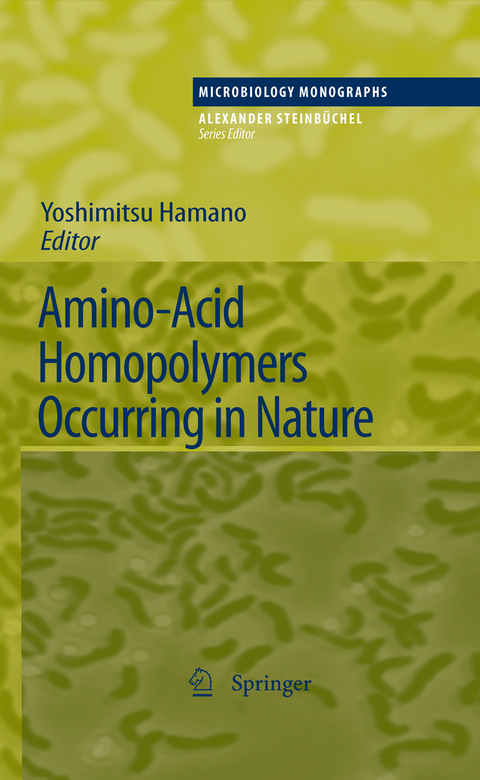
Amino-Acid Homopolymers Occurring in Nature
Seiten
2012
Springer Berlin (Verlag)
978-3-642-26405-4 (ISBN)
Springer Berlin (Verlag)
978-3-642-26405-4 (ISBN)
This book presents current knowledge of polyaminoacids and recent advances in their industrial and medical applications. It serves as a valuable source of information for scientists in basic research as well as in the pharmaceutical and food industry.
Microorganisms are capable of producing a wide variety of biopolymers. Homopolymer peptides, which are made up of only a single type of amino acid, are far less ubiquitous. The only two amino-acid homopolymers known to occur in nature are presented in this volume.
Poly-epsilon-L-lysine is a polycationic peptide and exhibits antimicrobial activity against a wide spectrum of microorganisms. It is both safe and biodegradable and is therefore used as a food preservative in several countries. In addition, there has been great interest in medical and other applications of poly-lysine and its derivatives.
In contrast, poly-gamma-glutamic acid is an unusual anionic polypeptide. It is also water soluble, biodegradable, edible, non-toxic and non-immunogenic and can be chemically modified to introduce various drugs. These features are very useful for pharmaceutical and biomedical applications. Poly-glutamic acid is also a highly attractive as a food ingredient.
Microorganisms are capable of producing a wide variety of biopolymers. Homopolymer peptides, which are made up of only a single type of amino acid, are far less ubiquitous. The only two amino-acid homopolymers known to occur in nature are presented in this volume.
Poly-epsilon-L-lysine is a polycationic peptide and exhibits antimicrobial activity against a wide spectrum of microorganisms. It is both safe and biodegradable and is therefore used as a food preservative in several countries. In addition, there has been great interest in medical and other applications of poly-lysine and its derivatives.
In contrast, poly-gamma-glutamic acid is an unusual anionic polypeptide. It is also water soluble, biodegradable, edible, non-toxic and non-immunogenic and can be chemically modified to introduce various drugs. These features are very useful for pharmaceutical and biomedical applications. Poly-glutamic acid is also a highly attractive as a food ingredient.
Munenori Takehara, Hideo Hirohara: Occurrence and biosynthesis of poly-epsilon-L-lysine in microorganisms; Yoshimitsu Hamano: Biochemistry and enzymology of poly-epsilon-L-lysine biosynthesis; Toyokazu Yoshida: Biochemistry and enzymology of poly-epsilon-L-lysine degradation; Kazuya Yamanaka, Yoshimitsu Hamano: Biotechnological production of poly-epsilon-L-lysine for food and medical applications; Makoto Ashiuchi: Occurrence and biosynthetic mechanism of poly-gamma-glutamic acid; Keitarou Kimura: Enzymic degradation of poly-gamma-glutamic acid; Takami Akagi, Michiya Matsusaki, Mitsuru Akashi: Pharmaceutical and medical applications of poly-gamma-glutamic acid; Hiroyuki Tanimoto: Food applications of poly-gamma-glutamic acid.
| Erscheint lt. Verlag | 5.9.2012 |
|---|---|
| Reihe/Serie | Microbiology Monographs |
| Zusatzinfo | VII, 250 p. 62 illus. |
| Verlagsort | Berlin |
| Sprache | englisch |
| Maße | 155 x 235 mm |
| Gewicht | 281 g |
| Themenwelt | Naturwissenschaften ► Biologie ► Biochemie |
| Naturwissenschaften ► Biologie ► Mikrobiologie / Immunologie | |
| Schlagworte | Amino acid • biochemistry • biopolymers • Glutamic acid • Lysine • Microorganism • Polyaminoacids |
| ISBN-10 | 3-642-26405-0 / 3642264050 |
| ISBN-13 | 978-3-642-26405-4 / 9783642264054 |
| Zustand | Neuware |
| Informationen gemäß Produktsicherheitsverordnung (GPSR) | |
| Haben Sie eine Frage zum Produkt? |
Mehr entdecken
aus dem Bereich

aus dem Bereich
Principles, Techniques, and Applications
Buch | Hardcover (2025)
John Wiley & Sons Inc (Verlag)
CHF 186,70


