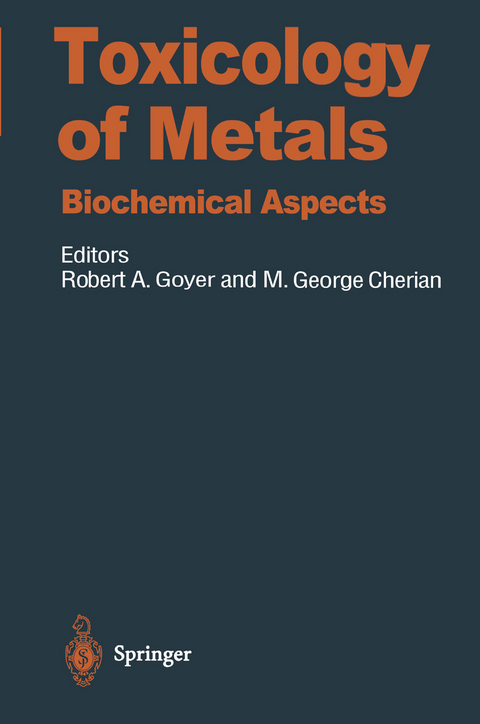
Toxicology of Metals
Springer Berlin (Verlag)
978-3-642-79164-2 (ISBN)
1 Transplacental Transfer of Lead and Cadmium.- A. Introduction.- I. Comparison of Human and Rodent Fetal-Maternal Blood Barriers.- II. Methods for Sampling the Human Placenta.- B. Placental Transfer of Lead.- I. Mechanism of Placental Transfer of Lead.- II. Maternal Blood Lead Levels During Pregnancy.- III. Effect of Maternal Lead on Birth Outcomes.- IV. Effect of Lead on Neurobehavioral and Cognitive Development In Utero.- V. Mechanisms for the Neurotoxicity of Lead.- C. Placental Transfer of Cadmium.- I. Cadmium Levels in Human Placenta.- II. Cadmium Effects on Placenta and Fetus.- III. Interactions in Placenta Between Cadmium, Zinc and Copper, and Metallothionein.- D. Summary.- References.- 2 Porphyrin Metabolism as Indicator of Metal Exposure and Toxicity.- A. Introduction.- B. Heme Biosynthesis and Porphyrin Metabolism.- C. Mechanistic Basis of Metal-Induced Porphyria (Porphyrinuria).- I. Metal Effects on Specific Steps of the Heme Biosynthetic Pathway.- II. Metal-Induced Oxidation of Reduced Porphyrins.- D. Metal- and Metalloid-Induced Porphyrinopathies and Porphyrinurias.- I. Lead.- 1. Erythrocyte ALA Dehydratase.- 2. Erythrocyte Zinc-Protoporphyrin.- 3. Urinary Coproporphyrin.- II. Mercury.- 1. Mercury-Directed Alteration of Renal Coproporphyrinogen Metabolism.- 2. Mercury-Facilitated Porphyrinogen Oxidation.- III. Arsenic.- IV. Other Metals.- 1. Cadmium.- 2. Platinum.- 3. Aluminum.- 4. Metal Interactions.- E. Perspectives on the Use of Porphyrins as Biomarkers of Metal Exposure in Human Studies.- References.- 3 Membrane Transporters as Sites of Action and Routes of Entry for Toxic Metals.- A. Introduction: Metals and Membranes.- B. Chemical Properties of Metals in Solutions.- C. Model Systems.- D. Mercury Inhibition of NaCl Cotransport: An Example Problem witha Model System.- E. Metal Entry into Cells.- F. Permeation in a Lipid-Soluble Form.- G. Permeation as a Cation.- H. Permeation as an Anion.- I. Transport of Organic Complexes.- J. Physiological Significance of Metal Permeation Pathways.- References.- 4 Immunotoxicology of Metals.- A. Introduction.- B. Basis of the Immune Response.- C. Hypersensitivity Reactions.- D. Experimental Models of Metal-Induced Autoimmunity.- I. Description of the Models.- 1. HgCl2-Induced Autoimmunity in Rats.- 2. HgCl2-Induced Autoimmunity in Other Species.- 3. Gold-Induced Autoimmunity.- II. Mechanisms of Induction.- III. Autoregulation.- E. Nonantigen-Specific Immunosuppression Induced by HgCl2.- F. Conclusions.- References.- 5 Effects of Metals on Gene Expression.- A. Introduction.- B. Molecular Control of Gene Expression.- C. Eukaryotic Strategies of Signal Transfer.- I. Multiple Factor Signal Transduction Systems.- II. Single Factor Signal Transduction Systems.- D. Transduction of Metal Signals in Eukaryotes.- I. Entry, Binding, and Storage of Essential Metals.- 1. Iron.- 2. Copper.- II. Essential Metals as Regulators of Metabolism.- 1. Iron.- 2. Copper.- III. Metallothionein and Other Genes as Models for Metal Regulation.- 1. Metal Regulation in Yeast.- 2. Metal Regulation in Mammals.- IV. Metal Bioavailability and Sequestration.- E. Other Metal-Regulated Genes.- I. Plastocyanin and cyt c6.- II. Superoxide Dismutase.- III. Heat Shock Proteins.- IV. Acute Phase Proteins, Heme Oxygenase, and Oncogenes.- F. Metal-Induced Changes in Chromatin Structure.- G. Summary.- References.- 6 Metallothionein and Its Interaction with Metals.- A. Introduction.- B. Metal Binding and Dynamic Aspects of Metallothionein Structure.- C. Induction of Metallothionein and Excretion of Metals.- D. Detoxificationof Metals.- E. Regulation of Zinc and Copper Metabolism.- F. Lipid Peroxidation and Oxidative Stress.- G. Summary.- References.- 7 Biochemical Mechanisms of Aluminum Toxicity.- A. Introduction.- B. Aluminum Species in Biological Systems.- C. Bioavailability of Aluminum.- I. Exposure.- II. Gastrointestinal Absorption.- III. Transcellular Uptake.- IV. Paracellular Uptake.- V. Systemic Transport.- VI.
| Erscheint lt. Verlag | 22.11.2011 |
|---|---|
| Reihe/Serie | Handbook of Experimental Pharmacology |
| Co-Autor | N. Ballatori, M.G. Cherian, D.C. Dawson, M. Delnomdedieu, P. Druet, B.R. Fisher, P. Goering, R.A. Goyer, S. Himeno, N. Imura, E.H. Jeffrey, M.M. Jones, J.H.R. Kägi, S. Kawanishi, C.D. Klaassen, J. Koropatnick, J.S. Lazo, M.E.I. Leibbrandt, K. Miura, A. Naganuma, E.J. O'Flaherty, L. Pelletier, T.G. Rossman, S. Silver, M. Styblo, D.M. Templeton, D.J. Thomas, M.P. Waalkes, M. Walderhaug, J.S. Woods, J. Zeng |
| Zusatzinfo | XXII, 467 p. |
| Verlagsort | Berlin |
| Sprache | englisch |
| Maße | 155 x 235 mm |
| Gewicht | 743 g |
| Themenwelt | Medizin / Pharmazie ► Medizinische Fachgebiete ► Pharmakologie / Pharmakotherapie |
| Medizin / Pharmazie ► Pharmazie | |
| Naturwissenschaften ► Biologie ► Biochemie | |
| Schlagworte | Chelate • chromium • gene expression • Gift • health effects • Human health • Mercury • Metal Chelation • Metalle • Metallothionein • Mutagene • Mutagenesis • Poison • resistance • Toxicity • toxic metals • Toxicology • Toxikologie |
| ISBN-10 | 3-642-79164-6 / 3642791646 |
| ISBN-13 | 978-3-642-79164-2 / 9783642791642 |
| Zustand | Neuware |
| Informationen gemäß Produktsicherheitsverordnung (GPSR) | |
| Haben Sie eine Frage zum Produkt? |
aus dem Bereich