


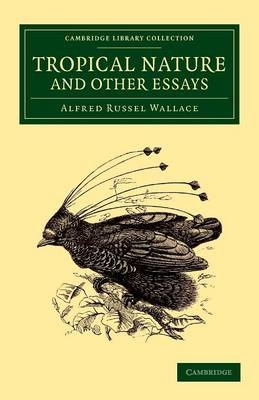
Tropical Nature and Other Essays
Seiten
2013
Cambridge University Press (Verlag)
978-1-108-05313-6 (ISBN)
Cambridge University Press (Verlag)
978-1-108-05313-6 (ISBN)
In this investigation of tropical life, Alfred Russel Wallace (1823–1913) explores in detail the features of the equatorial forest belt. First published in 1878, the book addresses some of the most delightful mysteries of contemporary evolutionary theory, from colour-changing caterpillars to the meteorology of the Amazon.
Sometimes referred to as 'the grand old man of science', Alfred Russel Wallace (1823–1913) was a naturalist, evolutionary theorist, and friend of Charles Darwin. In this study of tropical flora and fauna, he takes the reader on a tour of the equatorial forest belt - the almost continuous band of forest that stretches around the world between the tropics. There, chameleon-like caterpillars alter the colours of their cocoons, parasitical trees override their hosts with spectacular aerial root systems, and some of the most pressing questions of Victorian evolutionary science arise: how do animals and plants come to be brightly coloured? Can their adaptations provide clues about past geological eras? And was Darwin wholly correct in his theory of sexual selection? First published in 1878, Wallace's book is a skilfully written reflection of contemporary naturalism, still highly readable and relevant to students in the history of science.
Sometimes referred to as 'the grand old man of science', Alfred Russel Wallace (1823–1913) was a naturalist, evolutionary theorist, and friend of Charles Darwin. In this study of tropical flora and fauna, he takes the reader on a tour of the equatorial forest belt - the almost continuous band of forest that stretches around the world between the tropics. There, chameleon-like caterpillars alter the colours of their cocoons, parasitical trees override their hosts with spectacular aerial root systems, and some of the most pressing questions of Victorian evolutionary science arise: how do animals and plants come to be brightly coloured? Can their adaptations provide clues about past geological eras? And was Darwin wholly correct in his theory of sexual selection? First published in 1878, Wallace's book is a skilfully written reflection of contemporary naturalism, still highly readable and relevant to students in the history of science.
Preface; 1. The climate and physical aspects of the equatorial zone; 2. Equatorial vegetation; 3. Animal life in the tropical forests; 4. Humming-birds: as illustrating the luxuriance of tropical nature; 5. The colours of animals and sexual selection; 6. The colours of plants and the origin of the colour-sense; 7. By-paths in the domain of biology; 8. The distribution of animals as indicating geographical changes; Index.
| Erscheint lt. Verlag | 6.6.2013 |
|---|---|
| Reihe/Serie | Cambridge Library Collection - Darwin, Evolution and Genetics |
| Zusatzinfo | Worked examples or Exercises |
| Verlagsort | Cambridge |
| Sprache | englisch |
| Maße | 140 x 216 mm |
| Gewicht | 480 g |
| Themenwelt | Naturwissenschaften ► Biologie ► Evolution |
| ISBN-10 | 1-108-05313-0 / 1108053130 |
| ISBN-13 | 978-1-108-05313-6 / 9781108053136 |
| Zustand | Neuware |
| Informationen gemäß Produktsicherheitsverordnung (GPSR) | |
| Haben Sie eine Frage zum Produkt? |
Mehr entdecken
aus dem Bereich


aus dem Bereich
die Evolution des Seins, die Menschwerdung des Menschen und die Frage …
Buch | Softcover (2025)
Büchner-Verlag
CHF 41,90


