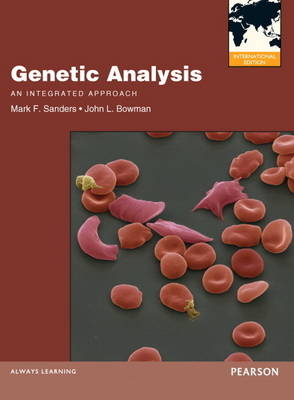
Genetic Analysis, plus MasteringGenetics with Pearson eText
Pearson Education Limited
978-1-4479-2461-6 (ISBN)
- Titel ist leider vergriffen;
keine Neuauflage - Artikel merken
Informed by many years of genetics teaching and research experience, authors Mark Sanders and John Bowman use an integrative approach that helps contextualize three core challenges of learning genetics: solving problems, understanding evolution, and understanding the connection between traditional genetics models and more modern approaches.
MyLab and Mastering from Pearson improve results for students and educators. Used by over ten million students, they effectively engage learners at every stage.
With proven success, Mastering has helped students make strides in learning for over 10 years. MasteringGenetics has immersive content and tools that are so engaging that one student said, "Now I understand how to do the work."
With MasteringGenetics, students gain knowledge that they will use throughout their lives, and universities gain a partner deeply committed to helping students and educators achieve their goals.
For students
Pearson eText gives you access to an eBook that can be used on the go, and allows you to highlight, search and take notes as you read online. Access to the eBook depends on the package you have bought.
You can work through the problems at your own pace, opening hints if you need help. If you make an error, you are given feedback based on that specific mistake so you can learn from it.
Engaging animations help you understand complex topics.
For educators
Online assignments, tests, quizzes can be easily created and assigned to students.
Gradebook: Assignments are automatically graded and visible at a glance.
Register now to benefit from these resources.
A student access code card is included with your textbook at a reduced cost. To register with your code, visit www.masteringgenetics.com
For educator access, contact your Pearson account manager. To find out who your account manager is, visit www.pearsoned.co.uk/replocator
For more instructor resources available with this title, visit www.pearsoned.co.uk
ark F. Sanders has been a faculty member in the Department of Molecular and Cellular Biology at the University of California, Davis for 27 years. In that time, he has taught more than 120 genetics courses to more than 30,000 undergraduate students. Specializing in teaching the genetics course for which this book is written, Dr. Sanders also teaches a genetics laboratory course, an advanced human genetics course for biology majors, and a human heredity course for non-science majors. His teaching experience also includes introductory biology, and courses in population genetics and evolution. Dr. Sanders received his Bachelors degree in Anthropology from San Francisco State University and his Master's and Ph.D. degrees in Biological Anthropology from the University of California, Los Angeles. Following graduation, he spent four years at the University of California, Berkeley as a post-doctoral researcher studying inherited susceptibility to human breast and ovarian cancer. At UC Berkeley he also taught his first genetics courses. Since coming to the University of California, Davis, Dr. Sanders has maintained a full-time teaching schedule and promotes academic achievement by undergraduate students in numerous ways, including as an active student advisor, through his on-going role as the director of a long-standing undergraduate student program, and by past service as the Associate Dean for Undergraduate Academic Programs in the College of Biological Sciences. John L. Bowman is a Professor in the School of Biological Sciences at Monash University in Melbourne, Australia and an Adjunct Professor in the Department of Plant Biology at the University of California, Davis in the US. He received a B.S. in Biochemistry at the University of Illinois at Urbana-Champaign, Illinois in 1986 and a Ph.D. in Biology from the California Institute of Technology in Pasadena, California. His Ph.D. research focused on how the identities floral organs are specified in Arabidopsis (described in Chapter 20). He conducted postdoctoral research at Monash University on the regulation of floral development. From 1996-2006 his laboratory at UC Davis focused on the developmental genetics of plant development, focusing on how leaves are patterned. From 2006-2011 he was a Federation Fellow at Monash University where his laboratory is studying land plant evolution using a developmental genetics approach. At UC Davis he taught genetics, 'from Mendel to cancer', to undergraduate students, and continues to teach in genetics courses at Monash University.
1 The Molecular Basis of Heredity, Variation, and Evolution
2 Transmission Genetics
3 Cell Division and Chromosome Heredity
4 Gene Interaction
5 Genetic Linkage and Mapping in Eukaryotes
6 Genetic Analysis and Mapping in Bacteria and Bacteriophage
7 DNA Structure and Replication
8 Molecular Biology of Transcription and RNA Processing
9 The Molecular Biology of Translation
10 The Integration of Genetic Approaches: Understanding Sickle Cell Disease
11 Chromosome Structure
12 Gene Mutation, DNA Repair, and Homologous Recombination
13 Chromosome Aberrations and Transposition
14 Regulation of Gene Expression in Bacteria and Bacteriophage
15 Regulation of Gene Expression in Eukaryotes
16 Forward Genetics and Recombinant DNA Technology
17 Applications of Recombinant DNA Technology and Reverse Genetics
18 Genomics: Genetics from a Whole-Genome Perspective
19 Cytoplasmic Inheritance and the Evolution of Organelle Genomes
20 Developmental Genetics
21 Genetic Analysis of Quantitative Traits
22 Population Genetics and Evolution
| Verlagsort | Harlow |
|---|---|
| Sprache | englisch |
| Maße | 216 x 274 mm |
| Gewicht | 1640 g |
| Themenwelt | Naturwissenschaften ► Biologie ► Genetik / Molekularbiologie |
| ISBN-10 | 1-4479-2461-4 / 1447924614 |
| ISBN-13 | 978-1-4479-2461-6 / 9781447924616 |
| Zustand | Neuware |
| Informationen gemäß Produktsicherheitsverordnung (GPSR) | |
| Haben Sie eine Frage zum Produkt? |
aus dem Bereich