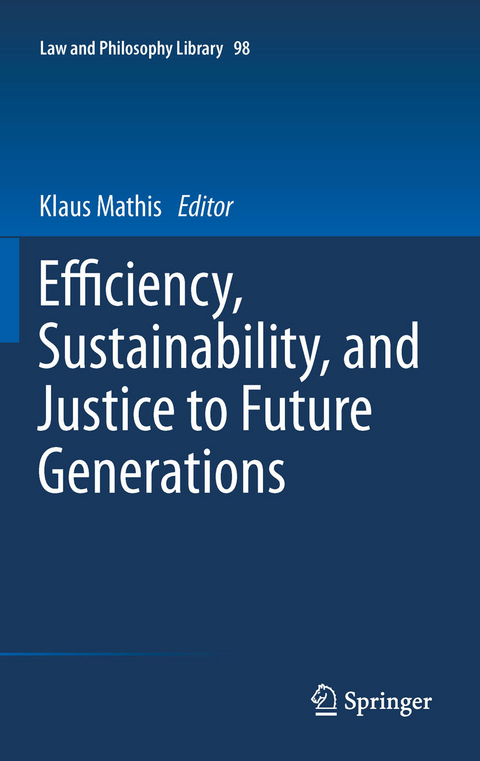
Efficiency, Sustainability, and Justice to Future Generations (eBook)
XX, 240 Seiten
Springer Netherland (Verlag)
978-94-007-1869-2 (ISBN)
A key requirement of sustainable development is justice to future generations. It is still a matter of fact that the law as well as the theories of justice are generally restricted to the resolution of conflicts between contemporaries and between people living in the same country. This in turn raises a number of questions: what is the philosophical justification for intergenerational justice? What bearing does sustainability have on the efficiency principle? How do we put a policy of sustainability into practice, and what is the role of the law in doing so?
The present volume is devoted to these questions. In Part One, 'Law and Economics', the role of economic analysis and efficiency in law is examined more closely. Part Two, 'Law and Sustainability', engages with the themes of sustainable development and justice to future generations. Finally, Part Three, 'Law, Economics and Sustainability', addresses the interrelationships between the different aspects.
Fifty years after the famous essay "e;The Problem of Social Cost"e; (1960) by the Nobel laureate Ronald Coase, Law and Economics seems to have become the lingua franca of American jurisprudence, and although its influence on European jurisprudence is only moderate by comparison, it has also gained popularity in Europe. A highly influential publication of a different nature was the Brundtland Report (1987), which extended the concept of sustainability from forestry to the whole of the economy and society. According to this report, development is sustainable when it "e;meets the needs of the present without compromising the ability of future generations to meet their own needs"e;.A key requirement of sustainable development is justice to future generations. It is still a matter of fact that the law as well as the theories of justice are generally restricted to the resolution of conflicts between contemporaries and between people living in the same country. This in turn raises a number of questions: what is the philosophical justification for intergenerational justice? What bearing does sustainability have on the efficiency principle? How do we put a policy of sustainability into practice, and what is the role of the law in doing so? The present volume is devoted to these questions. In Part One, "e;Law and Economics"e;, the role of economic analysis and efficiency in law is examined more closely. Part Two, "e;Law and Sustainability"e;, engages with the themes of sustainable development and justice to future generations. Finally, Part Three, "e;Law, Economics and Sustainability"e;, addresses the interrelationships between the different aspects.
Preface.- Authors.- Introduction.- Part I: Law and Economics.- Consequentialism in Law; Klaus Mathis.- Consequence-based Arguments in Legal Reasoning: a Jurisprudential Preface to Law and Economics; Péter Cserne.- Is the Rationality of Judicial Judgements Jeopardized by Cognitive Biases and Empathy? Klaus Mathis and Fabian Diriwächter.- Part II: Law and Sustainability.- Our Responsibility towards Future Generations; Paolo Becchi.- Future Generations in John Rawls’ Theory of Justice; Klaus Mathis.- What Is It Like to Be Unborn? Our Common Fate with Future Generations; Malte-Christian Gruber.- Cultural Heritage Preservation and Socio-environmental Sustainability: Sustainable Development, Human Rights and Citizenship Milena Petters Melo.- Part III: Law, Economics, and Sustainability.- Discounting the Future? Cost-Benefit Analysis and Sustainability; Klaus Mathis.- A Critical Review of “Efficiency Ethics”: the Case of Climate Economics; Felix Ekardt.- Valuing the Invaluable? Valuation of Human Life in Cost-Efficiency Assessments of Regulatory Interventions; Balz Hammer.
| Erscheint lt. Verlag | 13.8.2011 |
|---|---|
| Reihe/Serie | Law and Philosophy Library | Law and Philosophy Library |
| Zusatzinfo | XX, 240 p. |
| Verlagsort | Dordrecht |
| Sprache | englisch |
| Themenwelt | Naturwissenschaften ► Biologie ► Ökologie / Naturschutz |
| Recht / Steuern ► Allgemeines / Lexika | |
| Recht / Steuern ► EU / Internationales Recht | |
| Recht / Steuern ► Öffentliches Recht ► Umweltrecht | |
| Recht / Steuern ► Wirtschaftsrecht | |
| Technik | |
| Wirtschaft ► Volkswirtschaftslehre | |
| Schlagworte | Adam Smith's Invisible Hand Grows Green Fingers • climate change • Consequences of Human Action upon Nature • Cost-Benefit Analysis • Discounting and Sustainable Development • Economical, Social and Ecological Discussions of Sustainability • Economics for the Environment • Ensuring Justice for Future Generations • Environmental Commodities • Environmental Ethics • Environment as a Tradable Commodity • Global Climate Policy Debate • Legal Pluralism and Globalization • Principles of Coase's Bargaining Solution • Requirements of Sustainable Development • Social Distributive Justice • Solving Environmental Problems • Status Quo Theory • sustainable development • The Efficiency Principle • The Kyoto Protocol • Tradable Emissions Allowances • Trade in Emissions • Transnational Climate Protection • United Nations Conference on Environment and Development • Unleashing Environmental Destruction • Value of Social Projects • Weak Versus Strong Sustainability • World Commission on Environment and Development • World Summit for Sustainable Development |
| ISBN-10 | 94-007-1869-1 / 9400718691 |
| ISBN-13 | 978-94-007-1869-2 / 9789400718692 |
| Informationen gemäß Produktsicherheitsverordnung (GPSR) | |
| Haben Sie eine Frage zum Produkt? |
 PDF (Wasserzeichen)
DRM: Digitales Wasserzeichen
Dieses eBook enthält ein digitales Wasserzeichen und ist damit für Sie personalisiert. Bei einer missbräuchlichen Weitergabe des eBooks an Dritte ist eine Rückverfolgung an die Quelle möglich.
Dateiformat: PDF (Portable Document Format)
Mit einem festen Seitenlayout eignet sich die PDF besonders für Fachbücher mit Spalten, Tabellen und Abbildungen. Eine PDF kann auf fast allen Geräten angezeigt werden, ist aber für kleine Displays (Smartphone, eReader) nur eingeschränkt geeignet.
Systemvoraussetzungen:
PC/Mac: Mit einem PC oder Mac können Sie dieses eBook lesen. Sie benötigen dafür einen PDF-Viewer - z.B. den Adobe Reader oder Adobe Digital Editions.
eReader: Dieses eBook kann mit (fast) allen eBook-Readern gelesen werden. Mit dem amazon-Kindle ist es aber nicht kompatibel.
Smartphone/Tablet: Egal ob Apple oder Android, dieses eBook können Sie lesen. Sie benötigen dafür einen PDF-Viewer - z.B. die kostenlose Adobe Digital Editions-App.
Buying eBooks from abroad
For tax law reasons we can sell eBooks just within Germany and Switzerland. Regrettably we cannot fulfill eBook-orders from other countries.
aus dem Bereich