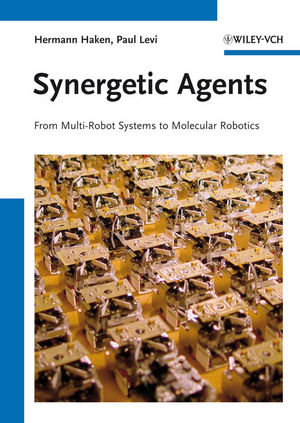
Synergetic Agents
Wiley-VCH (Verlag)
978-3-527-41166-5 (ISBN)
- Titel leider nicht mehr lieferbar
- Artikel merken
Für Leser, die sich mit den Grundlagen und theoretischen Werkzeugen für das faszinierende Gebiet der synergetischen Agenten vertraut machen wollen. Basierend auf dem Konzept von Informations-Minimierung, behandelt das Buch sowohl Multi-Roboter-Systeme als auch molekulare Robotik aus einheitlicher Sicht.Aus dem Inhalt:Teil I: Klassische synergetische Agenten1. Auf der Suche nach allgemeinen Grundsätzen 2. Multi-Roboter-Aktion I 3. Multi-Roboter-Aktion II: Erweiterte KonfigurationenTeil II: Quantensynergetische Agenten4. Molekulare Robotik und Quantenfeldtheorie 5. Die Quantentheorie der Roboter-Bewegung und chemische Wechselwirkungen 6. Anwendungen auf molekulare Prozesse 7. Molekularer Transport entlang eindimensionaler periodischer Strukturen 8. Ein Thema in Quantenbiologie 9. Quanteninformation 10. Molekulare RoboterAnhang:Die Bedeutung der Erwartungswerte und Korrelationsfunktionen von Bose- und Fermi-Operatoren
Hermann Haken is Professor of the Institute for Theoretical Physics at the University of Stuttgart. He is known as the founder of synergetics. His research has been in nonlinear optics (in particular laser physics), solid state physics, statistical physics, and group theory. After the implementation of the first laser in 1960, Professor Haken developed his institute to an international center for laser theory. The interpretation of the laser principles as self organization of non equilibrium systems paved the way to the development of synergetics, of which Haken is recognized as the founder. Hermann Haken has been visiting professor or guest scientist in England, France, Japan, USA, Russia, and China. He is the author of some 23 textbooks and monographs that cover an impressive number of topics from laser physics to synergetics, and editor of a book series in synergetics. For his pathbreaking work and his influence on academic research, he has been awarded many-times. Among others, he is member of the Order "Pour le merite" and received the Max Planck Medal in 1990. Paul Levi is Full Professor for Informatics in the Institute for Parallel and Distributed Systems of the University of Stuttgart, Germany. He graduated in physics and computer science and became a senior research scientist in informatics and robotics, and Head of the Department of Technical Expert Systems and Robotics at the University of Karlsruhe. In 1988 he was appointed Professor at the Technical University of Munich, and scientific member of the Bavarian Center for Knowledge-Based Systems. Later on he served as Director of the Institute for Parallel and Distributed High Performance Computers at the University of Stuttgart. He is Member of the Management Board of the Centre for Computer Science (FZI) and Director of the Division Intelligent Systems and Production Engineering (ISPE), Karlsruhe, Germany. Paul Levi's main research fields include computer vision, robotics, distributed AI and multi-agent systems. He has authored and co-authored both textbooks and monographs.
Introduction
Part I: Classical synergetic agents
1. In search for general principles
2. Multi-robot action I
3. Multi-robot action II: Extended configurations
Part II: Quantum synergetic agents
4. Molecular robotics and quantum field theory
5. Quantum theory of robotic motion and chemical interactions
6. Applications to molecular processes
7. Molecular transport along one-dimensional periodic structures
8. A topic in quantum biology
9. Quantum information
10. Molecular robots
Appendix: The meaning of expectation values and correlation functions of Bose and Fermi operators
References
| Erscheint lt. Verlag | 18.9.2012 |
|---|---|
| Verlagsort | Weinheim |
| Sprache | englisch |
| Maße | 170 x 240 mm |
| Gewicht | 796 g |
| Themenwelt | Naturwissenschaften ► Physik / Astronomie |
| Technik ► Elektrotechnik / Energietechnik | |
| Schlagworte | Electrical & Electronics Engineering • Electrical & Electronics Engineering • Elektrotechnik u. Elektronik • Komplexes System • Nichtlineares System • Nichtlineare u. komplexe Systeme • Nonlinear and Complex Systems • Physics • Physik • Roboter • Robotics • Robotik |
| ISBN-10 | 3-527-41166-6 / 3527411666 |
| ISBN-13 | 978-3-527-41166-5 / 9783527411665 |
| Zustand | Neuware |
| Informationen gemäß Produktsicherheitsverordnung (GPSR) | |
| Haben Sie eine Frage zum Produkt? |
aus dem Bereich