


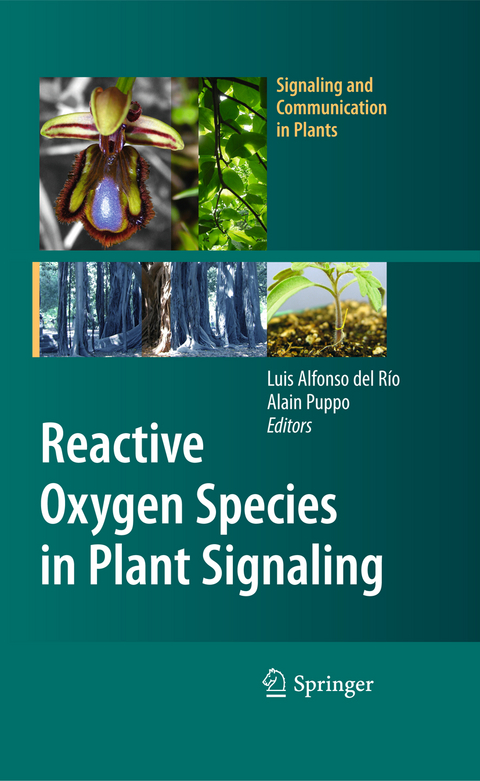
Reactive Oxygen Species in Plant Signaling
Seiten
2011
Springer Berlin (Verlag)
978-3-642-24261-8 (ISBN)
Springer Berlin (Verlag)
978-3-642-24261-8 (ISBN)
The production of reactive oxygen species in plants used to be thought harmful, but recent research shows ROS to be key regulators of plant metabolism, morphology and development. This book offers the latest in the field, highlighting new data and concepts.
Oxygen (O ) appeared in significant amounts in the Earth's atmosphere over 2. 2 2 billion years ago, largely due to the evolution of photosynthesis by cyanobacteria (Halliwell 2006). The O molecule is a free radical, as it has two impaired electrons 2 that have the same spin quantum number. This spin restriction makes O prefer to 2 accept its electrons one at a time, leading to the generation of the so-called reactive oxygen species (ROS). The chemical nature of these species dictates that they can create damage in cells. This has contributed to the creation of the "oxidative stress" concept; in this view, ROS are unavoidable toxic products of O metabolism and 2 aerobic organisms have evolved antioxidant defences to protect against this tox- ity (Halliwell 1981; Fridovich 1998). Indeed, even in present-day plants, which are full of antioxidants, much of the protein synthetic activity of chloroplasts is used to replace oxidatively damaged D1 and other proteins (Halliwell 2006). Yet, the use of the "oxidative stress" term implies that ROS exert their effects through indiscriminate widespread inactivation of cellular functions. In this context, ROS must not be able to react with lipids, proteins or nucleic acids in order to avoid any damage to vital cellular components. However, genetic evidence has suggested that, in planta, purely physicoche- cal damage may be more limited than previously thought (Foyer and Noctor 2005).
Oxygen (O ) appeared in significant amounts in the Earth's atmosphere over 2. 2 2 billion years ago, largely due to the evolution of photosynthesis by cyanobacteria (Halliwell 2006). The O molecule is a free radical, as it has two impaired electrons 2 that have the same spin quantum number. This spin restriction makes O prefer to 2 accept its electrons one at a time, leading to the generation of the so-called reactive oxygen species (ROS). The chemical nature of these species dictates that they can create damage in cells. This has contributed to the creation of the "oxidative stress" concept; in this view, ROS are unavoidable toxic products of O metabolism and 2 aerobic organisms have evolved antioxidant defences to protect against this tox- ity (Halliwell 1981; Fridovich 1998). Indeed, even in present-day plants, which are full of antioxidants, much of the protein synthetic activity of chloroplasts is used to replace oxidatively damaged D1 and other proteins (Halliwell 2006). Yet, the use of the "oxidative stress" term implies that ROS exert their effects through indiscriminate widespread inactivation of cellular functions. In this context, ROS must not be able to react with lipids, proteins or nucleic acids in order to avoid any damage to vital cellular components. However, genetic evidence has suggested that, in planta, purely physicoche- cal damage may be more limited than previously thought (Foyer and Noctor 2005).
Reactive Oxygen-Generating NADPH Oxidases in Plants.- Integration of ROS and Hormone Signaling.- Reactive Oxygen Species in Growth and Development.- ROS Signalling in Stomata.- Reactive Oxygen Species in Plant Cell Walls.- Peroxisomes as a Cellular Source of ROS Signal Molecules.- Reactive Oxygen Species in Plant-Pathogen Interactions.- ROS in the Legume-Rhizobium Symbiosis.- Hydrogen Peroxide-Responsive Genes in Stress Acclimation and Cell Death.- The ROS Signaling Network of Cells.- Reactive Oxygen Species and Signaling in Cadmium Toxicity.- Reactive Oxygen Species in Ozone Toxicity.- ROS and Plant Membrane Rafts.- ROS in Retrograde Signalling from the Chloroplast to the Nucleus.
| Erscheint lt. Verlag | 29.11.2011 |
|---|---|
| Reihe/Serie | Signaling and Communication in Plants |
| Zusatzinfo | X, 246 p. 28 illus., 7 illus. in color. |
| Verlagsort | Berlin |
| Sprache | englisch |
| Maße | 155 x 235 mm |
| Gewicht | 392 g |
| Themenwelt | Naturwissenschaften ► Biologie ► Biochemie |
| Naturwissenschaften ► Biologie ► Botanik | |
| Schlagworte | Cadmium • Chloroplast • Expression • gene expression • Metabolism • pathogen • Pflanzen • plant cell biology • Plant Molecular Biology • Plant Physiology • Plant signaling • Reactive oxygen species (ROS) • Signalübertragung (Biologie) |
| ISBN-10 | 3-642-24261-8 / 3642242618 |
| ISBN-13 | 978-3-642-24261-8 / 9783642242618 |
| Zustand | Neuware |
| Informationen gemäß Produktsicherheitsverordnung (GPSR) | |
| Haben Sie eine Frage zum Produkt? |
Mehr entdecken
aus dem Bereich
aus dem Bereich
Principles, Techniques, and Applications
Buch | Hardcover (2025)
John Wiley & Sons Inc (Verlag)
CHF 186,70


