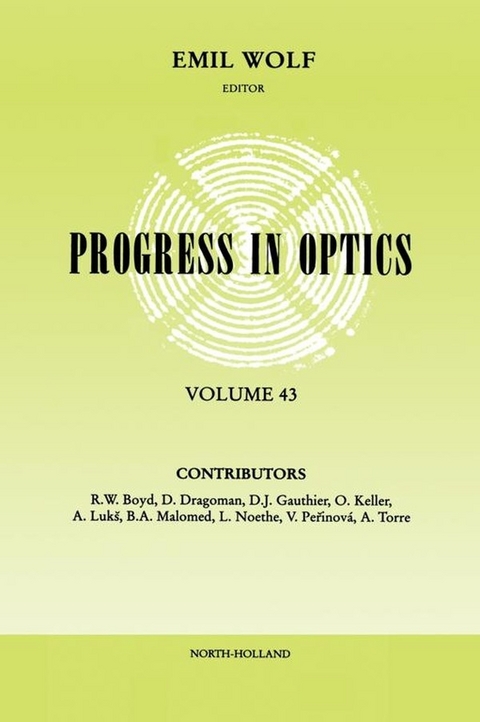
Progress in Optics (eBook)
634 Seiten
Elsevier Science (Verlag)
978-0-08-092998-9 (ISBN)
The seven reviews articles presented in this volume cover a broad range of subjects. The first article is concerned with the use of active optics in modern, large telescopes. The second article discusses variational methods used in nonlinear fibre optics and in related fields. The article by O. Keller which follows deals with a topic of historical interest, presenting a account of researches of the Danish physicist L.V. Lorenz who in 1867 established the electrodynamic theory of light, independently of the work of James Clerk Maxwell. The fourth article is concerned with the canonical quantum description of light propagation in dielectric media. The fifth article by D. Dragoman describes the similarities and the differences between classical optics and quantum mechanics in phase space. The article by R. Boyd and D. Gauthier which follows, summarizes research on pulse propagation effects in resonant material system. The concluding article by A. Torre is concerned with the fractional Fourier transform and some of it applications in optics. It is clear that the articles in this volume cover a broad range of subjects, some of which are likely to be of interest to many scientists concerned with optical theory or with optical devices.
Front Cover 1
Progress in Optics, Volume 43 4
Copyright Page 5
Contents 10
Preface 6
Chapter 1. Active optics in modern large optical telescopes 18
1. Introduction 20
2. Principles of active optics 21
3. Relationship between active-optics components and parameters 30
4. Wavefront sensing 31
5. Minimum elastic energy modes 38
6. Support of large mirrors 43
7. Alignment 51
8. Modification of the telescope optical configuration 55
9. Active-optics design for the NTT, the VLT and the Keck telescope 57
10. Practical experience with active optics at the NTT, the VLT and the Keck telescope 71
11. Existing active telescopes 82
12. Outlook 83
Acknowledgements 85
References 85
Chapter 2. Variational methods in nonlinear fiber optics and related fields, 88
1. Introduction 90
2. Dynamics of solitons in a single-mode nonlinear optical fiber or waveguide 104
3. Variational approximation for the inverse scattering transform 140
4. Internal dynamics of vector (two-component) solitons 144
5. Spatially nonuniform fibers and dispersion management 157
6. Solitons in dual-core optical fibers 181
7. Bragg-grating (gap) solitons 191
8. Stable beams in a layered focusing–defocusing Kerr medium 199
9. Conclusion 203
Acronyms adopted in the text 203
Acknowledgements 204
References 205
Chapter 3. Optical works of L.V. Lorenz 212
1. Introduction 214
2. Biography of Lorenz 218
3. Aether vibrations in polarized light 221
4. Surface optics: the first theory 230
5. Lorenz begins to doubt the elastic light theory 243
6. The phenomenological light theory of Lorenz 246
7. The electrodynamic theory of Lorenz 273
8. The discovery of the Lorenz–Lorentz relation 289
9. Light scattering by molecules and a sphere 297
10. Lorenz and the aether 306
References 309
Chapter 4. Canonical quantum description of light propagation in dielectric media, 312
1. Introduction 314
2. Origin of the macroscopic approach 321
3. Macroscopic theories and their applications 340
4. Microscopic theories 402
5. Microscopic models as related to macroscopic concepts 431
6. Conclusions 441
Acknowledgments 442
References 443
Chapter 5. Phase space correspondence between classical optics and quantum mechanics, 450
1. Introduction 452
2. The phase space in classical optics and quantum mechanics 456
3. Definitions and properties of phase space distribution functions 464
4. Nonclassical states in phase space 472
5. Measurement procedures of phase space distribution functions in quantum mechanics and classical optics 478
6. Propagation of classical fields and quantum states in phase space 486
7. Interactions of classical fields and quantum states as phase space overlap 491
8. Classical and quantum interference in phase space 494
9. Universality of the phase space treatment 505
10. Conclusions 506
References 508
Chapter 6. "Slow" and "fast" light 514
1. Elementary concepts 516
2. Optical pulse propagation in a resonant system 521
3. Nonlinear optics for slow light 527
4. Experimental studies of slow light 531
5. Experimental studies of fast light 540
6. Discussion and conclusions 545
Acknowledgements 545
References 546
Chapter 7. The fractional Fourier transform and some of its applications to optics 548
1. Introduction 550
2. The fractional Fourier transform 551
3. The optical fractional Fourier transform 558
4. Fractional Fourier transform and lens optics 567
5. Fractional Fourier transform and Wigner optics 578
6. Fractional Fourier transform and Fourier optics 586
7. Fractional Fourier transform and wave-propagation optics 596
8. Operational properties of the fractional Fourier transform 601
9. Conclusions 608
10. Acknowledgments 610
References 610
Author index for Volume 43 614
Subject index for Volume 43 628
Contents of previous volumes 632
Cumulative index – Volumes 1–43 642
Variational methods in nonlinear fiber optics and related fields
Boris A. Malomed Department of Interdisciplinary Studies, Faculty of Engineering, Tel Aviv University, Tel Aviv 69978, Israel
Acronyms adopted in the text
1D one-dimensional
2D two-dimensional
BDW Bloch domain wall
BG Bragg grating
c.c. complex conjugate (in equations)
CQ cubic–quintic (equation)
CW continuous wave
DCF dual-core fiber
DDF dispersion-decreasing fiber
DM dispersion management
DS dark soliton
FP fixed point (of dynamical equations or map)
FWHM full width at half-maximum (of a solitary pulse)
GL Ginzburg-Landau (equation)
GS gap soliton
IST inverse scattering transform
KdV Korteweg–de Vries (equation)
NLS nonlinear Schrödinger (equation, or soliton)
ODE ordinary differential equation
PAD path-average dispersion (in a dispersion-managed fiber-optic link)
PDE partial differential equation
rhs right-hand side (of an equation)
SDF self-defocusing (nonlinearity)
SF self-focusing (nonlinearity)
SPM self-phase modulation
TOD third-order dispersion
VA variational approximation
VK Vakhitov–Kolokolov (stability criterion for solitons)
WDM wavelength-division multiplexing
XPM cross-phase modulation
ZDP zero-dispersion point
ZS Zakharov-Shabat (equations)
§ 1 Introduction
1.1 The nonlinear Schrödinger equation and simplest optical solitons
The mathematical basis of nonlinear optics is Maxwell’s system of equations governing propagation of electromagnetic waves in a material medium, combined with relations accounting for the nonlinear response of the medium to the electromagnetic field (Newell and Moloney [1992]). In most cases, application of well-known asymptotic methods makes it possible to derive simplified partial differential equations (PDEs) governing the spatial and/or temporal evolution of essential field modes in the medium.
A typical and most important example of the thus derived asymptotic PDE is the nonlinear Schrödinger (NLS) equation, which governs the propagation of an electromagnetic wave in a glass fiber, or the spatial evolution of the electromagnetic field in a planar waveguide. In the case of a single-mode fiber, i.e., one permitting the propagation of a single electromagnetic-wave mode, the electric component of the field with a fixed polarization is taken in the form
(z,t)=u(z,τ)V0(r)exp(ik0z− iω0t),
(1)
where z, r and t are, respectively, the propagation distance along the fiber, the radial coordinate in the transverse plane, and time; the frequency ω0 and wavenumber k0 of the carrier wave obey a linear dispersion relation for the fiber, k = k(ω), and V0(r) describes the transverse structure of the propagating mode [the physical field is given by the real part of the complex expression (1)]. The dispersion relation determines the carrier’s group velocity Vgr ≡ 1/k′, dispersion coefficient D ≡ -k″, and “reduced time” τ ≡ t − z/Vgr, where the prime stands for the derivative d/dω taken at ω = ω0. Both D > 0 and D < 0 are possible, being referred to as, respectively, anomalous and normal dispersion.
The NLS equation for the slowly varying amplitude u(z, τ) of the modulated wave (1), derived from the Maxwell equations in the absence of dissipation, is (Agrawal [1995])
iuz+12Duττ+γ|u|2u=0.
(2)
Here, the nonlinearity coefficient is
≡n2ω0cAeff,
(3)
where n2, c and Aeff are, respectively, the Kerr coefficient, the light velocity in vacuum, and the fiber’s effective cross-sectional area. Usually, γ is scaled out of eq. (2) by means of an obvious transformation. The dispersion coefficient D can also be scaled out, provided that it is constant. However, in many important applications which will be considered in detail below in § 5, D is a function of the propagation coordinate z. The dispersion D can readily be made variable (modulated), as it is contributed to by the material dispersion of the silica glass and the geometric dispersion of the fiber waveguide. These two contributions may nearly cancel each other near the zero-dispersion point, so relatively small variations in the fiber’s cross-section area, while only slightly affecting y, can strongly change the small residual dispersion coefficient. Thus, a continuous variation of the cross-section in the process of drawing the fiber from glass melt gives rise to dispersion-decreasing fibers (see §5.1). Uniform fibers can be fabricated with different constant values of D, making it possible to build a long dispersion-compensated optical link by periodically alternating pieces with anomalous and normal dispersion. This is a basis for the dispersion-management (DM) technique, which finds important applications in transmitting signals through fiber-optic links in linear (Lin, Kogelnik and Cohen [1980]) and nonlinear regimes, see § 5.4.
The same NLS equation finds another well-known application to nonlinear optics, describing the spatial distribution of the stationary electromagnetic field in a planar waveguide (film). In that case, the electric field with fixed polarization is taken as
(z,x,t)=u(z,x)V0(y)exp(ik0z− iω0t)
(4)
(cf. eq. 1), where x and y are transverse (relative to the propagation distance z) coordinates, directed, respectively, along the film and perpendicular to it, and the function V0(y) accounts for the transverse structure of the propagating mode. Note that, unlike the case of propagation in a fiber, the slowly varying amplitude u from eq. (4) is a function of the transverse coordinate x, rather than the temporal variable r. The NLS equation governing the spatial evolution of u(z,x) in the lossless waveguide can be derived, after rescalings, in the form (see details in the book by Hasegawa and Kodama [1995])
uz+12uxx+|u|2u=U(x)u,
(5)
where, as in eq. (2), the cubic term is generated by the Kerr effect (a nonlinear correction to the effective refractive index in the material medium), while the second-derivative term, unlike that in eq. (1), accounts for the spatial diffraction of the field, rather than temporal dispersion. The term on the right-hand side (rhs) of eq. (5) takes into regard possible modulation of the waveguide in the transverse direction, which gives rise to an effective real potential U(x). Note that the positive sign in front of the nonlinear term in eq. (5) assumes that the Kerr nonlinearity is self-focusing (corresponding to a positive nonlinear correction to the effective refractive index), which is the case in most optical media, including silica glass. In the opposite case of a self-defocusing Kerr nonlinearity, which occurs in semiconductor waveguides (see, e.g., the paper by Michaelis, Peschel and Lederer [1997] and references therein), eq. (5) takes the form uz+12uxx−|u|2u=U(x)u.
The NLS equation with constant coefficients is one of the basic equations of modern mathematical physics. This equation finds numerous applications, not only in optics, but also in plasma physics, hydrodynamics, etc. Its most fundamental property is exact integrability by means of the inverse scattering transform (IST), which is based on a representation of the constant-coefficient NLS equation as a compatibility condition for two systems of auxiliary linear equations (see books by Zakharov, Manakov,...
| Erscheint lt. Verlag | 17.5.2002 |
|---|---|
| Mitarbeit |
Herausgeber (Serie): Emil Wolf |
| Sprache | englisch |
| Themenwelt | Naturwissenschaften ► Physik / Astronomie ► Optik |
| Technik | |
| ISBN-10 | 0-08-092998-2 / 0080929982 |
| ISBN-13 | 978-0-08-092998-9 / 9780080929989 |
| Informationen gemäß Produktsicherheitsverordnung (GPSR) | |
| Haben Sie eine Frage zum Produkt? |
 PDF (Adobe DRM)
Kopierschutz: Adobe-DRM
Adobe-DRM ist ein Kopierschutz, der das eBook vor Mißbrauch schützen soll. Dabei wird das eBook bereits beim Download auf Ihre persönliche Adobe-ID autorisiert. Lesen können Sie das eBook dann nur auf den Geräten, welche ebenfalls auf Ihre Adobe-ID registriert sind.
Details zum Adobe-DRM
Dateiformat: PDF (Portable Document Format)
Mit einem festen Seitenlayout eignet sich die PDF besonders für Fachbücher mit Spalten, Tabellen und Abbildungen. Eine PDF kann auf fast allen Geräten angezeigt werden, ist aber für kleine Displays (Smartphone, eReader) nur eingeschränkt geeignet.
Systemvoraussetzungen:
PC/Mac: Mit einem PC oder Mac können Sie dieses eBook lesen. Sie benötigen eine
eReader: Dieses eBook kann mit (fast) allen eBook-Readern gelesen werden. Mit dem amazon-Kindle ist es aber nicht kompatibel.
Smartphone/Tablet: Egal ob Apple oder Android, dieses eBook können Sie lesen. Sie benötigen eine
Geräteliste und zusätzliche Hinweise
Buying eBooks from abroad
For tax law reasons we can sell eBooks just within Germany and Switzerland. Regrettably we cannot fulfill eBook-orders from other countries.
aus dem Bereich