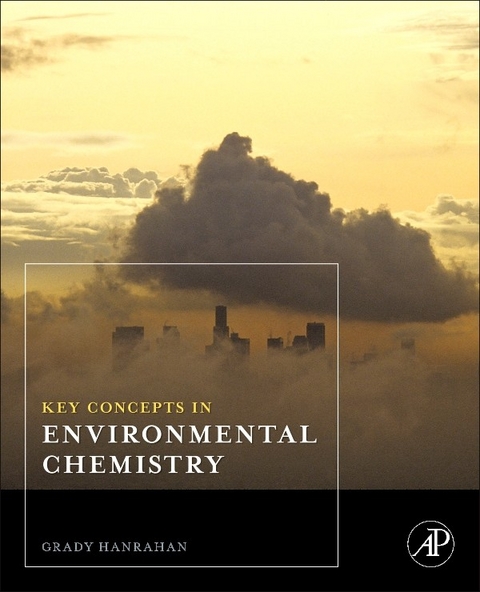
Key Concepts in Environmental Chemistry (eBook)
384 Seiten
Elsevier Science (Verlag)
978-0-08-096170-5 (ISBN)
Key Concepts in Environmental Chemistry provides a modern and concise introduction to environmental chemistry principles and the dynamic nature of environmental systems. It offers an intense, one-semester examination of selected concepts encountered in this field of study and provides integrated tools in explaining complex chemical problems of environmental importance. Principles typically covered in more comprehensive textbooks are well integrated into general chapter topics and application areas. The goal of this textbook is to provide students with a valuable resource for learning the basic concepts of environmental chemistry from an easy to follow, condensed, application and inquiry-based perspective. Additional statistical, sampling, modeling and data analysis concepts and exercises will be introduced for greater understanding of the underlying processes of complex environmental systems and fundamental chemical principles. Each chapter will have problem-oriented exercises (with examples throughout the body of the chapter) that stress the important concepts covered and research applications/case studies from experts in the field. Research applications will be directly tied to theoretical concepts covered in the chapter. Overall, this text provides a condensed and integrated tool for student learning and covers key concepts in the rapidly developing field of environmental chemistry. - Intense, one-semester approach to learning- Application-based approach to learning theoretical concepts- In depth analysis of field-based and in situ analytical techniques- Introduction to environmental modeling
Key Concepts in Environmental Chemistry 2
Copyright 3
Contents 4
Preface to Faculty 10
Philosophical Approach 10
Purpose and Organization 10
Preface to Students 14
Acknowledgments 16
About the Author 18
Chapter 1 Abstracts and Keywords 20
Chapter 1 - Introduction to Environmental Chemistry 22
1.1. Overview and Importance of Environmental Chemistry 23
1.2. Ecosystem Considerations 24
1.3. Review of energy and thermodynamic concepts 26
1.4. Review of chemical kinetics and Chemical Equilibrium 27
1.5. Global Water and element Cycles 31
1.6. An introduction to environmental data analysis 46
1.7. End of Chapter Problems 47
1.8 References 49
Chapter 2 Abstracts and Keywords 50
Chapter 2 - Environmental Statistical Analysis and Sampling Considerations 52
2.1. Introduction to Environmental Statistics 53
2.2. Sample Collection 53
2.3. The Distribution and Transformation of Data 57
2.4. Inferential Statistics and Hypothesis Testing 63
2.5. Outlying Results 66
2.6. Analysis of Variance 67
2.7. Graphical data analysis 70
2.8. Multivariate Data Analysis: A brief introduction 76
2.9. End of Chapter Problems 86
2.10 References 89
Chapter 3 Abstracts and Keywords 90
Chapter 3 - Aqueous Chemistry 92
3.1. Chemical Composition and Properties of Water 93
3.2. Acid-Base Phenomena 98
3.3. Oxidation-Reduction in Natural Waters 105
3.4. Dissolution and Precipitation in Aquatic Environments 116
3.5. Adsorption in Aquatic Environments 119
3.6. The Bjerrum Plot: Construction from Excel Spreadsheets 123
3.7. End of Chapter Problems 123
3.8 References 125
Chapter 4 Abstracts and Keywords 126
Chapter 4 - Surface/Groundwater Quality and Monitoring 128
4.1. Surface and Groundwater Relationships 128
4.2. Water Quality Units and Concentration Considerations 134
4.3. Water Quality Parameters and Criteria Guidelines 139
4.4. Physico-Chemical Water Quality Indicators 152
4.5. Developmental Toxicants 156
4.6. Biological Assessements 157
4.7. Water Quality Monitoring 159
4.8. Introduction to Environmental Modeling: a Water Quality Perspective 166
4.9. End of Chapter Problems 168
4.10 References 169
Chapter 5 Abstracts and Keywords 172
Chapter 5 - Water Treatment and Related Technologies 174
5.1. Municipal Wastewater Treatment 175
5.2. The Treatment of Municipal Sewage and Water 175
5.3. Disinfection 183
5.4. Use and Disposal of Biosolids 187
5.5. Point-of-entry and Point-of-use Technologies 189
5.6. End of Chapter Problems 193
5.7. References 195
Chapter 6 Abstracts and Keywords 196
Chapter 6 - The Atmosphere and Associated Processes 198
6.1. Introduction 199
6.2. The Layers of the Atmosphere 199
6.3. Atmospheric Radiation and Photochemical Reactions 201
6.4. Pressure and Temperature Considerations 207
6.5. Biosphere-Atmosphere Interactions 209
6.6. Transport, Transformation, and Deposition Processes: A brief Introduction 214
6.7. Global Climate Change: a Primer 224
6.8. End of Chapter Problems 226
6.9. References 228
Chapter 7 Abstracts and Keywords 232
Chapter 7 - Air Pollutants and Associated Chemical and Photochemical Processes 234
7.1. Introduction 235
7.2. Ambient Particulate Matter: Primary and Secondary Contributions and Formation 239
7.3. Photochemical Mechanism of Ozone (O3) Formation: The Role of VOCs and NOx 242
7.4. Peroxyacetyl Nitrate (PAN) Formation and NOX Transport 247
7.5. photochemical smog: formation Conditions and health effects 248
7.6. Aldehydes in the Atmosphere 250
7.7. Heterogeneous Atmospheric Reactions 252
7.8. Example Predictive Atmospheric Models 256
7.9. End of Chapter Problems 258
7.10. References 260
Chapter 8 Abstracts and Keywords 262
Chapter 8 - Soil Chemistry 264
8.1. Introduction to Soil Chemistry 265
8.2. Soil Formation, Composition, and Structure 265
8.3. Soil Organic Matter and Biochemical Aspects 268
8.4. Sorption of Metals and Hydrophobic Organic Compounds in soils 270
8.5. Pesticide Adsorption in Soils 276
8.6. Acid and Base Characteristics 278
8.7. End of Chapter Questions 279
8.8 References 280
Chapter 9 Abstracts and Keywords 282
Chapter 9 - Environmental Toxicology and Hazardous Waste Characterization 284
9.1. Introduction to Environmental Toxicology 284
9.2. Evaluating Exposure Pathways and Mechanisms of Action 287
9.3. Hazardous Waste Identification, Characterization, and Minimization 299
9.4. Risk Assessment 304
9.5. End of Chapter Problems 309
9.6 References 311
Chapter 10 Abstracts and Keywords 314
Chapter 10 - Green Chemistry and Sustainable Chemical Processes 316
10.1. Principles of Green Chemistry 317
10.2. Life of the Manufactured Chemical Product 321
10.3. Sustainable Chemical and Related Processes 326
10.4. Pollution Prevention and Waste Minimization 332
10.5. Sustainable Materials and Application Areas 333
10.6. End of Chapter Problems 336
10.7 References 337
Appendix I - Common Excel Shortcuts and Key Combinations 340
Appendix II - Values of Student’s t at the Various Confidence Levels 342
Appendix III - Critical Values of F for a One-Tailed Test with p = 0.05 344
Appendix IV - Critical Values of F for a Two-Tailed Test with p = 0.05 346
Appendix V - Common Matrix Notation and Calculations 348
Index 352
| Erscheint lt. Verlag | 2.8.2011 |
|---|---|
| Sprache | englisch |
| Themenwelt | Naturwissenschaften ► Biologie ► Ökologie / Naturschutz |
| Naturwissenschaften ► Chemie ► Physikalische Chemie | |
| Technik ► Umwelttechnik / Biotechnologie | |
| ISBN-10 | 0-08-096170-3 / 0080961703 |
| ISBN-13 | 978-0-08-096170-5 / 9780080961705 |
| Informationen gemäß Produktsicherheitsverordnung (GPSR) | |
| Haben Sie eine Frage zum Produkt? |
 EPUB (Adobe DRM)
Kopierschutz: Adobe-DRM
Adobe-DRM ist ein Kopierschutz, der das eBook vor Mißbrauch schützen soll. Dabei wird das eBook bereits beim Download auf Ihre persönliche Adobe-ID autorisiert. Lesen können Sie das eBook dann nur auf den Geräten, welche ebenfalls auf Ihre Adobe-ID registriert sind.
Details zum Adobe-DRM
Dateiformat: EPUB (Electronic Publication)
EPUB ist ein offener Standard für eBooks und eignet sich besonders zur Darstellung von Belletristik und Sachbüchern. Der Fließtext wird dynamisch an die Display- und Schriftgröße angepasst. Auch für mobile Lesegeräte ist EPUB daher gut geeignet.
Systemvoraussetzungen:
PC/Mac: Mit einem PC oder Mac können Sie dieses eBook lesen. Sie benötigen eine
eReader: Dieses eBook kann mit (fast) allen eBook-Readern gelesen werden. Mit dem amazon-Kindle ist es aber nicht kompatibel.
Smartphone/Tablet: Egal ob Apple oder Android, dieses eBook können Sie lesen. Sie benötigen eine
Geräteliste und zusätzliche Hinweise
Buying eBooks from abroad
For tax law reasons we can sell eBooks just within Germany and Switzerland. Regrettably we cannot fulfill eBook-orders from other countries.
aus dem Bereich