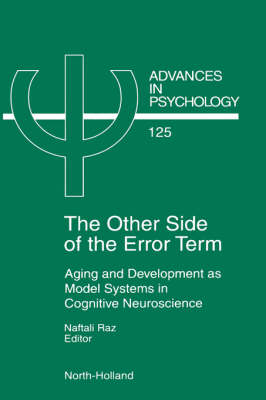
Other Side of the Error Term (eBook)
457 Seiten
Elsevier Science (Verlag)
9780080538273 (ISBN)
This book examines what we can learn about general and universal phenomena in cognition and its brain substrates from examining the odd, the rare, the transient, the exceptional and the abnormal.
It has been said more than once in psychology that one person's effect is another person's error term. By minimising and occasionally ignoring individual and group variability cognitive psychology has yieled many fine achievements. However, when investigators are working with special populations, the subjects, and the unique nature of the sample, come into focus and become the goal in itself. For developmental psychologists, gerontologists and psychopathologists, research progresses with an eye on their target populations of study. Yet every good study in any of these domains inevitably has another dimension. Whenever a study is designed to turn a spotlight on a special population, the light is also shed on the mainstream from which the target deviates.This book examines what we can learn about general and universal phenomena in cognition and its brain substrates from examining the odd, the rare, the transient, the exceptional and the abnormal.
Cover 1
Contents 8
Introduction 10
Chapter 1. Developmental Instability And Phenotypic Variation in Neural Organization 16
Chapter 2. Animal Models of Developmental Dyslexia: Lessons From Developmental And Cognitive Neuroscience 68
Chapter 3. Electrophysiological Correlates Of Early Speech Perception And Language Development During Infancy And Early Childhood 122
Chapter 4. Developmental And Individual Differences In Short-term Memory 170
Chapter 5. Lifespan Studies of Mental Chronometry: Insights Derived From Chronopsychophysiology 212
Chapter 6. Differential Contribution of Frontal and Medial Temporal Lobes to Memory: Evidence from Focal Lesions and Normal Aging 276
Chapter 7. Does Working Memory Work in Language Comprehension? Evidence From Behavioral Neuroscience 334
Chapter 8. Problem Solving, Inhibition, and Frontal Lobe Function 410
Subject Index 464
Author Index 466
| Erscheint lt. Verlag | 23.4.1998 |
|---|---|
| Sprache | englisch |
| Themenwelt | Geisteswissenschaften ► Psychologie ► Allgemeine Psychologie |
| Geisteswissenschaften ► Psychologie ► Entwicklungspsychologie | |
| Geisteswissenschaften ► Psychologie ► Verhaltenstherapie | |
| Naturwissenschaften ► Biologie ► Humanbiologie | |
| Naturwissenschaften ► Biologie ► Zoologie | |
| ISBN-13 | 9780080538273 / 9780080538273 |
| Informationen gemäß Produktsicherheitsverordnung (GPSR) | |
| Haben Sie eine Frage zum Produkt? |
 PDF (Adobe DRM)
Kopierschutz: Adobe-DRM
Adobe-DRM ist ein Kopierschutz, der das eBook vor Mißbrauch schützen soll. Dabei wird das eBook bereits beim Download auf Ihre persönliche Adobe-ID autorisiert. Lesen können Sie das eBook dann nur auf den Geräten, welche ebenfalls auf Ihre Adobe-ID registriert sind.
Details zum Adobe-DRM
Dateiformat: PDF (Portable Document Format)
Mit einem festen Seitenlayout eignet sich die PDF besonders für Fachbücher mit Spalten, Tabellen und Abbildungen. Eine PDF kann auf fast allen Geräten angezeigt werden, ist aber für kleine Displays (Smartphone, eReader) nur eingeschränkt geeignet.
Systemvoraussetzungen:
PC/Mac: Mit einem PC oder Mac können Sie dieses eBook lesen. Sie benötigen eine
eReader: Dieses eBook kann mit (fast) allen eBook-Readern gelesen werden. Mit dem amazon-Kindle ist es aber nicht kompatibel.
Smartphone/Tablet: Egal ob Apple oder Android, dieses eBook können Sie lesen. Sie benötigen eine
Geräteliste und zusätzliche Hinweise
Buying eBooks from abroad
For tax law reasons we can sell eBooks just within Germany and Switzerland. Regrettably we cannot fulfill eBook-orders from other countries.
aus dem Bereich