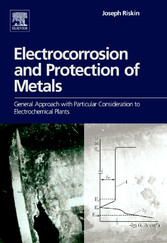
Electrocorrosion and Protection of Metals (eBook)
264 Seiten
Elsevier Science (Verlag)
978-0-08-093300-9 (ISBN)
Electrocorrosion, the corrosion of metallic constructions by external currents, is the most significant factor in conductive aggressive environments. Corrosion of underground and underwater metal constructions by stray currents has been comprehensively studied in the past decades and is considered here only in the form of a review. The primary attention is on corrosion, by external anodic (mainly) and cathodic currents, of metal constructions in the highly aggressive environments typical for electrochemical plants, where penetration of the external currents (leakage currents) from the electrolytic baths into metal constructions is unavoidable. , A new approach to the problem of electrocorrosion protection of passive structural metals is considered in this book, , keeping the metals attacked by external currents in the boundaries of their passive field. The systems, developed in accordance with this approach, are based on the modification of existing and elaboration of new methods of electrocorrosion protection. These systems take into account corrosion and electrochemical characteristics of the aggressive media (redox potential, conductivity etc.) and of the passive metal (corrosion and activation potentials, current density in a passive state, etc) as well as the sizes and distribution character of the external currents.
The book covers analysis of leakage current distributions in electrochemical plants, their influence, methods ,to estimate corrosion stability of metallic structures subject to external currents and presents many concrete examples of the successful introduction of corrosion protection systems in operating plants.
- A new approach to ,protection from electrocorrosion, taking into account the passive state of the metal in aggressive media
- Newly developed and modifications of well known methods of electrocorrosion protection are presented.
- Systematized data on electrocorrosion and protection of metals, especially in electrochemical plants, allow corrosion engineers, researchers and personnel maintaining the equipment of electrochemical plants to analyze the corrosion state of , metallic equipment and prevent electrocorrosion.
Electrocorrosion, the corrosion of metallic constructions by external currents, is the most significant factor in conductive aggressive environments. Corrosion of underground and underwater metal constructions by stray currents has been comprehensively studied in the past decades and is considered here only in the form of a review. The primary attention is on corrosion, by external anodic (mainly) and cathodic currents, of metal constructions in the highly aggressive environments typical for electrochemical plants, where penetration of the external currents (leakage currents) from the electrolytic baths into metal constructions is unavoidable.A new approach to the problem of electrocorrosion protection of passive structural metals is considered in this book, keeping the metals attacked by external currents in the boundaries of their passive field. The systems, developed in accordance with this approach, are based on the modification of existing and elaboration of new methods of electrocorrosion protection. These systems take into account corrosion and electrochemical characteristics of the aggressive media (redox potential, conductivity etc.) and of the passive metal (corrosion and activation potentials, current density in a passive state, etc) as well as the sizes and distribution character of the external currents.The book covers analysis of leakage current distributions in electrochemical plants, their influence, methods to estimate corrosion stability of metallic structures subject to external currents and presents many concrete examples of the successful introduction of corrosion protection systems in operating plants. - A new approach to protection from electrocorrosion, taking into account the passive state of the metal in aggressive media- Newly developed and modifications of well known methods of electrocorrosion protection are presented- Systematized data on electrocorrosion and protection of metals, especially in electrochemical plants, allow corrosion engineers, researchers and personnel maintaining the equipment of electrochemical plants to analyze the corrosion state of metallic equipment and prevent electrocorrosion
Front Cover 1
Electrocorrosion and Protection of Metals: General Approach with Particular Consideration to Electrochemical Plants 4
Copyright Page 5
Table of Contents 8
Preface 14
Introduction 16
Corrosion and Electric Current – 200 Years Together 16
Chapter 1 Dependence of the Corrosion Behavior of Metals Attacked by an External Current on their Initial State 20
1.1 State of Metals in Aggressive Media in the Absence of Attack by External Currents 20
1.2 Polarization of Metals 24
1.3 Attack of External Anodic Current on Actively Corroding Metals 25
1.4 Attack of External Anodic Current on Passive Metals 27
1.5 Attack of External Anodic Current on Thermodynamically Stable Metals 31
1.6 Attack of External Cathodic Current on Metals 32
1.7 Attack of External Alternating Current on Metals 34
1.8 External Current As a Factor of the Aggressiveness of the Environment 34
Chapter 2 Corrosion and Protection of Underground and Underwater Structures Attacked by Stray Currents 38
2.1 Main Media, Sources of Stray Currents and Objects of Their Corrosive Attack 38
2.2 Methods of Detection and Control of Stray Currents 41
2.3 Metal Corrosion by Stray Currents 43
2.4 Protection of Metals Against Corrosion Attack by Stray Currents 46
2.4.1 Measures for reducing stray currents 46
2.4.2 Protection of underground structures by electrodrainage 47
2.4.3 Cathodic protection 48
Chapter 3 Operating Features of Electrochemical Plants 52
3.1 General Characteristics of Electrochemical Plants 52
3.2 Leakage Currents in Electrochemical Plants 54
3.2.1 Sources of leakage currents, concepts and problems connected with them 54
3.2.2 Methods of measuring and controlling leakage currents 56
3.2.3 Magnitudes and distribution regularity of leakage currents along the lines of electrochemical cells 60
3.3 Aggressive Media 64
Chapter 4 Using Structures of Metallic Materials in Electrochemical Plants Without Taking into Account Attack by Leakage Currents 70
4.1 Non-Metallic Materials 70
4.2 Traditional Metallic Materials 71
4.3 Experience in the Field of Titanium Application 74
4.3.1 Preconditions for the application of titanium in electrochemical plants 74
4.3.2 Attempts at titanium application in the zones of attack by leakage currents 75
4.3.3 Preconditions and experience of titanium application in wet chlorine lines of electrochemical plants 78
4.3.4 Laboratory and industrial tests of titanium resistance against crevice corrosion in wet chlorine and in chlorine-saturated water: Comparison of 80
Chapter 5 Corrosion Behavior Investigations of Traditional Structural Metallic Materials in Electrochemical Plant Media, Taking into Account Attack by 84
5.1 Carbon Steel in Neutral, Alkaline and Chloride-Alkali Media 84
5.1.1 Neutral solutions of salts 84
5.1.2 Alkaline solutions 85
5.1.3 Chloride-alkali solutions 86
5.2 Stainless Steel 18-10 in Alkaline and Acid Media 87
5.2.1 Solution of 50% NaOH at 120°C comparison of corrosion behavior of stainless steel 18-10 and of nickel
5.2.2 Technological solution for producing sodium perborate 90
5.2.3 Acid sulfate containing electrolyte for copper electrorefining 91
Chapter 6 Corrosion Behavior Investigations of Titanium and Its Alloys in the Media of Electrochemical Plants, Taking into Account the Attack by Anodic 94
6.1 Corrosion and Electrochemical Characteristics of Titanium 94
6.2 Chloride and Chloride-Alkali Media of Chlorine-Producing Electrochemical Plants 96
6.3 Electrolyte for Copper Electrorefining 100
6.4 Media of Nickel Electrorefining 103
6.5 Influence of Welding Seams and Crevices 105
6.5.1 Welding seams 105
6.5.2 Artificial crevices 107
6.6 Titanium Alloys 112
Chapter 7 Hydrogenation and Corrosion Investigations of Titanium under Attack by an External Cathodic Current 118
7.1 Conditions of Hydrogenation and Corrosion of Titanium. Methodological Features of Experiments 118
7.2 Investigations in Non-Stirred NaCl Solutions 120
7.3 Investigations under Conditions of Electrolyte Stirring and Flowing 124
7.3.1 Relation between the corrosion rate of titanium and the accumulation of oxygen–chlorine compounds in the solution 124
7.3.2 Two corrosion mechanisms of hydrogenated titanium 127
7.4 Welding Seams 128
7.5 Hydrogenation of Cathode Blanks in Solution of Nickel Electrorefining 131
7.5.1 Electrochemical investigations of combined discharge of nickel and hydrogen ions on titanium 131
7.5.2 Radiochemical investigations of titanium hydrogenation in the process of nickel deposition 132
Chapter 8 Estimation of Corrosion Stability of Structures Made of Passive Metals in Aggressive Media, in the Field of an External Current 136
8.1 Estimation Based on the Potential Value 137
8.1.1 Activation potential as an estimation criterion of the passive metal state in the field of an external current 137
8.1.2 Types of structural elements in the form of tubes in the field of an external current 138
8.1.3 Potential and current distribution along structural elements in the form of tubes 140
8.1.4 Procedure for computation of the potential distribution along the internal tube surface with the help of a computer 142
8.2 Estimation Based on the External Current Value 143
8.2.1 Estimation based on the external current value for tube-shaped structural elements 144
8.3 Practical Steps and Examples of Corrosion Stability Estimation of Structures in the Form of Tubes of Different Types 148
8.4 Significance of the Electrochemical Characteristics of Passive Metals for the Estimation and Provision of Corrosion Stability of Metal Structures 151
Chapter 9 Electrocorrosion Protection of Metals in Electrochemical Plants Based on Existing Methods 156
9.1 Insulating Coatings 156
9.2 Reduction of Leakage Currents Coming from Electrochemical Cells 158
9.2.1 Reduction of leakage currents along electrolyte piping and prevention of current oscillations 159
9.2.2 Reduction of leakage currents along piping of wet gases 160
9.3 Sectionalization of Piping Made of Passive Metals 166
9.4 Possibilities of Applying "Traditional" Methods of Electrochemical Protection and Their Modifications for Electrochemical Plants 169
9.4.1 Electrodrainage protection 169
9.4.2 Protection by sacrificial anodes for current drainage in chloride electrolysis plants 170
9.4.3 Protection by sacrificial anodes for current drainage in electrolysis plants with metal deposition 172
Chapter 10 New Principles of Protection of Passive Metals against Electrocorrosion in Electrochemical Plants 178
10.1 Protection of Metals with the Relationship . = Eox – Ea < 0, against Corrosion Attack by an External Anodic Current, with the Help of Dimensionally
10.1.1 Theoretical basis 178
10.1.2 Experimental verification of the protection principle 181
10.2 Corrosion Protection with the Help of Dimensionally Stable Anodes, Oriented along the Field of the External Current 184
10.2.1 Theoretical basis 184
10.2.2 Investigation of the protection principle 187
10.3 Protection of Metals against Corrosion Attack by an External Cathodic Current 191
10.4 Protection of Metals against Corrosion Attack by Leakage Currents that Periodically Change their Direction 194
10.5 Protection of Metals against Corrosion Attack by External Currents at the Design Stage 198
Chapter 11 Electrodes for Metal Protection against Corrosion Attack by Leakage Currents in Electrochemical Plants 204
11.1 Requirements Upon Materials of Electrodes that are used for Protection Against Corrosion Attack by External Currents 204
11.2 Application of Anodes of Commercial Electrolysis Processes for Protection Against Electrocorrosion 206
11.2.1 Neutral and acid chloride-containing media 207
11.2.2 Chloride-sulfate media 210
11.3 Anodes for Media Containing Sulfuric Acid 211
11.4 Dimensionally Stable Anodes With a Coating Obtained on the Basis of Intermetallic Compounds Produced in an Electric spark 213
11.4.1 Preconditions for the choice of materials and methods of producing the anodes: Test conditions 213
11.4.2 Investigations in chloride solutions 215
11.4.3 Investigations in chloride-alkali solutions 223
11.5 Stable Cathodes 225
11.5.1 Cathodes for media containing dissolved chlorine and for chloride media 225
11.5.2 Titanium cathodes for other aggressive media 228
11.5.3 Possibilities of increasing the stability of titanium cathode blanks 231
Chapter 12 Industrial Tests and the Introduction into Electrochemical Plants of the Developed Methods for the Protection of Metals against Corrosion Attack 236
12.1 Protection by Sacrificial Anodes in Electrorefining Plants 236
12.1.1 Industrial tests 236
12.1.2 Introduction of the protection in a copper electrorefining plant 238
12.2 Industrial Tests and the Introduction of Corrosion Protection of Titanium Structures by Current Leak-Off Anodes 239
12.2.1 Industrial tests 239
12.2.2 Introduction of protection 243
12.3 Industrial Tests and the Introduction of Corrosion Protection by Anodes Oriented Along The Field of the External Current in Electrochemical Plants 248
12.3.1 Industrial tests 248
12.3.2 Introduction of protection 249
12.4 Industrial Tests of Titanium Protection Against Corrosion Attack by Cathodic Leakage Currents with the Help of Stable Cathodes 250
12.5 Combined Protection of Metals Against Corrosion Attack by Leakage Currents 251
12.6 Effectiveness and Possibilities of Using the Developed Methods of Metal Protection Against Electrocorrosion 252
Index 256
Color Plates 264
| Erscheint lt. Verlag | 7.11.2008 |
|---|---|
| Sprache | englisch |
| Themenwelt | Naturwissenschaften ► Chemie ► Physikalische Chemie |
| Naturwissenschaften ► Chemie ► Technische Chemie | |
| Technik ► Maschinenbau | |
| Technik ► Umwelttechnik / Biotechnologie | |
| ISBN-10 | 0-08-093300-9 / 0080933009 |
| ISBN-13 | 978-0-08-093300-9 / 9780080933009 |
| Informationen gemäß Produktsicherheitsverordnung (GPSR) | |
| Haben Sie eine Frage zum Produkt? |
 EPUB (Adobe DRM)
Kopierschutz: Adobe-DRM
Adobe-DRM ist ein Kopierschutz, der das eBook vor Mißbrauch schützen soll. Dabei wird das eBook bereits beim Download auf Ihre persönliche Adobe-ID autorisiert. Lesen können Sie das eBook dann nur auf den Geräten, welche ebenfalls auf Ihre Adobe-ID registriert sind.
Details zum Adobe-DRM
Dateiformat: EPUB (Electronic Publication)
EPUB ist ein offener Standard für eBooks und eignet sich besonders zur Darstellung von Belletristik und Sachbüchern. Der Fließtext wird dynamisch an die Display- und Schriftgröße angepasst. Auch für mobile Lesegeräte ist EPUB daher gut geeignet.
Systemvoraussetzungen:
PC/Mac: Mit einem PC oder Mac können Sie dieses eBook lesen. Sie benötigen eine
eReader: Dieses eBook kann mit (fast) allen eBook-Readern gelesen werden. Mit dem amazon-Kindle ist es aber nicht kompatibel.
Smartphone/Tablet: Egal ob Apple oder Android, dieses eBook können Sie lesen. Sie benötigen eine
Geräteliste und zusätzliche Hinweise
Buying eBooks from abroad
For tax law reasons we can sell eBooks just within Germany and Switzerland. Regrettably we cannot fulfill eBook-orders from other countries.
aus dem Bereich