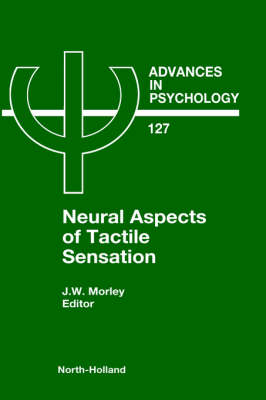
Neural Aspects of Tactile Sensation (eBook)
354 Seiten
Elsevier Science (Verlag)
9780080537351 (ISBN)
Individual chapters address, the response of mechanoreceptors to stimuli (including movement and shape), the role of the somatosensory cortex in processing tactile information, the psychophysics and neurophysiology of the detection and categorisation of somesthetic stimuli, perceptual constancy, recent findings in regard to short term and long term plasticity in the somatosensory cortex and the psychophysical correlates of this plasticity, and parallel versus serial information processing in the cortex.
The authors look at past and current research, and comment on the direction of future investigation, relating findings from psychophysical studies of tactile behavior to our growing understanding of the underlying neural mechanisms.
The world within reach is characterised to a large extent by our ability to sense objects through touch. Research into the sensation of touch has a long history. However, it is only relatively recently that significant advances have been made in understanding how information about objects we touch is represented in both the peripheral and central divisions of the nervous systems. This volume draws together the increasing body of knowledge regarding the mechanisms underlying tactile sensation and how they relate to tactile perception.Individual chapters address; the response of mechanoreceptors to stimuli (including movement and shape), the role of the somatosensory cortex in processing tactile information, the psychophysics and neurophysiology of the detection and categorisation of somesthetic stimuli, perceptual constancy, recent findings in regard to short term and long term plasticity in the somatosensory cortex and the psychophysical correlates of this plasticity, and parallel versus serial information processing in the cortex.The authors look at past and current research, and comment on the direction of future investigation, relating findings from psychophysical studies of tactile behavior to our growing understanding of the underlying neural mechanisms.
Cover 1
Contents 8
Preface 6
Contributors 10
Chapter 1. Factors Affecting Direction Discrimination of Moving Tactile Stimuli 12
Chapter 2. Extracting the Shape of an Object from the Responses of Peripheral Nerve Fibers 66
Chapter 3. The Signalling of Touch, Finger Movements and Manipulation Forces by Mechanoreceptors in Human Skin 100
Chapter 4. Similarities Between Touch and Vision 142
Chapter 5. Functional Organization of the Somatosensory Cortex in the Primate 178
Chapter 6. Representation of Tactile Functions in the Somatosensory Cortex 206
Chapter 7. Processing of Somesthetic Stimuli in Primate Sensory-motor Cortex 250
Chapter 8. Constancy in the Somatosensory System: Central Neural Mechanisms Underlying the Appreciation of Texture During Active Touch. 286
Chapter 9. Short-term Plasticity in Adult Somatosensory Cortex 310
Subject index 362
| Erscheint lt. Verlag | 9.7.1998 |
|---|---|
| Sprache | englisch |
| Themenwelt | Geisteswissenschaften ► Psychologie ► Allgemeine Psychologie |
| Geisteswissenschaften ► Psychologie ► Verhaltenstherapie | |
| Medizin / Pharmazie ► Medizinische Fachgebiete ► Neurologie | |
| Naturwissenschaften ► Biologie ► Humanbiologie | |
| Naturwissenschaften ► Biologie ► Zoologie | |
| ISBN-13 | 9780080537351 / 9780080537351 |
| Informationen gemäß Produktsicherheitsverordnung (GPSR) | |
| Haben Sie eine Frage zum Produkt? |
 PDF (Adobe DRM)
Kopierschutz: Adobe-DRM
Adobe-DRM ist ein Kopierschutz, der das eBook vor Mißbrauch schützen soll. Dabei wird das eBook bereits beim Download auf Ihre persönliche Adobe-ID autorisiert. Lesen können Sie das eBook dann nur auf den Geräten, welche ebenfalls auf Ihre Adobe-ID registriert sind.
Details zum Adobe-DRM
Dateiformat: PDF (Portable Document Format)
Mit einem festen Seitenlayout eignet sich die PDF besonders für Fachbücher mit Spalten, Tabellen und Abbildungen. Eine PDF kann auf fast allen Geräten angezeigt werden, ist aber für kleine Displays (Smartphone, eReader) nur eingeschränkt geeignet.
Systemvoraussetzungen:
PC/Mac: Mit einem PC oder Mac können Sie dieses eBook lesen. Sie benötigen eine
eReader: Dieses eBook kann mit (fast) allen eBook-Readern gelesen werden. Mit dem amazon-Kindle ist es aber nicht kompatibel.
Smartphone/Tablet: Egal ob Apple oder Android, dieses eBook können Sie lesen. Sie benötigen eine
Geräteliste und zusätzliche Hinweise
Buying eBooks from abroad
For tax law reasons we can sell eBooks just within Germany and Switzerland. Regrettably we cannot fulfill eBook-orders from other countries.
aus dem Bereich