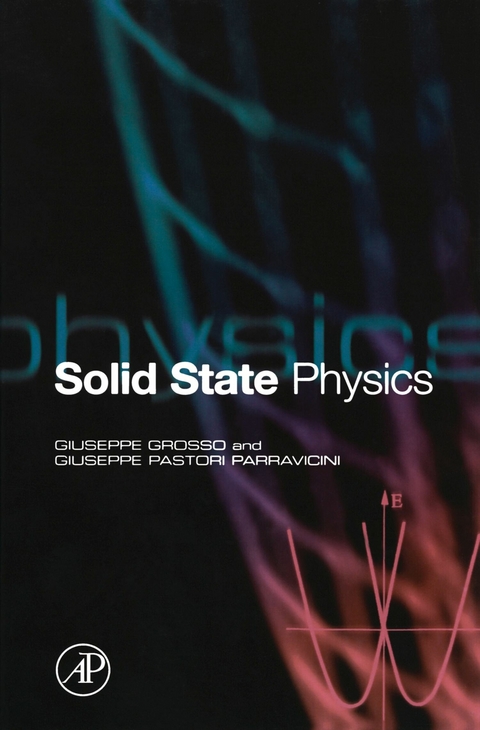
Solid State Physics (eBook)
714 Seiten
Elsevier Science (Verlag)
978-0-08-048102-9 (ISBN)
traditionally taught in solid state courses. This book fills that gap. The style is tutorial, simple, and completely self-contained.
Solid State Physicsexplains to readers the newest advances in the area of condensed matter physics with rigorous, but lucid mathematics. Examples are an integral part of the text, and they are carefully designed to apply the fundamental principles illustrated in the text to currently active topics of research.
Key Features
* Bridges the gap between fundamental principles and active fields of reserch, including explanations of all the latest advances
* Provides an in-depth treatment of current research topics
* Examples are integral to the text and apply fundamental principles to current topics of research
* Both authors have many years of experience of teaching at a variety of levels--undergraduate, post-graduate, tutorial workshops and seminars
Although there are many books published in solid state physics, there is a wide gap between the active field of research and the conceptstraditionally taught in solid state courses. This book fills that gap. The style is tutorial, simple, and completely self-contained. Solid State Physicsexplains to readers the newest advances in the area of condensed matter physics with rigorous, but lucid mathematics. Examples are an integral part of the text, and they are carefully designed to apply the fundamental principles illustrated in the text to currently active topics of research. - Bridges the gap between fundamental principles and active fields of reserch, including explanations of all the latest advances- Provides an in-depth treatment of current research topics- Examples are integral to the text and apply fundamental principles to current topics of research- Both authors have many years of experience of teaching at a variety of levels--undergraduate, post-graduate, tutorial workshops and seminars
Cover 1
Contents 4
Preface 11
Chapter I. Electrons in one-dimensional periodic potentials 14
1 The Bloch theorem for one-dimensional periodicity 15
2 Energy levels in a periodic array of quantum wells 18
3 Electron tunneling and energy bands 21
4 The tight-binding approximation 29
5 Plane waves and nearly free-electron approximation 37
6 Some dynamical aspects of electrons in band theory 42
Further reading 48
Chapter II. Geometrical description of crystals: direct and reciprocal lattices 50
1 Simple lattices and composite lattices 51
2 Geometrical description of some crystal structures 56
3 Wigner-Seitz primitive cells 66
4 Reciprocal lattices 67
5 Brillouin zones 72
6 Translational symmetry and quantum mechanical aspects 75
7 Density-of-states and critical points 83
Further reading 88
Chapter III. The Sommerfeld free-electron theory of metals 90
1 Quantum theory of the free-electron gas 90
2 Fermi-Dirac distribution function and chemical potential 95
3 Electronic specific heat in metals and thermodynamic functions 99
4 Thermionic emission from metals 101
Appendix A. Outline of statistical physics and thermodynamic relations 102
A1. Microcanonical ensemble and thermodynamic quantities 102
A2. Canonical ensemble and thermodynamic quantities 104
A3. Grand canonical ensemble and thermodynamic quantities 106
Appendix B. Fermi–Dirac and Bose–Einstein statistics for independent particles 108
Appendix C. Modified Fermi–Dirac statistics in a model of correlation effects 111
Further reading 113
Chapter IV. The one-electron approximation and beyond 115
1 Introductory remarks on the many-electron problem 116
2 The Hartree equations 117
3 Identical particles and determinantal wavefunctions 119
4 Matrix elements between determinantal states 120
5 The Hartree-Fock equations 123
6 Overview of approaches beyond the one-electron approximation 134
7 Electronic properties and phase diagram of the homogeneous electron gas 135
8 The density functional theory and the Kohn-Sham equations 143
Appendix A. Bielectronic integrals among spin-orbitals 150
Appendix B. Outline of second quantization formalism for identical fermions 151
Appendix C. An integral on the Fermi sphere 154
Further reading 155
Chapter V. Band theory of crystals 156
1 Basic assumptions of the band theory 156
2 The tight-binding method (LCAO method) 158
3 The orthogonalized plane wave (OPW) method 167
4 The pseudopotential method 176
5 The cellular method 182
6 The augmented plane wave (APW) method 184
7 The Green's function method (KKR method) 190
8 Other methods and developments in electronic structure calculations 197
Further reading 209
Chapter VI. Electronic properties of selected crystals 212
1 Band structure and cohesive energy of rare-gas solids 213
2 Electronic properties of ionic crystals 220
3 Covalent crystals with diamond structure 231
4 Band structures and Fermi surfaces of some metals 235
Further reading 241
Chapter VII. Excitons, plasmons and dielectric screening in crystals 243
1 Exciton states in crystals 244
2 Plasmon excitations in crystals 252
3 General considerations on the longitudinal dielectric function 253
4 Static dielectric screening in metals with the Thomas-Fermi model 255
5 Static dielectric screening in metals with the Lindhard model 258
6 Dynamic dielectric screening in metals and plasmon modes 263
7 Quantum expression of the longitudinal dielectric function in materials 267
8 Quantum expression of the longitudinal dielectric function in crystals 272
9 Longitudinal dielectric function and energy-loss of a fast charged particle 275
Appendix A. Lindhard dielectric function for the free-electron gas 276
Further reading 279
Chapter VIII. Interacting electronic–nuclear systems and the adiabatic principle 281
1 Electronic-nuclear systems and adiabatic potential-energy surfaces 282
2 Non-degenerate adiabatic surface and nuclear dynamics 285
3 Degenerate adiabatic surfaces and Jahn–Teller systems 291
4 The Hellmann–Feynman theorem and electronic–nuclear systems 307
5 Parametric Hamiltonians and Berry phase 310
6 Macroscopic electric polarization in crystals and Berry phase 314
Further reading 318
Chapter IX. Lattice dynamics of crystals 320
1 Dynamics of monatomic one-dimensional lattices 321
2 Dynamics of diatomic one-dimensional lattices 325
3 Dynamics of general three-dimensional crystals 328
4 Quantum theory of the harmonic crystal 336
5 Lattice heat capacity. Einstein and Debye models 338
6 Considerations on anharmonic effects and melting of solids 340
7 Optical phonons and polaritons in polar crystals 342
Appendix A. Quantum theory of the Linear harmonic oscillator 357
Further reading 361
Chapter X. Scattering of particles by crystals 362
1 General considerations 362
2 Elastic scattering of X-rays from crystals 365
3 Inelastic scattering of particles and phonon spectra of crystals 376
4 Compton scattering and electron momentum density 381
5 Diffusion of particles by a single elastically-bound scatterer 386
6 Diffusion of particles by a crystal and effects of lattice vibrations 393
7 Mössbauer effect 397
Further reading 400
Chapter XI. Optical and transport properties in metals 402
1 Macroscopic theory of optical constants in homogeneous materials 403
2 The Drude theory of the optical properties of free carriers 408
3 Transport properties and Boltzmann equation 416
4 Static and dynamic conductivity in metals 419
5 Boltzmann treatment and quantum treatment of intraband transitions 426
6 The Boltzmann equation in electric fields and temperature gradients 427
Further reading 437
Chapter XII. Optical properties of semiconductors and insulators 438
1 Quantum expression of the transverse dielectric function in materials 439
2 Quantum theory of band-to-band optical transitions and critical points 446
3 Indirect phonon-assisted transitions 451
4 Two-photon absorption 456
5 Exciton effects on the optical properties 459
6 Fano resonances and absorption lineshapes 465
7 Optical properties of vibronic systems 471
Appendix A. Transitions rates at first and higher orders of perturbation theory 482
Further reading 484
Chapter XIII. Transport in intrinsic and homogeneously doped semiconductors 486
1 Fermi level and carrier density in intrinsic semiconductors 486
2 Impurity levels in semiconductors 491
3 Fermi level and carrier density in doped semiconductors 498
4 Thermionic emission in semiconductors 503
5 Non-equilibrium carrier distributions 504
6 Solutions of typical transport equations in uniformly doped semiconductors 511
Further reading 517
Chapter XIV. Transport in inhomogeneous semiconductors 519
1 Properties of the pn junction at equilibrium 519
2 Current–voltage characteristics of the pn junction 525
3 The bipolar junction transistor 530
4 The junction field-effect transistor (JFET) 533
5 Semiconductor heterojunctions 537
6 Metal–semiconductor contacts and MESFET transistor 540
7 The metal–oxide–semiconductor structure and MOSFET transistor 546
Further reading 554
Chapter XV. Electron gas in magnetic fields 556
1 Magnetization and magnetic susceptibiity 557
2 Energy levels and density-of-states of a free-electron gas in magnetic fields 559
3 Orbital magnetic susceptibility and de Haas–van Alphen effect 567
4 Spin paramagnetism of a free-electron gas 575
5 Magnetoresistivity and classical Hall effect 577
6 The quantum Hall effect 582
Appendix A. Free energy of an electron gas in a uniform magnetic field 587
Appendix B. Generalized orbital magnetic susceptibility of the free-electron gas 592
Further reading 598
Chapter XVI. Magnetic properties of localized systems and Kondo impurities 599
1 Quantum mechanical treatment of magnetic susceptibility 600
2 Magnetic susceptibility of closed-shell systems 602
3 Permanent magnetic dipoles in atoms or ions with partially filled shells 604
4 Paramagnetism of localized magnetic moments 606
5 Localized magnetic states in normal metals 611
6 Dilute magnetic alloys and the resistance minimum phenomenon 615
7 Magnetic impurity in normal metals at very low temperatures 625
Further reading 631
Chapter XVII. Magnetic ordering in crystals 632
1 Ferromagnetism and the Weiss molecular field 633
2 Microscopic origin of the coupling between localized magnetic moments 640
3 Antiferromagnetism in the mean field approximation 648
4 Spin waves and magnons in ferromagnetic crystals 651
5 The Ising model with the transfer matrix method 656
6 The Ising model with the renormalization group theory 660
7 The Stoner–Hubbard itinerant electron model for magnetism 672
Further reading 675
Chapter XVIII. Superconductivity 676
1 Some phenomenolgical aspects of superconductors 677
2 The Cooper pair idea 685
3 Ground state for a superconductor in the BCS theory at zero temperature 691
4 Excited states of superconductors at zero temperature 699
5 Treatment of superconductors at finite temperature and heat capacity 706
6 Diamagnetism of superconductors and Meissner effect 711
7 Macroscopic quantum phenomena 717
8 Cooper pair tunneling between superconductors and Josephson effects 724
Appendix A. The phonon–induced electron-electron interaction 730
Further reading 733
Subject index 735
| Erscheint lt. Verlag | 14.2.2000 |
|---|---|
| Mitarbeit |
Herausgeber (Serie): Giuseppe Grosso |
| Sprache | englisch |
| Themenwelt | Naturwissenschaften ► Physik / Astronomie ► Festkörperphysik |
| Technik ► Maschinenbau | |
| ISBN-10 | 0-08-048102-7 / 0080481027 |
| ISBN-13 | 978-0-08-048102-9 / 9780080481029 |
| Informationen gemäß Produktsicherheitsverordnung (GPSR) | |
| Haben Sie eine Frage zum Produkt? |
 PDF (Adobe DRM)
Kopierschutz: Adobe-DRM
Adobe-DRM ist ein Kopierschutz, der das eBook vor Mißbrauch schützen soll. Dabei wird das eBook bereits beim Download auf Ihre persönliche Adobe-ID autorisiert. Lesen können Sie das eBook dann nur auf den Geräten, welche ebenfalls auf Ihre Adobe-ID registriert sind.
Details zum Adobe-DRM
Dateiformat: PDF (Portable Document Format)
Mit einem festen Seitenlayout eignet sich die PDF besonders für Fachbücher mit Spalten, Tabellen und Abbildungen. Eine PDF kann auf fast allen Geräten angezeigt werden, ist aber für kleine Displays (Smartphone, eReader) nur eingeschränkt geeignet.
Systemvoraussetzungen:
PC/Mac: Mit einem PC oder Mac können Sie dieses eBook lesen. Sie benötigen eine
eReader: Dieses eBook kann mit (fast) allen eBook-Readern gelesen werden. Mit dem amazon-Kindle ist es aber nicht kompatibel.
Smartphone/Tablet: Egal ob Apple oder Android, dieses eBook können Sie lesen. Sie benötigen eine
Geräteliste und zusätzliche Hinweise
Buying eBooks from abroad
For tax law reasons we can sell eBooks just within Germany and Switzerland. Regrettably we cannot fulfill eBook-orders from other countries.
aus dem Bereich