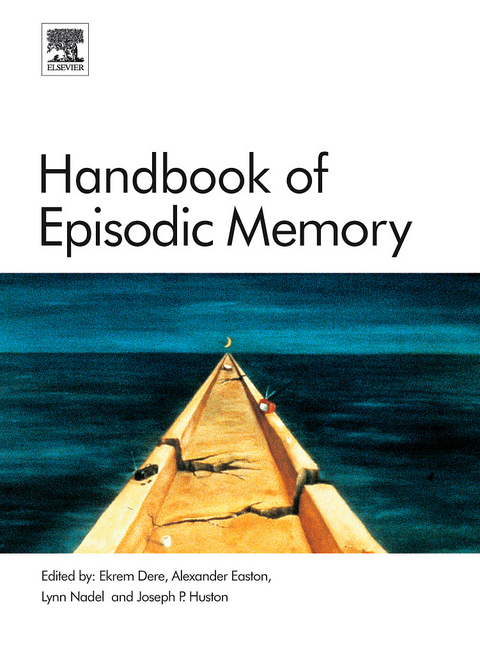
Handbook of Episodic Memory (eBook)
628 Seiten
Elsevier Science (Verlag)
9780080932361 (ISBN)
This book brings together a renowned team of contributors from the fields of cognitive psychology, neuropsychology and behavioural and molecular neuroscience. It provides a detailed and comprehensive overview of recent developments in understanding human episodic memory and animal episodic-like memory in terms of concepts, methods, mechanisms, neurobiology and pathology. The work presented within this book will have a profound effect on the direction that future research in this topic will take.
- The first and most current comprehensive handbook on what we know about episodic memory, the memory of events, time, place, and emotion, and a key feature of awareness and consciousness
- Articles summarize our understanding of the mechanisms of episodic memory as well as surveying the neurobiology of epsidodic memory in patients, animal studies and functional imaging work
- Includes 34 heavily illustrated chapters in two sections by the leading scientists in the field
Episodic memory is the name of the kind of memory that records personal experiences instead of the mere remembering of impersonal facts and rules. This type of memory is extremely sensitive to ageing and disease so an understanding of the mechanisms of episodic memory might lead to the development of therapies suited to improve memory in some patient populations. Episodic memory is unique in that it includes an aspect of self-awareness and helps us to remember who we are in terms of what we did and what we have been passed through and what we should do in the future. This book brings together a renowned team of contributors from the fields of cognitive psychology, neuropsychology and behavioural and molecular neuroscience. It provides a detailed and comprehensive overview of recent developments in understanding human episodic memory and animal episodic-like memory in terms of concepts, methods, mechanisms, neurobiology and pathology. The work presented within this book will have a profound effect on the direction that future research in this topic will take. - The first and most current comprehensive handbook on what we know about episodic memory, the memory of events, time, place, and emotion, and a key feature of awareness and consciousness- Articles summarize our understanding of the mechanisms of episodic memory as well as surveying the neurobiology of epsidodic memory in patients, animal studies and functional imaging work- Includes 34 heavily illustrated chapters in two sections by the leading scientists in the field
Fornt cover 1
Handbook of Episodic Memory 4
Copyright page 5
List of Contributors 6
Preface 10
Contents 12
Part One. Theories and Concepts of Episodic Memory 16
Section 1. Characteristics, Development, and Functions of Episodic Memory 18
Chapter 1.1. Perspectives on episodic and semantic memory retrieval 20
I. MTT: Episodic retrieval and beyond 22
II. Extending MTT from episodic to semantic memory 27
III. Conclusions 30
Acknowledgment 30
References 31
Chapter 1.2. Exploring episodic memory 34
I. Characteristics of episodic memory 34
II. The content of episodic memories 35
III. Functions of episodic memories 36
IV. The brain basis of episodic memory 40
V. Episodic memory: the future 42
Acknowledgment 43
References 43
Chapter 1.3. Episodic memory and mental time travel 46
I. Introduction 46
II. A prospection and memory taxonomy 47
III. Evidence for the Janus hypothesis 48
IV. Defining episodic memory: what-where-when memory versus autonoetic consciousness 49
V. A third approach to episodic memory 51
VI. Animal models and comparisons 53
References 55
Chapter 1.4. Episodic memory: reconsolidation 58
I. Which cues trigger memory reconsolidation and updatingquest 62
II. The special role of context in updating episodic memory 63
III. How animals ‘‘recognize’’ a context 64
IV. What defines a contextquest 66
V. Beyond contexts in memory reconsolidation 66
VI. Other forms of memory updating 67
VIII. The cognitive neuroscience of human episodic memory updating 68
References 69
Chapter 1.5. The attributes of episodic memory processing 72
I. Introduction 72
II. Contemporary viewpoints on the neurobiological basis of episodic memory 73
III. Attribute model of memory 76
IV. Attributes of episodic memory processing 80
V. Tests of the attribute model of episodic memory processing 85
VI. Conclusions 90
Acknowledgments 91
References 91
Chapter 1.6. The cognitive and neural bases of flashbulb memories 96
I. What are flashbulb memoriesquest 96
II. How can we best study FMsquest 97
III. Are FMs more accurate and more durable than everyday memoriesquest 100
IV. What makes a flashbulb memoryquest 101
V. Are flashbulb memories specialquest 105
VI. Future directions 106
Acknowledgments 108
References 108
Chapter 1.7. From the past into the future: the developmental origins and trajectory of episodic future thinking 114
I. Key definitions and distinctions 115
II. Episodic memory development 115
III. From episodic memory to episodic future thinking 117
IV. Reexperiencing our past and preexperiencing our future: similar or different cognitive processesquest 123
V. What factors influence episodic future thinkingquest 125
VI. Future directions 126
VII. Conclusion 126
References 127
Chapter 1.8. Emotion and episodic memory 130
I. Emotion and episodic memory 130
II. Episodic memory defined 131
III. Episodic versus declarative memory 131
IV. Emotions defined 136
V. Research on emotions and episodic memory 138
VI. Conclusion 142
References 143
Section 2. Is Episodic Memory Unique to Humans? 148
Chapter 2.1. The current status of cognitive time travel research in animals 150
I. The current status of cognitive time travel research in animals 150
II. Evidence for episodic-like memory in animals 152
III. The search for episodic-like memory in other species 153
IV. Evidence for anticipation of future events 161
V. The Bischof-Kohler hypothesis 163
VI. What have we learnedquest 166
References 166
Chapter 2.2. Animal episodic memory 170
I. The concept of episodic memory according to Endel Tulving 170
II. An alternative view of episodic memory 171
III. Measurement of human episodic memory 172
IV. Episodic memory in animals 174
V. Metacognition in animals 176
VI. Conscious recollection in animals 177
VII. Temporal ordersolsequence memory in animals 178
VIII. Mental time travel in animals: retrospective memory and prospective cognition 178
IX. Food-rewarded memory for ‘‘what, where, and when’’ in animals 181
X. One-trial ‘‘what, where, and when’’ memory in rodents 184
XI. Reconsidering the criteria for episodic memory in animals 186
XII. The one-trial object recognition paradigm for measuring fractals of episodic memory 187
XIII. Neuronal histamine and episodic memory 192
XIV. Conclusions 193
Acknowledgments 193
References 193
Chapter 2.3. A new working definition of episodic memory: replacing ‘‘when’’ with ‘‘which’’ 200
I. What is episodic memoryquest 200
II. Defining episodic memory beyond the conscious experience 201
III. Animals’ memory for when something happened 203
IV. The importance of time in human episodic memory 203
V. Alternatives to knowing when something happened 204
VI. Applying the memory of ‘‘which occasion’’ to studies of episodic memory in animals 205
VII. Other features of episodic memory: does what-where-which fit the billquest 208
VIII. A new working definition of episodic memory 210
References 210
Chapter 2.4. Episodic-like memory in food-hoarding birds 212
I. Episodic memory as adaptation 212
II. Episodic-like memory in food-hoarding birds 214
III. Conclusions 226
Acknowledgments 227
References 228
Chapter 2.5. Representing past and future events 232
I. Retrospective versus prospective coding processes 233
II. Conclusions regarding prospective versus retrospective coding processes 240
III. Conclusions regarding episodic memory and future planning 247
Acknowledgment 247
References 247
Part Two. The Neurobiology and Neuropathology of Episodic Memory 250
Section 3. The Neuroanatomy of Episodic Memory 252
Chapter 3.1. Functional neuroanatomy of remote, episodic memory 254
I. Historical background 256
II. A challenge to the standard theory: multiple trace theory (MTT) 257
III. Functional neuroanatomy of remote memory according to SMC and MTT: predictions 258
IV. Extrahippocampal contributions to autobiographical memory: lesions and neuroimaging 267
V. Studies with nonhuman animals 270
VI. Overall conclusions 275
Acknowledgment 276
References 277
Chapter 3.2. The medial temporal lobe: visual perception and recognition memory 286
I. Intact visual perception in patients with medial temporal lobe lesions 286
II. The hippocampus mediates both recollection and familiarity 291
III. Conclusion 295
Acknowledgments 295
References 295
Chapter 3.3. Toward a neurobiology of episodic memory 298
I. The hippocampus and features of episodic memory 299
II. Neural representations of episodic memories 309
III. How does episodic memory emerge within the hippocampal memory systemquest 311
IV. Final thoughts 313
References 314
Chapter 3.4. Spatio-temporal context and object recognition memory in rodents 316
I. Recognition memory: returning to the past 317
II. Recognition memory receiver operating characteristics (ROC) in rats 318
III. One-trial spontaneous object recognition memory 319
IV. Context-dependent object recognition memory: a tale of two halvesquest 322
V. Object recognition memory and Alzheimer’s disease pathology in mice 323
VI. Time as a property of memory in animals 324
VII. Context-dependent memory and associative learning 325
VIII. Summary and conclusions 328
Acknowledgments 328
References 328
Chapter 3.5. The role of the prefrontal cortex in episodic memory 332
I. Introduction 332
II. Neural correlates of episodic memory 333
III. The role of the prefrontal cortex in autobiographical memory disorders in patients with organic or dissociative amnesia 344
IV. Conclusion 348
List of abbreviations 349
References 349
Chapter 3.6. The basal forebrain and episodic memory 358
I. Introduction 358
II. Anatomy of the basal forebrain (Figs. 1 and 2) 359
III. Historical review implying a crucial role of the basal forebrain in episodic memory 362
IV. Which structures within or near the basal forebrain are involved in episodic memoryquest 363
V. The role of the basal forebrain in episodic memory 370
VI. Summary 374
Acknowledgments 374
References 374
Chapter 3.7. The role of the precuneus in episodic memory 378
I. Introduction 378
II. Functional anatomy of the precuneus 378
III. Behavioral correlates of the precuneus 381
IV. Precuneus, episodic memory, and consciousness 388
References 389
Chapter 3.8. The multiple roles of dopaminergic neurotransmission in episodic memory 394
I. Pharmacology and functional neuroanatomy of the dopaminergic system 394
II. Dopaminergic modulation of hippocampal plasticity in vitro and in vivo 395
III. The mesolimbic reward system and hippocampus-dependent memory 397
IV. A hippocampus-dependent dopaminergic novelty signal 399
V. Pharmacological studies on dopamine and human episodic memory 400
VI. Genetics of the dopamine system and episodic memory 401
VII. Beyond the hippocampus: dopaminergic modulation of complex memories in neocortex 403
VIII. Clinical implications 404
IX. Conclusions and perspectives 406
Acknowledgments 406
References 406
Section 4. The Cellular and Molecular Correlates of Episodic Memory 412
Chapter 4.1. Neural coding of episodic memory 414
I. Introduction: seeking the neural code 414
II. Brief history of memory research 416
III. In search of memory traces 417
IV. Visualizing network-level memory traces 418
V. Identification of neural cliques as real-time memory coding units 422
VI. Hierarchical and categorical organization of memory-encoding neural clique assemblies 423
VII. Universal activation codes for the brain’s real-time neural representations across individuals and species 426
Acknowledgments 429
References 429
Chapter 4.2. The primate hippocampus and episodic memory 432
I. Introduction 432
II. Systems-level functions of the primate hippocampus 433
III. The operation of hippocampal circuitry as a memory system 440
IV. Discussion 448
Acknowledgments 449
References 449
Chapter 4.3. Hippocampal neuronal activity and episodic memory 454
I. Introduction 454
II. Hippocampal unit activity related to components of episodic memory 457
III. Conclusions and some remaining issues 473
References 475
Chapter 4.4. The hippocampus, context processing and episodic memory 480
I. Introduction 480
II. The hippocampal role in context processing 481
III. The hippocampal role in context-specific discrimination learning 482
IV. What kinds of ‘‘context’’ does the hippocampus encodequest 484
V. Neurophysiological evidence of hippocampal context processing 485
VI. Hippocampal inactivation impairs contextual learning 486
VII. Place fields are part of a context representation 488
VIII. Could episodic memory impairments result from context processing deficitsquest 488
IX. Hippocampal neuronal responses differentiate contexts but not episodic memories of individual trials 489
X. The problem of identifying neurophysiological mechanisms of episodic memory 490
XI. A hierarchical coding scheme for context differentiation 492
XII. Concluding remarks 493
References 494
Section 5. The Effects of Aging and Disease on Episodic Memory 498
Chapter 5.1. Memory and perceptual impairments in amnesia and dementia 500
I. The role of medial temporal lobe structures in memory 500
II. Is human MTL specialized for declarative memoryquest 501
III. Do these impairments in perception transfer to memoryquest 508
IV. Beyond long-term declarative memoryquest 510
Acknowledgments 511
References 511
Chapter 5.2. Using hippocampal amnesia to understand the neural basis of diencephalic amnesia 518
I. Introduction 518
II. Are the core features of diencephalic amnesia and medial temporal lobe amnesia differentquest 520
III. Is damage to the fiber tracts directly linking the hippocampus with the medial diencephalon sufficient to cause anterograde amnesiaquest 521
IV. What connections are conveyed by the fornixquest 524
V. Is it possible to determine which of the many connections within the fornix are the most critical for episodic memoryquest 527
VI. What are the implications of these findings for our understanding of diencephalic amnesiaquest 529
Acknowledgments 530
References 530
Chapter 5.3. Structure-function correlates of episodic memory in aging 536
I. Introduction 536
II. Measures of episodic-memory performance in aging 537
III. Age-related structural changes in the brain 538
IV.Episodic memory and aging: evidence from functional neuroimaging 541
V. Structure-function correlates of longitudinal changes in episodic-memory performance 544
VI. Summary and future directions 546
References 547
Chapter 5.4. Memory and cognitive performance in preclinical Alzheimer’s disease and preclinical vascular disease 552
I. Prevalence of Alzheimer’s disease and vascular dementia 553
II. Cognitive performance as a marker of preclinical AD 553
III. Cognitive performance as a marker of preclinical VaD 556
IV. Change in cognitive performance in preclinical dementia 558
V. Avenues for future research 561
VI. Summary 562
Acknowledgments 562
References 562
Chapter 5.5. Transgenic mouse models of Alzheimer’s disease and episodic-like memory 568
I. Introduction 568
II. Transgenic models of Alzheimer’s disease 569
III. Reference (trial-independent) memory in APP transgenic mice 570
IV. Episodic-like and working memory in APP transgenic mice 574
V. Conclusions 583
References 584
Chapter 5.6. Episodic memory in the context of cognitive control dysfunction: the case of Huntington’s disease 590
I. The cognitive profile of HD 591
II. HD and multiple learning systems 593
III. Preclinical memory deficit: when do problems startquest 593
IV. Episodic memory and behavior in HD 594
References 594
Chapter 5.7. Adrenal steroids and episodic memory: relevance to mood disorders 600
I. Introduction 600
II. Adrenal steroids and depression 601
III. Adrenal steroids and memory 601
IV. Depression and episodic memory 604
V. Conclusion 605
List of abbreviations 605
Acknowledgments 605
References 605
Subject Index 612
Color Plate Section 632
Chapter 1.1 Perspectives on episodic and semantic memory retrieval
Lee Ryan, Siobhan Hoscheidt, Lynn Nadel*
Department of Psychology and McKnight Brain Institute, University of Arizona, Tucson, AZ, USA
* Corresponding author.
E-mail address: nadel@u.arizona.edu
Abstract
Episodic or autobiographical recollection involves re-experiencing a past event that is specific in time and place, while semantic recollection is concerned with facts and general knowledge about the world. Several prominent memory theories posit that the hippocampus differentiates between these two types of memories, mediating episodic, but not semantic, retrieval. In this chapter we explore a different view of hippocampus, one that emphasizes a singular response of the hippocampus during memory encoding and retrieval of both episodic and semantic memories, based on an amalgam of two existing theories of hippocampal function, multiple trace theory (MTT; Nadel & Moscovitch, 1997), and cognitive map theory (O'Keefe & Nadel, 1978). We review neuropsychological and neuroimaging literature suggesting that both semantic and episodic memory retrieval engages the hippocampus, at least within the normally functioning brain. We then describe an updated version of MTT that incorporates these new findings. Finally, we explore the notion that differences in the role the hippocampus plays in these forms of memory reflect two critical factors - the nature of the information being retrieved, and the requirements of the retrieval task.
Episodic and semantic memory seem, at least phenomenologically, quite different from one another. Episodic or autobiographical recollection involves thinking about a past event – it is personal, emotional, populated with players and specific places, imbued with detail, and it often has relevance to our sense of self and the meaning of our lives. Semantic recollection, on the other hand, has to do with knowledge – it is factual, and typically devoid of emotion or reference to time, place, and self. While semantic knowledge conveys meanings, it is rarely the kind of personal meaning embodied in autobiographical and episodic memories. This distinction, as outlined by Tulving (1983), focused originally on the different types of information processed by the two systems, unique spatial-temporal contexts for episodic memory, and facts and concepts for semantic memory. More recently, Tulving (2002, 2005) has emphasized that the critical distinction is not so much the type of information being processed, but instead that episodic memory allows the rememberer to have the conscious experience, or autonoesis, of being mentally present once again within the spatial-temporal context of the original experience – the phenomenal experience of remembering. Of course, this ability presupposes that the individual can retrieve the spatial-temporal context in which the to-be-remembered event occurred. Thus, spatial-temporal context remains a critical component of episodic memory.
Given the significant differences across these two memory types, it is not unreasonable to assume that they are mediated by separate and relatively independent systems, not only at the level of cognition, but also the brain. This idea was bolstered early on by the finding that amnesia resulting from damage to the medial temporal lobe (MTL) combined severe deficits in episodic memory retrieval with an apparent ability to access previously acquired world knowledge, facts, and skills. Given the brain damage observed in H.M. and other MTL amnesics, it seemed plausible that the hippocampus differentiated between these two types of memories, mediating episodic, but not semantic, retrieval.
The hippocampal role in retrieval has traditionally been viewed as temporary, lasting only until a process of memory consolidation (cf., McGaugh, 2002) transferred responsibility for retrieval to extrahippocampal (presumably neocortical) circuits. This has become known as the standard theory of consolidation (Squire, 1992). A more recent alternative view, multiple trace theory (MTT; Nadel and Moscovitch, 1997, 1998) addressed the question of what happens to episodic memories over time and, in contrast to standard consolidation theory, postulated an ongoing role of hippocampus in autobiographical memory retrieval. Based on an extensive review of the amnesia literature, MTT proposed that episodic memory retrieval would elicit a new encoding, leading to an expanded representation of that memory within the hippocampus itself. Early computational models suggested that such an assumption could plausibly account for the facts of retrograde amnesia (e.g., Nadel et al., 2000).
The debate over whether the hippocampus is utilized in retrieval of well-consolidated episodic memories has been largely resolved. fMRI studies have shown repeatedly, and in various ways, that even very remote event memories activate the hippocampus. Neuroimaging studies have shown consistent activation in MTL structures during retrieval of recent and very remote autobiographical memories (Ryan et al., 2001; Maguire et al., 2001a; Gilboa et al., 2004; Rekkas and Constable, 2005). Even those studies reporting a time-dependent gradient have shown that the activity appears to be related to aspects of the memories such as vividness or the amount of detail retrieved, rather than how recently the event was experienced (Addis et al., 2004) Additionally, it appears that amnesics are not normal in autobiographical memory retrieval for very old events as was once assumed (Cipolotti et al., 2001; Steinvorth et al., 2005; but see Kirwan et al., 2008). Although they may be able to access the general facts of a particular past event (e.g., that their wedding happened in 1972 in Toronto), their recollections are generally sparse and lacking in detail; they are unable to reconstruct a cohesive description of these types of events that normal individuals would produce naturally (Moscovitch et al., 2006). And, consistent with Tulving's (1983, 2005) predictions, they appear equally unable to imagine themselves within the context of a future event (Klein et al., 2002; Hassabis et al., 2007). The preponderance of evidence supports the view that the hippocampus plays a lasting role in the retrieval of episodic memories (see the chapter by Moscovitch et al., this volume, for further discussion of issues surrounding episodic memory consolidation).
In contrast, debate continues regarding whether the hippocampus is critical for the retrieval of semantic memories, including personal semantics and world knowledge. Much of the evidence on both sides of this debate comes from patients with MTL damage. Squire and others (Squire and Zola, 1998; Lou and Niki, 2002; Manns et al., 2003; Squire et al., 2004) emphasize that at least some amnesics appear to have significant deficits in semantic memory retrieval, even for well-established world knowledge. However, semantic memory impairment tends to be extensive only when the damage extends beyond the hippocampus to other MTL and neocortical structures (Schmolck et al., 2002) and can reach the same level of deficit as autobiographical memory loss, or even exceed it, in some patients (Bayley et al., 2003; Bayley and Squire, 2005). Alternatively, a recent review of the patient literature (Moscovitch et al., 2006) concluded that retrograde amnesia for semantic memory is either spared completely or confined to a period of about 10 years prior to the head injury, providing that the damage is limited primarily to the hippocampal formation.
While the extent of hippocampal involvement in retrieval remains controversial, there is little doubt that acquisition of new episodic and semantic memories is impaired by damage to the hippocampus, at least when the injury is acquired in adulthood. Anterograde amnesia remains a defining feature of the amnesic disorder (Milner, 2005; Keane and Verfaellie, 2006). Cases of developmental amnesia caused by hippocampal damage early in life are interesting because of the remarkable amount of semantic information that these individuals acquire despite profound deficits in episodic memory (de Haan et al., 2006), although their acquisition of new knowledge is not completely normal (Vicari et al., 2007). Adult-onset amnesics too can learn new semantic information, but it is clearly a very inefficient learning process and the resulting knowledge is inflexible and does not easily generalize to other contexts (Baddeley and Wilson, 1986; Glisky et al., 1986; Wilson and Baddeley, 1988). Thus, the hippocampus appears to play an important role in the acquisition, but not retrieval, of semantic memories, while participating in both the acquisition of new episodes and their subsequent retrieval throughout the lifetime of the rememberer.
In this chapter we explore a different view of hippocampus, one that emphasizes a singular response of the hippocampus during memory encoding and retrieval of both episodic and semantic memories. This view is an amalgam of fundamental assumptions drawn from cognitive map theory (CMT; O’Keefe and Nadel, 1978), and MTT (Nadel and Moscovitch, 1997). CMT assumes that the hippocampus is preferentially involved in the processing of spatial contexts and spatial relations. MTT assumes that inputs to the MTL automatically engage hippocampal networks, whether the information involved is semantic or episodic, resulting in activation in cortical networks related to the input. While CMT...
| Erscheint lt. Verlag | 4.9.2008 |
|---|---|
| Sprache | englisch |
| Themenwelt | Geisteswissenschaften ► Psychologie ► Allgemeine Psychologie |
| Geisteswissenschaften ► Psychologie ► Biopsychologie / Neurowissenschaften | |
| Geisteswissenschaften ► Psychologie ► Verhaltenstherapie | |
| Medizin / Pharmazie ► Medizinische Fachgebiete ► Neurologie | |
| Naturwissenschaften ► Biologie ► Humanbiologie | |
| Naturwissenschaften ► Biologie ► Zoologie | |
| ISBN-13 | 9780080932361 / 9780080932361 |
| Informationen gemäß Produktsicherheitsverordnung (GPSR) | |
| Haben Sie eine Frage zum Produkt? |
 EPUB (Adobe DRM)
Kopierschutz: Adobe-DRM
Adobe-DRM ist ein Kopierschutz, der das eBook vor Mißbrauch schützen soll. Dabei wird das eBook bereits beim Download auf Ihre persönliche Adobe-ID autorisiert. Lesen können Sie das eBook dann nur auf den Geräten, welche ebenfalls auf Ihre Adobe-ID registriert sind.
Details zum Adobe-DRM
Dateiformat: EPUB (Electronic Publication)
EPUB ist ein offener Standard für eBooks und eignet sich besonders zur Darstellung von Belletristik und Sachbüchern. Der Fließtext wird dynamisch an die Display- und Schriftgröße angepasst. Auch für mobile Lesegeräte ist EPUB daher gut geeignet.
Systemvoraussetzungen:
PC/Mac: Mit einem PC oder Mac können Sie dieses eBook lesen. Sie benötigen eine
eReader: Dieses eBook kann mit (fast) allen eBook-Readern gelesen werden. Mit dem amazon-Kindle ist es aber nicht kompatibel.
Smartphone/Tablet: Egal ob Apple oder Android, dieses eBook können Sie lesen. Sie benötigen eine
Geräteliste und zusätzliche Hinweise
Buying eBooks from abroad
For tax law reasons we can sell eBooks just within Germany and Switzerland. Regrettably we cannot fulfill eBook-orders from other countries.
aus dem Bereich