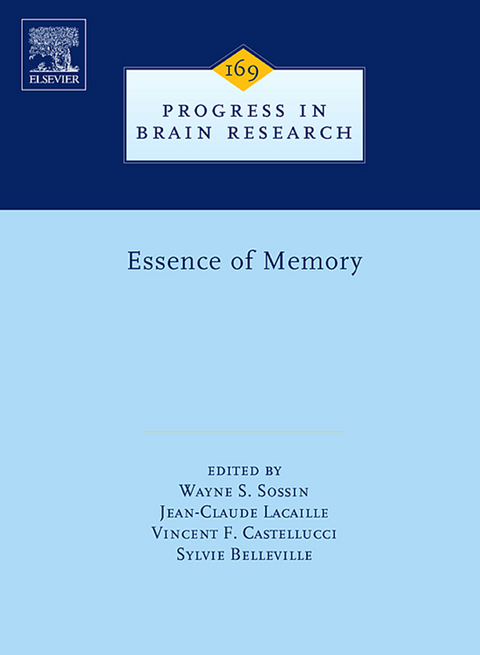
Essence of Memory (eBook)
450 Seiten
Elsevier Science (Verlag)
9780080932330 (ISBN)
* Provides an unique overview that covers all perspectives and methodological approaches to memory
* Broad coverage of memory research from molecular to human studies in one source
* Up-to-date reviews give the latest important ideas on memory formation
This selection of reviews gives an up-to-date picture of memory research. Great progress has been made in identifying the memory trace at the molecular and cellular level and individual reviews address the major mechanisms by which changes in synaptic strength can persist. Exciting research at the systems level is also reviewed including the growing importance of changes in inhibitory interneurons and how they play a role in memory formation. Finally, reviews present cognitive and neurobiological models of human memory that explain, characterize and organize the act of memory within a coherent framework. - Provides an unique overview that covers all perspectives and methodological approaches to memory- Broad coverage of memory research from molecular to human studies in one source- Up-to-date reviews give the latest important ideas on memory formation
Front Cover 1
Copyright page 5
Essence of Memory 4
List of contributors 6
Preface 10
Contents 12
Section I. Cellular and Molecular Approaches to the Essence of memory 16
Chapter 1. Molecular memory traces 18
Introduction 18
What types of cellular changes underlie memory formation? 20
Molecular memory can be dissociated into temporal phases 22
Protein-synthesis/gene-expression-dependent memory 28
Conclusions 34
Abbreviations 34
Acknowledgments 34
References 35
Chapter 2. PKMzeta, LTP maintenance, and the dynamic molecular biology of memory storage 42
The discovery of PKMzeta 43
PKMzeta is synthesized from a PKMzeta mRNA 44
PKMzeta synthesis is regulated by other protein kinases in LTP induction 46
PKMzeta potentiates postsynaptic AMPA receptor responses 46
PKMzeta maintains late-LTP 48
PKMzeta maintains potentiation after synaptic tagging 49
PKMzeta maintains long-term spatial memory storage in the hippocampus 50
PKMzeta maintains long-term associative memory storage in the neocortex 51
Conclusions 51
References 52
Chapter 3. Understanding the importance of mRNA transport in memory 56
Introduction 56
mRNA transport in neurons is a dynamic and active mechanism 57
The mechanisms of mRNA transport 58
The molecular components of RNA granules 62
The relevance of mRNA transport in memory 66
Conclusions 68
Abbreviations 68
References 68
Chapter 4. Cap-dependent translation initiation and memory 74
Regulation of translation 74
Localization of translation in the neuron 78
Activity-induced regulation of translation initiation machinery 80
Lessons learned from the 4E-BP2 knockout mouse 84
Translation regulation and disease 89
Future directions 90
Acknowledgments 92
References 92
Chapter 5. Translational control of gene expression: a molecular switch for memory storage 96
Overview of translation initiation in eukaryotes 96
Pharmacologic evidence that translation regulates long-term synaptic plasticity and memory 101
Genetic evidence that translation regulates long-—term synaptic plasticity and memory 102
GCN2 in the brain regulates selection of balanced diet 104
A master switch for the conversion from short-term to long-term synaptic plasticity and memory formation 104
Summary 107
Acknowledgments 107
References 108
Chapter 6. Regulation of hippocampus-dependent memory by cyclic AMP-dependent protein kinase 112
Introduction 112
cAMP-dependent protein kinase (PKA) 114
Properties of memory 114
The role of the cAMP/PKA system in spatial memory 115
The role of the cAMP/PKA system in contextual conditioning 116
The cAMP/PKA pathway as a target of cognition-enhancing drugs 118
Synaptic tagging 118
Downstream substrates for PKA in synaptic plasticity and memory storage 119
The role of PKA in shaping the essence of memory 123
Acknowledgments 124
References 124
Chapter 7. Synaptic tagging’ and ’cross-tagging’ and related associative reinforcement processes of functional plasticity as the cellular basis for memory formation 132
LTP and LTD as elementary cellular memory models 133
Consolidation of LTP and LTD: requirement for protein synthesis 134
Consolidation of LTP/LTD: role for transcription? 136
LTP/LTD-induction by glutamate receptors 138
Non-glutamatergic, neuromodulatory and ‘‘reinforcing’’ transmitters required for late plasticity events 138
Phases of LTP and LTD 139
Input-specificity of late-LTP/LTD via ’synaptic tagging’ and by associative properties 140
Identifying molecules mediating synaptic tags and the identity of PRPs within functional compartments 142
Late-associative properties of LTP and LTD: restriction of associative properties to neuronal compartments 145
Physiological, structural and behavioural reinforcement of early-plasticity events by activation of neuromodulatory inputs 146
Structural reinforcement: identifying modulatory brain structures 148
Behavioural reinforcement: identification of content and interaction of modulatory brain structures 149
Concept of ’cellular memory formation’ 150
Abbreviations 154
Acknowledgements 154
References 154
Chapter 8. Synaptic plasticity in learning and memory: stress effects in the hippocampus 160
Introduction: synaptic plasticity, learning, and memory 160
Mechanisms underlying synaptic plasticity in the hippocampus 161
Acute stress 163
Conclusion 169
Abbreviations 169
Acknowledgments 169
References 169
Chapter 9. The role of the GluR-A (GluR1) AMPA receptor subunit in learning and memory 174
Introduction 174
The hippocampus and spatial memory 175
AMPA receptors and hippocampus-dependent spatial memory 176
GluR-A knockout mice 177
Spatial reference memory is GluR-A-independent 177
Spatial working memory is GluR-A-dependent 178
Spatial working memory on the T-maze 179
Genetic rescue of GluR-A-dependent spatial working memory 180
GluR-A and performance on conditional learning tasks 181
Non-spatial hippocampus-dependent tasks 181
NMDA receptors, LTP and spatial memory 183
NMDAR mutants and spatial memory 183
Dentate-gyrus-specific NR1 knockout selectively impairs spatial working memory 184
Is the spatial working memory impairment in GluR-A-/- mice related to frontal or hippocampal processing deficits? 184
Understanding the psychological basis of the impairment in GluR-A-/- mice 185
Are GluR-A-/- mice more susceptible to proactive interference? 186
Two separable forms of hippocampal-dependent, spatial information processing 187
Hippocampal GluR-A and priming in short-term memory 188
Conclusions 190
References 190
Chapter 10. Synaptic remodeling, synaptic growth and the storage of long-term memory in Aplysia 194
Introduction 194
Functional architecture of the synapse 195
Synaptic plasticity and memory storage 196
Growth of new sensory neuron synapses and the persistence of long-term sensitization 197
Time-lapse imaging reveals LTF is associated with presynaptic activation of silent synapses and growth of new functional synapses 201
Remodeling of the presynaptic actin network for learning-related synaptic growth requires activation of Cdc42-mediated signaling pathways 204
5-HT-induced internalization of apCAM: a preliminary and permissive step for initiation of learning-related synaptic growth 205
Nuclear translocation of apCAM-associated protein (CAMAP) activates presynaptic gene transcription for induction of LTF 207
An overall view 208
Conclusions 209
Acknowledgments 210
References 210
Chapter 11. Spine dynamics and synapse remodeling during LTP and memory processes 214
Introduction 214
Morphological changes associated to synaptic plasticity 215
Morphological remodeling of activated spines 216
Synaptogenesis associated to plasticity 216
Mechanisms of plasticity-induced synaptogenesis 217
Spine turnover and synapse formation mechanisms 218
Memory and synapse formation mechanisms 219
Conclusion 220
Acknowledgment 220
References 220
Section II. Systems Approaches to the Essence of Memory 224
Chapter 12. The age of plasticity: developmental regulation of synaptic plasticity in neocortical microcircuits 226
Plasticity and circuit excitability 227
Plasticity in the visual system 228
Experience-dependent plasticity in the absence of competition 228
Pre-critical period plasticity within layer 4 229
Developmental changes in synaptic properties within cortical layer 4 232
Critical period plasticity within cortical layer 4 234
Experience-dependent rewiring is regulated by cortical development 235
Is homeostatic plasticity still induced during the critical period? 236
References 236
Chapter 13. Differential mechanisms of transmission and plasticity at mossy fiber synapses 240
Anatomy of the granule cell mossy fiber axon 240
Basic properties of mossy fiber-inhibitory interneuron transmission 243
Two types of AMPA/NMDAR populate mossy fiber-interneuron synapses 243
Mossy fiber-inhibitory interneuron plasticity 246
mGluR7 functions as a trigger for bidirectional plasticity at the mossy fiber-interneuron synapses 250
Implications for the mossy fiber-CA3 circuit 252
Acknowledgment 254
References 254
Chapter 14. Long-term synaptic plasticity in hippocampal feedback inhibitory networks 256
Different local circuit inhibitory networks in the hippocampus 257
Afferent specific mechanisms of transmission 258
Afferent-specific short-term synaptic plasticity 258
Long-term plasticity 259
Consequences of plasticity in interneurons 261
Conclusions 262
Abbreviations 263
Acknowledgments 263
References 263
Chapter 15. Persistent neural activity in the prefrontal cortex: a mechanism by which BDNF regulates working memory? 266
Introduction: working memory and persistent neuronal firing 266
Persistent activity and its regulation 267
Possible roles of BDNF in the PFC: from working memory to persistent neural activity 271
Conclusions 275
Abbreviations 276
Acknowledgment 276
References 276
Section III. Animal Approaches to the Essence of Memory 282
Chapter 16. Animal models and behaviour: their importance for the study of memory 284
Why use animal models to begin with? 284
Which animal models? 285
Future challenges for animal models: the case of the Aplysia experimental model 286
Conclusion 288
Abbreviations 289
Acknowledgement 289
References 289
Chapter 17. New tricks for an old slug: the critical role of postsynaptic mechanisms in learning and memory in Aplysia 292
Introduction 292
Different phases of memory in Aplysia 294
Mechanisms of learning-related synaptic facilitation in Aplysia 296
Conclusions 302
References 303
Chapter 18. Olfactory memory traces in Drosophila 308
Introduction 308
Olfactory-processing circuit in Drosophila 310
Short-term memory traces 311
Intermediate-term memory traces 312
Another MB extrinsic memory trace 314
Long-term memory traces 315
Concluding thoughts and future considerations 316
Abbreviations 317
Acknowledgments 318
References 318
Chapter 19. Associative learning signals in the brain 320
Introduction 320
Associative learning in the medial temporal lobe 321
Associative learning in motor regions of the frontal lobe 328
Associative learning in the prefrontal cortex 328
Associative learning in the striatum 329
Discussion 330
Conclusion 333
Acknowledgments 333
References 333
Section IV. Human Approaches to the Essence of Memory 336
Chapter 20. What are the differences between long-term, short-term, and working memory? 338
Historical roots of a basic scientific question 338
Description of three kinds of memory 339
The short-term memory/long-term memory distinction 341
Duration limits 341
Conclusion 350
Acknowledgment 351
References 351
Chapter 21. Encoding-retrieval overlap in human episodic memory: a functional neuroimaging perspective 354
Introduction 354
Transfer-appropriate processing 355
Cortical reinstatement and episodic retrieval 355
The complementary nature of TAP and reinstatement theory 356
Empirical findings 358
Concluding comments 365
Acknowledgments 365
References 365
Chapter 22. Cognitive aging and increased distractibility: costs and potential benefits 368
Disruptive effects of distraction 369
Fortuitous effects of distraction 374
Conclusion 377
Acknowledgments 378
References 378
Chapter 23. Characterizing the memory changes in persons with mild cognitive impairment 380
Episodic memory in mild cognitive impairment 381
Working memory in MCI 384
Natural history of MCI 386
Conclusion 387
Abbreviations 388
Acknowledgments 388
References 388
Chapter 24. Aging, metamemory regulation and executive functioning 392
Metacognition and metamemory regulation 393
Evaluation of metamemory regulation processes 393
Metamemory and frontal executive function 394
Executive decline hypothesis of memory and metamemory in aging 395
Aging, metamemory regulation, and executive functioning 396
Concluding remarks and future research 403
Acknowledgment 405
References 405
Chapter 25. Cognitive neuroscience studies of semantic memory in Alzheimer’s disease 408
Introduction 408
Assessing semantic loss 409
Effortful semantic memory deteriorates early on in Alzheimer’s disease 410
Localization of semantic memory may explain its breakdown in Alzheimer’s disease 412
Category-specific semantic memory loss in Alzheimer’s disease 413
Further studies of category effects 415
Brain imaging to elucidate category effects in semantic memory 416
What causes category effects? 417
Summary and conclusions 419
Acknowledgment 419
References 420
Chapter 26. The effects of surgery and anesthesia on memory and cognition 424
Introduction 424
Incidence of POCD 425
The issue of late POCD 426
Methodological issues in the study of POCD 427
Patient-related factors 428
The role of surgery and anesthesia in POCD 429
Inflammation and POCD pathogenesis 429
Animal models and POCD 431
Conclusion 432
Abbreviations 433
Acknowledgments 433
References 433
Subject index 438
Color Plate Section 440
| Erscheint lt. Verlag | 28.4.2008 |
|---|---|
| Sprache | englisch |
| Themenwelt | Geisteswissenschaften ► Psychologie ► Allgemeine Psychologie |
| Geisteswissenschaften ► Psychologie ► Biopsychologie / Neurowissenschaften | |
| Geisteswissenschaften ► Psychologie ► Verhaltenstherapie | |
| Naturwissenschaften ► Biologie ► Humanbiologie | |
| Naturwissenschaften ► Biologie ► Zoologie | |
| ISBN-13 | 9780080932330 / 9780080932330 |
| Informationen gemäß Produktsicherheitsverordnung (GPSR) | |
| Haben Sie eine Frage zum Produkt? |
 PDF (Adobe DRM)
Kopierschutz: Adobe-DRM
Adobe-DRM ist ein Kopierschutz, der das eBook vor Mißbrauch schützen soll. Dabei wird das eBook bereits beim Download auf Ihre persönliche Adobe-ID autorisiert. Lesen können Sie das eBook dann nur auf den Geräten, welche ebenfalls auf Ihre Adobe-ID registriert sind.
Details zum Adobe-DRM
Dateiformat: PDF (Portable Document Format)
Mit einem festen Seitenlayout eignet sich die PDF besonders für Fachbücher mit Spalten, Tabellen und Abbildungen. Eine PDF kann auf fast allen Geräten angezeigt werden, ist aber für kleine Displays (Smartphone, eReader) nur eingeschränkt geeignet.
Systemvoraussetzungen:
PC/Mac: Mit einem PC oder Mac können Sie dieses eBook lesen. Sie benötigen eine
eReader: Dieses eBook kann mit (fast) allen eBook-Readern gelesen werden. Mit dem amazon-Kindle ist es aber nicht kompatibel.
Smartphone/Tablet: Egal ob Apple oder Android, dieses eBook können Sie lesen. Sie benötigen eine
Geräteliste und zusätzliche Hinweise
Buying eBooks from abroad
For tax law reasons we can sell eBooks just within Germany and Switzerland. Regrettably we cannot fulfill eBook-orders from other countries.
aus dem Bereich