


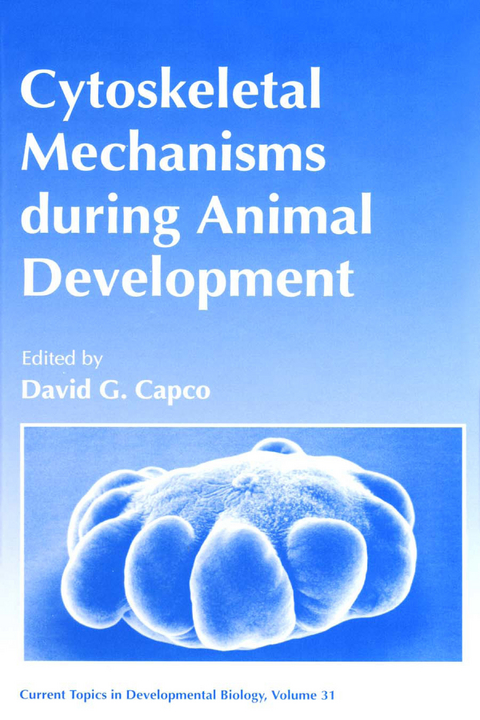
Cytoskeletal Mechanisms During Animal Development (eBook)
501 Seiten
Elsevier Science (Verlag)
978-0-08-058454-6 (ISBN)
The cytoskeleton is central to cell biology and is instrumental in developmental events. Volume 31 is divided into two major sections: nonchordate development and chordate development. Summaries of each section compare evolutionary conservation among organisms.
Front Cover 1
Cytoskeletal Mechanisms during Animal Development 4
Copyright Page 5
Contents 6
Contributors 12
Notice 14
Introduction 16
Preface to Section I: Nonchordates 20
Section I: Cytoskeletal Mechanisms in Nonchordate Development 22
Chapter 1. Cytoskeleton, Cellular Signals, and Cytoplasmic localization in Chaetopterus Embryos 24
I. Introduction 24
II. Cytoplasmic Localization 27
III. Cytoskeleton 35
IV. Cellular Signals Leading to Cytoskeletal Reorganization after Fertilization 44
V. Summary and Future Prospects 48
Appendix: Methods for Obtaining and Using Eggs and Embryos in Studies of the Cytoskeleton and Early Development 50
References 54
Chapter 2. Cytoskeleton and Ctenophore Development 60
I. Introduction to Ctenophores 60
II. Features of the Cytoplasm 65
III. Cell Biology of Early Developmental Events 66
IV. Concluding Remarks 75
Appendix: Methods 77
References 80
Chapter 3. Sea Urchin Microtubules 84
I. Introduction 84
II. Microtubule Organization 85
III. Biochemistry and Molecular Biology of Microtubule Components 88
IV. Regulation of Microtubule Assembly Dynamics 96
V. Role of Microtubules in Translational Regulation and Cytoplasmic Localization 98
VI. Prospects for the Future 102
Appendix: Methods 103
References 108
Chapter 4. Actin–Membrane Cytoskeletal Dynamics in Early Sea Urchin Development 120
I. Introduction 120
II. Sea Urchin Egg Fertilization: Physiological Activation 121
III. Sea Urchin Egg Fertilization: Actin Cytoskeletal Dynamics 123
IV. Sea Urchin Egg: Actin-Binding Proteins 126
V. Cortical Actin–Membrane Cytoskeletal Dynamics during Early Embryogenesis 134
VI. Concluding Remarks 142
VII. Appendix: Sea Urchin Egg and Embryo Methods 142
References 150
Chpter 5. RNA Localization and the Cytoskeleton in Drosophila Oocytes 158
I. Introduction 158
II. Oogenesis in Drosophila 159
III. Localization of Developmental Determinants 162
IV. The Connection between the Cytoskeleton and Positional Information 169
V. Toward a General Model for RNA Localization in Drosophila? 172
VI. Conclusions 178
VII. Appendix: Methods 179
References 183
Chapter 6. Role of the Actin Cytoskeleton in Early Drosophila Development 186
I. Introduction and Overview 186
II. Studies of Actin-Binding Protein Function 194
III. Conclusions and Future Prospects 207
Appendix: Methods for Drosophila Embryo Fixation for Immunofluorescence 208
References 212
Chapter 7. Role of the Cytoskeleton in the Generation of Spatial Patterns in Tubifex Eggs 216
I. Introduction 216
II. Early Development in Tubifex 217
III. Reorganization of Cortical F-Actin upon Activation 219
IV. Establishment of Bipolar Organization of Cortical F-Actin 221
V. Developmental Role of Cortical Actin Cytoskeleton 223
VI. Polar Cortical Actin Lattice during Early Cleavage 240
VII. Developmental Role of Subcortical Actin Cytoskeleton 242
VIII. Role of Centrosomes and Cortex in Generating Cleavage Patterns 244
IX. Concluding Remarks 248
Appendix: Methods 249
References 251
Preface to Section II: Chordates 256
Section II: Cytoskeletal Mechanisms in Chordate Development 260
Chapter 8. Development and Evolution of an Egg Cytoskeletal Domain in Ascidians 262
I. Introduction 262
II. Ascidian Development 263
III. Control of Development 267
IV. The Myoplasmic Cytoskeletal Domain 268
V. Evolutionary Changes in Development 278
VI. Evolutionary Changes in the Myoplasmic Cytoskeletal Domain 281
VII. Role of the Myoplasmic Cytoskeletal Domain in Anural Development 285
VIII. Conclusions and Prospectus 288
Appendix: Methods for Studying the Ascidian Egg Cytoskeleton 291
References 294
Chapter 9. Remodeling of the Specialized Intermediate Filament Network in Mammalian Eggs and Embryos during Development: Regulation by Protein Kinase C and Protein Kinase M 298
I. Introduction 298
II. Specialized Organization of the Intermediate Filament Network (i.e., Cytoskeletal Sheets) 303
III. Functions of the Sheet in Development 318
IV. Regulation of the Sheets by Signal Transduction Mechanisms 323
V. Summary 327
Appendix: Methods 327
References 336
Chapter 10. Mammalian Model Systems for Exploring Cytoskeletal Dynamics during Fertilization 342
I. Introduction 342
II. Cytoskeletal Organization and Dynamics during Rodent Fertilization 343
III. Cytoskeletal Organization and Dynamics in Other Mammalian Species 348
IV. Summary and Implications 354
Appendix: Methods 359
References 360
Chapter 11. Cytoskeleton in Teleost Eggs and Early Embryos: Contributions to Cytoarchitecture and Motile Events 364
I. Introduction 364
II. Actin, Myosin, and Spectrin Are Components of the Unfertilized Egg 365
III. Fertilization Triggers Changes in the Organization of Actin 369
IV. Ooplasmic Segregation 373
V. Epiboly and Gastrulation 383
VI. Conclusions and Future Directions 392
Appendix: Methods 393
References 395
Chapter 12. Confocal lmmunofluorescence Microscopy of Microtubules, Microtubule-Associated Proteins, and Microtubule-Organizing Centers during Amphibian Oogenesis and Early Development 404
I. Introduction 404
II. MT Organization during Amphibian Oogenesis and Early Development 406
III. Regulation of MT Assembly and Organization in Oocytes and Eggs: MTOCs and MAPs 426
IV. Concluding Remarks: Toward an Understanding of MT Assembly during Amphibian Oogenesis and Early Development 438
Appendix: Confocal Microscopy of MTs in Amphibian Oocytes, Eggs, and Early Embryos 440
References 445
Chapter 13. Cortical Cytoskeleton of the Xenopus Oocyte, Egg, and Early Embryo 454
I. Introduction 454
II. Cortical Cytoskeleton of the Meiotically Immature Oocyte 455
III. Cortical Cytoskeleton of the Unfertilized Egg 463
IV. Cortical Cytoskeleton during the First Cell Cycle 466
V. Conclusion 469
References 470
Chapter 14. Intermediate Filament Organization, Reorganization, and Function in the Clawed Frog Xenopus 476
I. Introduction 476
II. IF Proteins in Xenopus 477
III. IF Function in the Oocyte 484
IV. Maturation-Induced Disassembly of Keratin Filaments 485
V. Fertilization and the Reappearance of the Keratin Network 490
VI. Organization of the Embryonic Keratin Filament System 491
VII. Interactions between Adherence and Inductive Systems: The Plakoglobin Connection 493
VIII. The Appearance of Nonepithelial IFPs 496
IX. Desmin Organization and Function 497
Appendix: Methods 498
References 500
Index 508
| Erscheint lt. Verlag | 9.2.1996 |
|---|---|
| Mitarbeit |
Herausgeber (Serie): Roger A. Pedersen, Gerald P. Schatten |
| Sprache | englisch |
| Themenwelt | Naturwissenschaften ► Biologie ► Evolution |
| Naturwissenschaften ► Biologie ► Genetik / Molekularbiologie | |
| Naturwissenschaften ► Biologie ► Zellbiologie | |
| Technik | |
| ISBN-10 | 0-08-058454-3 / 0080584543 |
| ISBN-13 | 978-0-08-058454-6 / 9780080584546 |
| Informationen gemäß Produktsicherheitsverordnung (GPSR) | |
| Haben Sie eine Frage zum Produkt? |
 PDF (Adobe DRM)
Kopierschutz: Adobe-DRM
Adobe-DRM ist ein Kopierschutz, der das eBook vor Mißbrauch schützen soll. Dabei wird das eBook bereits beim Download auf Ihre persönliche Adobe-ID autorisiert. Lesen können Sie das eBook dann nur auf den Geräten, welche ebenfalls auf Ihre Adobe-ID registriert sind.
Details zum Adobe-DRM
Dateiformat: PDF (Portable Document Format)
Mit einem festen Seitenlayout eignet sich die PDF besonders für Fachbücher mit Spalten, Tabellen und Abbildungen. Eine PDF kann auf fast allen Geräten angezeigt werden, ist aber für kleine Displays (Smartphone, eReader) nur eingeschränkt geeignet.
Systemvoraussetzungen:
PC/Mac: Mit einem PC oder Mac können Sie dieses eBook lesen. Sie benötigen eine
eReader: Dieses eBook kann mit (fast) allen eBook-Readern gelesen werden. Mit dem amazon-Kindle ist es aber nicht kompatibel.
Smartphone/Tablet: Egal ob Apple oder Android, dieses eBook können Sie lesen. Sie benötigen eine
Geräteliste und zusätzliche Hinweise
Buying eBooks from abroad
For tax law reasons we can sell eBooks just within Germany and Switzerland. Regrettably we cannot fulfill eBook-orders from other countries.
aus dem Bereich


