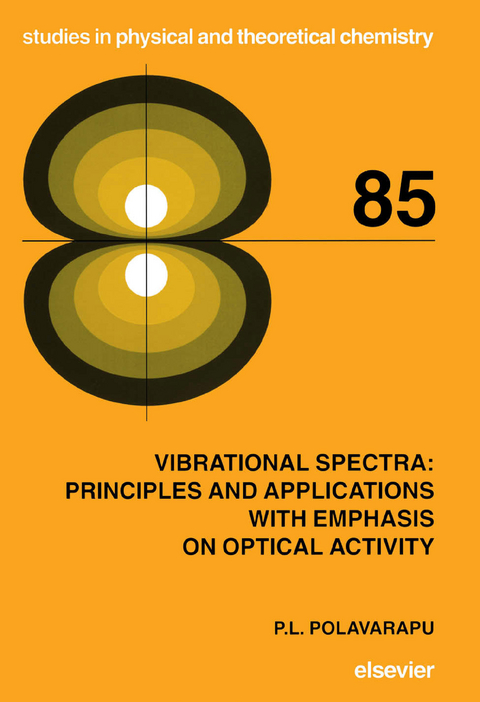
Vibrational Spectra: Principles and Applications with Emphasis on Optical Activity (eBook)
411 Seiten
Elsevier Science (Verlag)
978-0-08-054353-6 (ISBN)
Features of this book:
&bull, Comprehensive coverage of vibrational circular dichroism and vibrational Raman optical activity.
&bull, Coverage of theoretical and instrumental details.
&bull, A comprehensive survey of VCD and VROA applications is included, so that the reader can get an overview of theory, instrumentation and applications in one source.
The topics covered are of an advanced level, which makes this book invaluable for graduate students and practising scientists in vibrational spectroscopy.
This book originated out of a desire to combine topics on vibrational absorption, Raman scattering, vibrational circular dichroism (VCD) and Raman optical activity (VROA) into one source. The theoretical details of these processes are presented in ten different chapters. Using dispersive and Fourier transform techniques, the instrumentation involved in these spectral measurements are given in three chapters. Major emphasis is placed on the newer techniques, i.e. VCD and VROA, with the conventional vibrational absorption and vibrational Raman scattering methods incorporated as natural parts of the newer methods.Features of this book:* Comprehensive coverage of vibrational circular dichroism and vibrational Raman optical activity.* Coverage of theoretical and instrumental details.* A comprehensive survey of VCD and VROA applications is included, so that the reader can get an overview of theory, instrumentation and applications in one source.The topics covered are of an advanced level, which makes this book invaluable for graduate students and practising scientists in vibrational spectroscopy.
Cover 1
Contents 10
Chapter 1. Introduction 16
Chapter 2. Quantum theoretical techniques 18
2.1 Interaction with electric field 19
2.2 Time independent perturbation theory 22
2.3 Time dependent perturbation theory 25
2.4 Transition rates 34
2.5 Spectral intensities 36
2.6 Transition polarizabilities 38
Chapter 3. Diatomic molecules 42
3.1 Vibrational equation 42
3.2 Energy levels of harmonic oscillator 45
3.3 Energy levels of anharmonic oscillator 47
3.4 Energy levels of Morse oscillator 56
3.5 Electric dipole transition moments of harmonic oscillator 58
3.6 Electric dipole transition moments of anharmonic oscillator 59
3.7 Electric dipole transition moments of Morse oscillator 66
3.8 Magnetic dipole transition moments of harmonic oscillator 68
3.9 Magnetic dipole transition moments of anharmonic oscillator 70
3.10 Transition polarizabilities 73
Chapter 4. Polyatomic molecules 76
4.1 Energy levels of harmonic oscillators 76
4.2 Energy levels of anharmonic oscillators 79
4.3 Electric dipole transition moments of harmonic oscillators 88
4.4 Electric dipole transition moments of anharmonic oscillators 89
4.5 Magnetic dipole transition moments of harmonic oscillators 93
4.6 Magnetic dipole transition moments of anharmonic oscillators 93
Chapter 5. Vibrational analysis 96
5.1 Cartesian displacement coordinates 96
5.2 Internal coordinates 101
5.3 Energy distribution 111
5.4 Non-equilibrium geometries 112
5.5 Redundant internal coordinates 114
Chapter 6. Local modes 122
6.1 Hamiltonian in local coordinates 122
6.2 Approximations 125
Chapter 7. Vibrational frequencies and force constants 132
7.1 Molecular orbital theory 133
7.2 Energy derivatives 139
Chapter 8. Vibrational absorption and circular dichroism 158
8.1 Vibrational absorption spectra 158
8.2 Vibrational circular dichroism spectra 176
Chapter 9. Vibrational Raman and Raman optical activity 198
9.1 Vibrational Raman spectra 198
9.2 Vibrational Raman optical activity spectra 211
Chapter 10. Applications of symmetry 226
10.1 Introduction 226
10.2 Symmetry operations and point groups 226
10.3 Representations 228
10.4 Vibrational properties 236
Chapter 11. Principles of spectral measurements 250
11.1 Introduction 250
11.2 Polarization modulation using a photoelastic modulator 252
11.3 Polarization modulation using a quarter-wave retarder 261
11.4 Double polarization modulation 263
11.5 Dispersive spectrometers 264
Chapter 12. Amplitude division interferometry 278
12.1 Introduction 278
12.2 Principles of measurements 278
Chapter 13. Polarization division interferometry 304
13.1 Introduction 304
13.2 PDIs based on Wollaston prism 304
13.3 PDIs based on wire-grid beamsplitters 306
13.4 Principles of measurements 310
13.5 Additional modulations 324
13.6 Time resolved measurements 326
13.7 Double polarization modulation interferometers 327
Chapter 14. Applications and molecular structure 336
14.1 Vibrational frequencies and absorption and Raman spectra 336
14.2 Vibrational circular dichroism spectra 348
14.3 Vibrational Raman optical activity spectra 375
Appendices 398
1. Summation convention for vector products 398
2. Harmonic oscillator integrals with dimensionless p and q operators 399
3. Some relations among dimensionless p and q operators 402
4. Polarized light 403
5. Summation convention for tensor products 409
6. Vibrational Raman optical activities 411
7. Classical expressions for Aaß. and G'aß 419
Index 422
| Erscheint lt. Verlag | 17.9.1998 |
|---|---|
| Sprache | englisch |
| Themenwelt | Naturwissenschaften ► Chemie ► Analytische Chemie |
| Naturwissenschaften ► Chemie ► Physikalische Chemie | |
| Naturwissenschaften ► Physik / Astronomie ► Atom- / Kern- / Molekularphysik | |
| Technik | |
| ISBN-10 | 0-08-054353-7 / 0080543537 |
| ISBN-13 | 978-0-08-054353-6 / 9780080543536 |
| Informationen gemäß Produktsicherheitsverordnung (GPSR) | |
| Haben Sie eine Frage zum Produkt? |
 PDF (Adobe DRM)
Kopierschutz: Adobe-DRM
Adobe-DRM ist ein Kopierschutz, der das eBook vor Mißbrauch schützen soll. Dabei wird das eBook bereits beim Download auf Ihre persönliche Adobe-ID autorisiert. Lesen können Sie das eBook dann nur auf den Geräten, welche ebenfalls auf Ihre Adobe-ID registriert sind.
Details zum Adobe-DRM
Dateiformat: PDF (Portable Document Format)
Mit einem festen Seitenlayout eignet sich die PDF besonders für Fachbücher mit Spalten, Tabellen und Abbildungen. Eine PDF kann auf fast allen Geräten angezeigt werden, ist aber für kleine Displays (Smartphone, eReader) nur eingeschränkt geeignet.
Systemvoraussetzungen:
PC/Mac: Mit einem PC oder Mac können Sie dieses eBook lesen. Sie benötigen eine
eReader: Dieses eBook kann mit (fast) allen eBook-Readern gelesen werden. Mit dem amazon-Kindle ist es aber nicht kompatibel.
Smartphone/Tablet: Egal ob Apple oder Android, dieses eBook können Sie lesen. Sie benötigen eine
Geräteliste und zusätzliche Hinweise
Buying eBooks from abroad
For tax law reasons we can sell eBooks just within Germany and Switzerland. Regrettably we cannot fulfill eBook-orders from other countries.
aus dem Bereich