


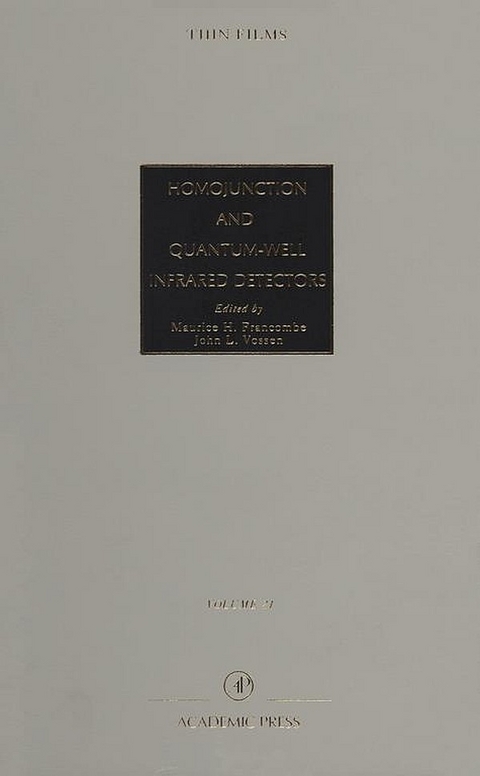
Advances in Research and Development (eBook)
387 Seiten
Elsevier Science (Verlag)
978-0-08-054288-1 (ISBN)
In order to be able to reflect the development of today's science and to cover all modern aspects of thin films, the series, starting with Volume 20, has moved beyond the basic physics of thin films. It now addresses the most important aspects of both inorganic and organic thin films, in both their theoretical as well as technological aspects. Therefore, in order to reflect the modern technology-oriented problems, the title has been slightly modified from Physics of Thin Films to Thin Films.
Key Features
* Discusses the latest research about structure, physics, and infrared photoemissive behavior of heavily doped silicon homojunctions and Ge and GaAs-based alloy junctions
* Reviews the current status of SiGe/Si quantum wells for infrared detection
* Discusses key developments in the growing research on quantum-well infrared photodetectors (QWIPs)
* Reviews Chois development of a family of novel three-terminal, multi-quantum well devices designed to improve high-temperature IR detectivity at long wavelengths
* Describes recent studies aimed at using multi-quantum well structures to achieve higher performance in solar cell devices based on materials systems
Physics of Thin Films is one of the longest running continuing series in thin film science, consisting of twenty volumes since 1963. The series contains quality studies of the properties of various thinfilms materials and systems. In order to be able to reflect the development of today's science and to cover all modern aspects of thin films, the series, starting with Volume 20, has moved beyond the basic physics of thin films. It now addresses the most important aspects of both inorganic and organic thin films, in both their theoretical as well as technological aspects. Therefore, in order to reflect the modern technology-oriented problems, the title has been slightly modified from Physics of Thin Films to Thin Films. - Discusses the latest research about structure, physics, and infrared photoemissive behavior of heavily doped silicon homojunctions and Ge and GaAs-based alloy junctions- Reviews the current status of SiGe/Si quantum wells for infrared detection- Discusses key developments in the growing research on quantum-well infrared photodetectors (QWIPs)- Reviews Chois development of a family of novel three-terminal, multi-quantum well devices designed to improve high-temperature IR detectivity at long wavelengths- Describes recent studies aimed at using multi-quantum well structures to achieve higher performance in solar cell devices based on materials systems
Front Cover 1
Thin Films: Advances in Research and Development 4
Copyright Page 5
Contents 6
Contributors 10
Preface 12
Chapter 1. Physics and Novel Device Applications of Semiconductor Homojunctions 16
I. Introduction and Background 17
II. Homojunction Internal Photoemission IR Detectors 19
III. Other Homojunction IR Detectors 52
IV. Spontaneous Spiketrain Generation in Si Homojunctions 56
V. Summary and Future 83
References 86
Chapter 2. Progress of SiGe/Si Quantum Wells for Infrared Detection 92
I. Introduction 92
II. Material Considerations 94
III. Quantum Size Effects 96
IV. Intersubband Transition in p-Type SiGe/Si Quantum Wells 105
V. Intersubband Transition in p-Type d-Doped Si Quantum Wells 110
VI. Detector Design 116
VII. Detector Photoresponse 119
VIII. Summary 125
References 126
Chapter 3. Recent Developments in Quantum-Well Infrared Photodetectors 128
I. Introduction 129
II. Intersubband Absorption 132
III. Bound-to-Bound State QWIPs 138
IV. Bound-to-Continuum State QWIPs 141
V. Asymmetrical GaAs/AlxGa1–x As QWIPs 175
VI. Single QWIPs 185
VII. Superlattice Miniband QWIPs 199
VIII. Indirect Band-Gap QWIPs 206
IX. QWIPs with Other Materials Systems 211
X. Light Coupling Methods 230
XI. Imaging Arrays 234
XII. Summary 244
References 247
Chapter 4. Multiquantum-Well Structures for Hot-Electron Phototransistors 254
I. Introduction 254
II. Intersubband Transitions in QWIP Structures 256
III. Excitation Hot-Electron Spectroscopy 261
IV. Infrared Hot-Electron Transistors 270
V. Multicolor QWIP and IHET 304
VI. Conclusion 322
References 323
Chapter 5. Quantum-Well Structures for Photovoltaic Energy Conversion 326
I. Introduction 327
II. Principles of Photovoltaics 328
III. QWSC Spectral Response 338
IV. QWSC Voltage Behavior 362
V. Limiting Efficiency of the QWSC 372
VI. Future Work and Other Novel Approaches 377
References 381
Author Index 384
Subject Index 396
Recent Volumes in this Serial 404
Physics and Novel Device Applications of Semiconductor Homojunctions
A.G.U. Perera Department of Physics and Astronomy, Georgia State University, Atlanta, Georgia
I Introduction and Background
A junction formed by two different electrical types of the same (band-gap) material can be classified as a homojunction. Similarly, a heterojunction is formed by two chemically different materials. These types of junction structures are well known and extensively discussed in the literature. A common example for a homojunction is the heavily used, well-understood silicon p−n junction. Recently developed GaAs/AlxGa1–x As structures are a good example of a heterojunction. Here our emphasis is on crystalline semiconductor homojunctions, especially Si. Since almost all the circuit components, such as resistors, capacitors, transistors, diodes, charged coupled devices (CCDs), charge integrated devices (CIDs), shift registers, and detectors, could be fabricated using standard Si technology, putting all those components in one single chip to fabricate an integrated circuit (IC) is a major advantage of using Si.
Semiconductor homojunction structures, especially the p+–n–n+ (p–i–n) structures on which we concentrate here, have been studied for a very long time and have been used in a variety of applications. The advent of the molecular beam epitaxy (MBE), chemical vapor deposition (CVD), and other thin film techniques has advanced both homoand heterojunction design and fabrication to new levels. However, our studies in recent years have demonstrated that even simple and mundane p+–n–n+ junction structures can exhibit a variety of new electrical and optical phenomena, leading to novel and intriguing device applications consistent with twenty-first century research interests. Here our focus is on homojunctions for both electronic and optoelectronic applications, which mainly involve intraband processes rather than interband processes. These devices will include different types of infrared detectors and spontaneous pulse generators, that act like biological neurons. The fact that the same semiconductor material (with different dopants or concentrations) is used in the homojunction makes the fabrication of these samples much simpler than heterostructures. The materials-technology needs for the implementation of these devices in practical applications were met at least a decade ago, making the incorporation of these devices into high-performance integrated circuits just a routine exercise.
First we will address homojunction infrared detectors based on internal photoemission mechanisms. Various IR detector approaches, using interfacial workfunctions in homojunctions and other IR detector approaches based on homojunctions, such as a delta doped potential well approach and a room-temperature FIR detector approach, based on a p-type high–low Si junction and a charge storage approach, will be discussed. The interfacial workfunction-type structures will be subdivided into three groups based on their impurity concentrations. Recent experimental results on Si homojunctions showing spectral response with a long-wavelength threshold (λt) varying from around 30 to 200 μm confirm the wavelength tunability of these detectors. The main significance of this detector concept is in establishing a technology base for the evolution of large-area, uniform detector arrays with a multispectral capability for greatly improved NE∆T sensitivity using the well-established Si growth and processing technology.
Next we will discuss spontaneous pulsing in silicon p+–n–n+ homojunctions. Another mode of infrared detection will be discussed in connection with these pulses (spiketrains). This is the only mode of IR detection which does not need any preamplifiers. Compared to measuring very small (pico-or microampere) currents spread out over a long duration, counting pulses will be much easier. These spiketrains convey both analog and digital information (mixed character), which can carry more information than either situation alone. The interpulse time intervals convey analog information, whereas the presence or the absence of the almost-uniform-height pulses conveys digital information. Noise immunity is another advantage of this pulsing approach.
Another application of these pulses is in emulating biological neurons, opening up pathways to design brainlike parallel asynchronous multispectral focal-plane image/sensor processors for various missions. These low-power, high-resolution sensor/processor innovations may have a profound impact on techniques currently being explored for defense, geological and meterological survey systems, strategic and tactical IR systems, ground, airborne, and space-based FLIR systems, planetary probes, and medical diagnostic systems even though these are futuristic approaches.
II Homojunction Internal Photoemission IR Detectors
In general, infrared detectors can be categorized as thermal and photon detectors. The latter can be further divided into photoconductors, photo-voltaic detectors, and internal photoemission detectors. In photoconductors, the electrical conductivity of the material is changed by the incident photons. The photovoltaic effect needs an internal potential barrier and a built-in electric field. According to various photon detection mechanisms, photon detectors can also be classified as intrinsic, extrinsic, intersubband, and internal photoemission detectors. A detailed review of extrinsic IR photoconductors can be found in articles by Bratt (8) and later by Sclar (9). A well-known example of intersubband photoconductors is multiquantum well infrared photodetectors (MQWIPs), developed recently (10, 11). Although extrinsic photovoltaic detection is possible, most of the practical photovoltaic detectors utilize the intrinsic photoeffect. A typical photovoltaic structure is a simple p–n junction. Other structures include p–i–n junctions, Schottky barriers, and MIS structures. Recently, the concept of a photovoltaic intersubband detector was demonstrated for the long-wavelength IR range (12). In addition, blocked-impurity-band (BIB) detectors, developed first at Rockwell Science Center (13), can also be categorized as an extrinsic photovoltaic detector. There are several internal photoemission detectors under development (14), among which metal–semiconductor Schottky barrier detectors (15) and GexSi1–x /Si heterojunction detectors (16, 17) are two examples. Although a large body of research on the above topics exists, our aim is to concentrate mainly on homojunction internal photoemission detectors (HIP) where the term HIP follows the terminology of Lin and Maserjian (16), who used it for heterojunction internal photoemission. Typical spectral ranges obtained for Si and Ge homojunction type IR detectors are shown in Fig. 1 with the relevant reference also listed in the figure.
The basic structure of the HIP detectors (18) consists of a heavily doped layer for IR absorption and an intrinsic (or lightly doped) layer across which most of the external bias is dropped. According to the doping concentration level in the heavily doped layer (Nd), these HIP detectors can be divided into three types (labeled I, II, and III) due to their different photoresponse mechanisms and response wavelength ranges. More details of these three types of HIP detectors will be given after discussing the concentration dependence of the workfunction, which accounts for most of the wavelength tunability. The concentration-dependent interfacial workfunctions in type I and II structures will be used as the barriers involved in the IR detection process, whereas in type III the barrier is due to the space charge effect...
| Erscheint lt. Verlag | 22.11.1995 |
|---|---|
| Mitarbeit |
Herausgeber (Serie): Maurice H. Francombe, John L. Vossen |
| Sprache | englisch |
| Themenwelt | Naturwissenschaften ► Chemie |
| Naturwissenschaften ► Physik / Astronomie ► Angewandte Physik | |
| Naturwissenschaften ► Physik / Astronomie ► Festkörperphysik | |
| Technik ► Elektrotechnik / Energietechnik | |
| Technik ► Maschinenbau | |
| ISBN-10 | 0-08-054288-3 / 0080542883 |
| ISBN-13 | 978-0-08-054288-1 / 9780080542881 |
| Informationen gemäß Produktsicherheitsverordnung (GPSR) | |
| Haben Sie eine Frage zum Produkt? |
 PDF (Adobe DRM)
Kopierschutz: Adobe-DRM
Adobe-DRM ist ein Kopierschutz, der das eBook vor Mißbrauch schützen soll. Dabei wird das eBook bereits beim Download auf Ihre persönliche Adobe-ID autorisiert. Lesen können Sie das eBook dann nur auf den Geräten, welche ebenfalls auf Ihre Adobe-ID registriert sind.
Details zum Adobe-DRM
Dateiformat: PDF (Portable Document Format)
Mit einem festen Seitenlayout eignet sich die PDF besonders für Fachbücher mit Spalten, Tabellen und Abbildungen. Eine PDF kann auf fast allen Geräten angezeigt werden, ist aber für kleine Displays (Smartphone, eReader) nur eingeschränkt geeignet.
Systemvoraussetzungen:
PC/Mac: Mit einem PC oder Mac können Sie dieses eBook lesen. Sie benötigen eine
eReader: Dieses eBook kann mit (fast) allen eBook-Readern gelesen werden. Mit dem amazon-Kindle ist es aber nicht kompatibel.
Smartphone/Tablet: Egal ob Apple oder Android, dieses eBook können Sie lesen. Sie benötigen eine
Geräteliste und zusätzliche Hinweise
Buying eBooks from abroad
For tax law reasons we can sell eBooks just within Germany and Switzerland. Regrettably we cannot fulfill eBook-orders from other countries.


