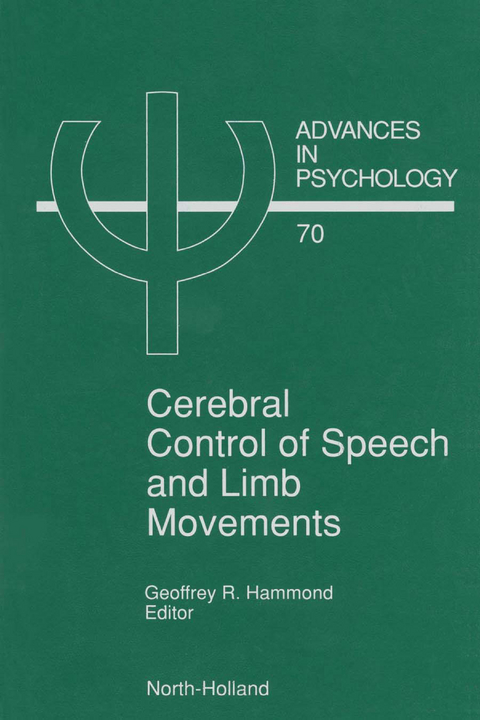
Cerebral Control of Speech and Limb Movements (eBook)
708 Seiten
Elsevier Science (Verlag)
978-0-08-086724-3 (ISBN)
1. Motor control and speech examines speech as a motor activity,
2. Language and gesture examines the correspondence between spoken language and manual gesture,
3. Motor performance and aphasia examines the motor impairments associated with aphasias,
4. Interactions of speech and manual performance examines the interactions that occur between concurrent verbal and manual activities.
Discussed in this book is the association between speech and movements, especially those of the preferred hand. Both are skilled motor activities that appear to depend upon a similar neural organization that is available in the left hemisphere of the brain. The nature of this association of the cerebral control of speech and skilled manual performance is discussed in four sections:1. Motor control and speech examines speech as a motor activity2. Language and gesture examines the correspondence between spoken language and manual gesture3. Motor performance and aphasia examines the motor impairments associated with aphasias4. Interactions of speech and manual performance examines the interactions that occur between concurrent verbal and manual activities
Front Cover 1
Cerebral Control of Speech and Limb Movements 4
Copyright Page 5
Table of Contents 8
PART I: CONTROL OF LIMB AND SPEECH MOVEMENTS 18
Chapter 1. Characteristics of Speech as a Motor Control System 20
Chapter 2. Control of Human Jaw and Multi-joint Arm Movements 46
Chapter 3. Manual Performance Asymmetries 76
Chapter 4. The Development of Hemispheric and Manual Specialization 96
Chapter 5. Disorders of Motor Function following Cortical Lesions: Review and Theoretical Considerations 158
Chapter 6. Complex Movement Behavior: Toward Understanding Cortical and Subcortical Interactions in Regulating Control Processes 186
PART II: LANGUAGE AND GESTURE 218
Chapter 7. Speech and Gesture 220
Chapter 8. Gestures and Speech: Evidence from Aphasia 274
Chapter 9. The Concomitance of Speech and Manual Gesture in Aphasic Subjects 296
Chapter 10. Language and Motor Disorders in Deaf Signers 320
Chapter 11. Relations Between Verbal and Gestural Explanations 344
PART III: MOTOR PERFORMANCE AND APHASIA 364
Chapter 12. Motoric Characteristics of Adult Aphasic and Apraxic Speakers 366
Chapter 13. Hemispheric Control of Articulatory Speech Output in Aphasia 404
Chapter 14. The Relationship between Pantomime Expression and Recognition in Aphasia: The Search for Causes 434
Chapter 15. The Dissociation of Aphasia from Apraxia of Speech, Ideomotor Limb, and Buccofacial Apraxia 468
Chapter 16. Evidence for Common Expressions of Apraxia 494
Chapter 17. The Assessment of Limb Apraxia: The Limb Apraxia Test 520
PART IV: INTERACTIONS OF SPEECH AND MANUAL PERFORMANCE 550
Chapter 18. Interaction of Vocal and Manual Movements 552
Chapter 19. Comparative Investigations of Speech and Other Neuromotor Systems 592
Chapter 20. Development of Sensorimotor Capacities Relevant to Speech and Concurrent Task Performance 612
Chapter 21. Is Time Sharing Asymmetry a Valid Indicator of Speech Lateralization? Evidence for Left Handers 628
Chapter 22. Asymmetric Manual Interference as an Indicator of Lateralized Brain Function 652
Chapter 23. Temporal Constraints on Concurrent Task Performance 678
Subject Index 700
Author Index 704
| Erscheint lt. Verlag | 6.12.1990 |
|---|---|
| Sprache | englisch |
| Themenwelt | Geisteswissenschaften ► Psychologie ► Allgemeine Psychologie |
| Geisteswissenschaften ► Psychologie ► Verhaltenstherapie | |
| Geisteswissenschaften ► Sprach- / Literaturwissenschaft ► Sprachwissenschaft | |
| Naturwissenschaften ► Biologie ► Humanbiologie | |
| Naturwissenschaften ► Biologie ► Zoologie | |
| ISBN-10 | 0-08-086724-3 / 0080867243 |
| ISBN-13 | 978-0-08-086724-3 / 9780080867243 |
| Informationen gemäß Produktsicherheitsverordnung (GPSR) | |
| Haben Sie eine Frage zum Produkt? |
 PDF (Adobe DRM)
Kopierschutz: Adobe-DRM
Adobe-DRM ist ein Kopierschutz, der das eBook vor Mißbrauch schützen soll. Dabei wird das eBook bereits beim Download auf Ihre persönliche Adobe-ID autorisiert. Lesen können Sie das eBook dann nur auf den Geräten, welche ebenfalls auf Ihre Adobe-ID registriert sind.
Details zum Adobe-DRM
Dateiformat: PDF (Portable Document Format)
Mit einem festen Seitenlayout eignet sich die PDF besonders für Fachbücher mit Spalten, Tabellen und Abbildungen. Eine PDF kann auf fast allen Geräten angezeigt werden, ist aber für kleine Displays (Smartphone, eReader) nur eingeschränkt geeignet.
Systemvoraussetzungen:
PC/Mac: Mit einem PC oder Mac können Sie dieses eBook lesen. Sie benötigen eine
eReader: Dieses eBook kann mit (fast) allen eBook-Readern gelesen werden. Mit dem amazon-Kindle ist es aber nicht kompatibel.
Smartphone/Tablet: Egal ob Apple oder Android, dieses eBook können Sie lesen. Sie benötigen eine
Geräteliste und zusätzliche Hinweise
Buying eBooks from abroad
For tax law reasons we can sell eBooks just within Germany and Switzerland. Regrettably we cannot fulfill eBook-orders from other countries.
aus dem Bereich