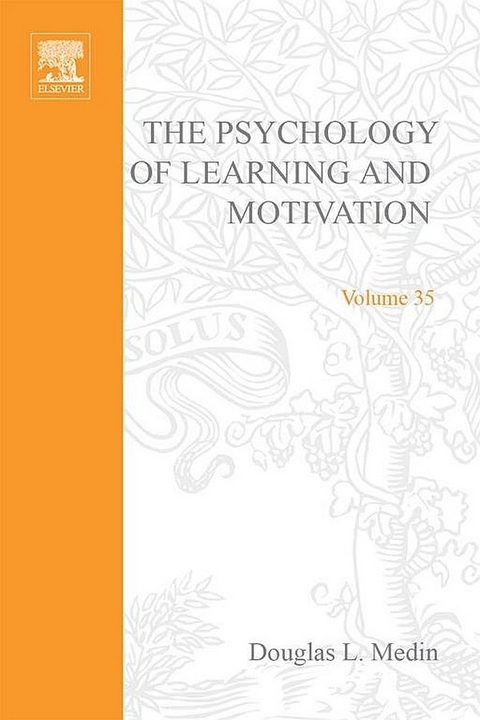
Psychology of Learning and Motivation (eBook)
337 Seiten
Elsevier Science (Verlag)
9780080863863 (ISBN)
The Psychology of Learning and Motivation publishes empirical and theoretical contributions in cognitive and experimental psychology, ranging from classical and instrumental conditioning to complex learning and problem solving. Each chapter provides a thoughtful integration of a body of work. Volume 35 covers spatial working memory, memory for asymmetric events, distance and location processes in memory, category learning, and visual spatial attention.
Front Cover 1
The Psychology of Learning and Motivation, Volume 35 4
Copyright Page 5
Contents 6
Contributors 10
CHAPTER 1. DISTANCE AND LOCATION PROCESSES IN MEMORY FOR THE TIMES OF PAST EVENTS 12
I. Introduction 12
II. Location Processes 13
III. Distance Processes 21
IV. The Roles of Distance-Based and Location-Based Processes 48
References 50
CHAPTER 2. VERBAL AND SPATIAL WORKING MEMORY IN HUMANS 54
I. Introduction 54
II. Dissociating Phonological and Spatial Storage 57
III. Dissociation of Verbal Storage from Rehearsal 79
IV. Summary and Conclusions 90
References 94
CHAPTER 3. MEMORY FOR ASYMMETRIC EVENTS 100
I. Introduction 100
II. Memory for Presence versus Absence 101
III. Memory for Long versus Short Durations: The “Choose-Short’’ Effect 122
IV. Memory for Stimulus Modality 132
V. Conclusion 134
References 135
CHAPTER 4. THE MAINTENANCE OF A COMPLEX KNOWLEDGE BASE AFTER SEVENTEEN YEARS 138
I. Introduction 138
II. A Developing Paradigm: Method and More 145
III. Findings 155
IV. The Future 172
References 173
CHAPTER 5. CATEGORY LEARNING AS PROBLEM SOLVING 176
I. Introduction 176
II. Classification Learning and Category Learning 177
III. Category Learning as Problem Solving 178
IV. Related Work 180
V. Overview of the Research Project 183
VI. Interactions with Instances 184
VII. Use of Categories 188
VIII. Discussion of Category Use 194
IX. Summary 200
References 201
CHAPTER 6. BUILDING A COHERENT CONCEPTION OF HIV TRANSMISSION: A NEW APPROACH TO AIDS EDUCATION 204
I. Introduction 204
II. Learning and Motivation Issues in Educating Children about AIDS 205
III. A New Approach to AIDS Education: Building a Coherent Conception of HIV Transmission 210
IV. How to Help Children Understand a Basic Causal Mechanism for AIDS Transmission 223
V. Conclusions 247
References 248
CHAPTER 7. SPATIAL EFFECTS IN THE PARTIAL REPORT PARADIGM: A CHALLENGE FOR THEORIES OF VISUAL SPATIAL ATTENTION 254
I. Introduction 254
II. Partial Report Paradigm 255
III. Theoretical Analysis of the Partial Report Task 260
IV. Fitting Theory to Data 268
V. Other Distance and Density Effects in Partial Report Tasks 277
VI. Conclusions 281
Appendix 282
References 291
CHAPTER 8. STRUCTURAL BIASES IN CONCEPT LEARNING: INFLUENCES FROM MULTIPLE FUNCTIONS 294
I. Introduction 294
II. The Role of Concept Use in Concept-Learning Research 295
III. The Need for a Broader Perspective on Function in Concept Learning 298
IV. Models Focus on External Functions 301
V. Concept Learning as Serving Internal and External Functions 306
VI. Value Systematicity Experiments: Effects on Learning Predictive Structure 307
VII. Experiments on Consistent Contrast and Hierarchical Inclusion Relations 318
VIII. Conclusions 327
References 329
Index 334
Contents of Recent Volumes 344
| Erscheint lt. Verlag | 28.10.1996 |
|---|---|
| Mitarbeit |
Herausgeber (Serie): Douglas L. Medin |
| Sprache | englisch |
| Themenwelt | Geisteswissenschaften ► Psychologie ► Allgemeine Psychologie |
| Geisteswissenschaften ► Psychologie ► Biopsychologie / Neurowissenschaften | |
| Geisteswissenschaften ► Psychologie ► Pädagogische Psychologie | |
| Geisteswissenschaften ► Psychologie ► Verhaltenstherapie | |
| Medizin / Pharmazie ► Medizinische Fachgebiete ► Neurologie | |
| Medizin / Pharmazie ► Medizinische Fachgebiete ► Psychiatrie / Psychotherapie | |
| Naturwissenschaften ► Biologie ► Humanbiologie | |
| Naturwissenschaften ► Biologie ► Zoologie | |
| ISBN-13 | 9780080863863 / 9780080863863 |
| Informationen gemäß Produktsicherheitsverordnung (GPSR) | |
| Haben Sie eine Frage zum Produkt? |
 PDF (Adobe DRM)
Kopierschutz: Adobe-DRM
Adobe-DRM ist ein Kopierschutz, der das eBook vor Mißbrauch schützen soll. Dabei wird das eBook bereits beim Download auf Ihre persönliche Adobe-ID autorisiert. Lesen können Sie das eBook dann nur auf den Geräten, welche ebenfalls auf Ihre Adobe-ID registriert sind.
Details zum Adobe-DRM
Dateiformat: PDF (Portable Document Format)
Mit einem festen Seitenlayout eignet sich die PDF besonders für Fachbücher mit Spalten, Tabellen und Abbildungen. Eine PDF kann auf fast allen Geräten angezeigt werden, ist aber für kleine Displays (Smartphone, eReader) nur eingeschränkt geeignet.
Systemvoraussetzungen:
PC/Mac: Mit einem PC oder Mac können Sie dieses eBook lesen. Sie benötigen eine
eReader: Dieses eBook kann mit (fast) allen eBook-Readern gelesen werden. Mit dem amazon-Kindle ist es aber nicht kompatibel.
Smartphone/Tablet: Egal ob Apple oder Android, dieses eBook können Sie lesen. Sie benötigen eine
Geräteliste und zusätzliche Hinweise
Buying eBooks from abroad
For tax law reasons we can sell eBooks just within Germany and Switzerland. Regrettably we cannot fulfill eBook-orders from other countries.
aus dem Bereich