


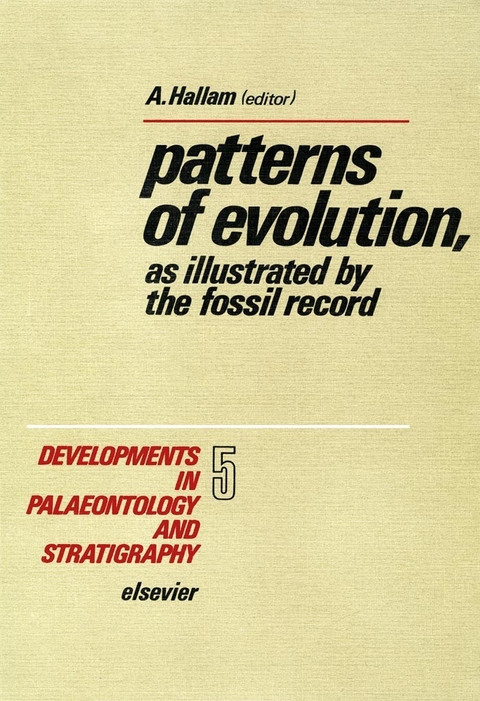
Patterns of evolution, as illustrated by the fossil record (eBook)
590 Seiten
Elsevier Science (Verlag)
978-0-08-086846-2 (ISBN)
Patterns of evolution, as illustrated by the fossil record
Front Cover 1
Patterns of Evolution: As Illustrated by the Fossil Record 4
Copyright Page 5
CONTENTS 10
PREFACE 6
LIST OF CONTRIBUTORS 9
CHAPTER 1. ETERNAL METAPHORS OF PALAEONTOLOGY 16
The content of palaeontology 16
A taxonomic interlude 19
Pre-evolutionary establishment of the three questions 21
The altered context of evolutionary theory 27
Contemporary palaeobiology recycles the ancient issues 32
An editorial comment in conclusion 35
References 40
CHAPTER 2. GENERAL PATTERNS OF METAZOAN EVOLUTION 42
Introduction 42
Phylogenetic models 42
The fossil record of the establishment of body plans 45
Adaptive models of metazoan body plans 49
The timing of the evolution of body plans 54
Models of evolutionary explosions 56
Phanerozoic metazoan patterns 62
Summary of major metazoan evolutionary patterns 68
Acknowledgements 70
References 70
CHAPTER 3. STOCHASTIC MODELS IN EVOLUTIONARY PALAEONTOLOGY 74
Introduction 74
Concepts of randomness 74
Path-dependent versus independent events models 76
Markov processes 77
Strategies for applying stochastic models 80
Applications 85
Summary 91
Acknowledgements 92
References 92
CHAPTER 4. BRACHIOPOD EVOLUTION 94
Introduction 94
Nature of numerical data 95
General aspects of brachiopod history 99
Major events in brachiopod evolution 103
Conclusions 132
References 134
CHAPTER 5. EVOLUTION OF PRIMITIVE ECHINODERMS 138
Introduction 138
Origin, characteristics and relationships of echinoderms 139
Patterns of echinoderm evolution 142
Vital functions in fossil echinoderms 146
References 171
Postscript 173
CHAPTER 6. PATTERNS AND THEMES OF EVOLUTION AMONG BRYOZOA 174
General considerations 174
Patterns of evolution 182
Themes of evolution 199
Summary 215
Acknowledgements 216
References 216
CHAPTER 7. TRENDS, RATES, AND PATTERNS OF EVOLUTION IN THE BIVALVIA 224
Introduction 224
Bivalve phylogeny 224
Methods of phyletic reconstruction 228
The Cambro-Ordovician divergence 229
Trends and patterns of evolution and extinction 231
Rates of evolution and extinction 237
Biological agents in macro-evolution 250
Summary 261
References 262
CHAPTER 8. AMMONITE EVOLUTION 266
Introduction 266
Ammonite biology 266
The major features of ammonoid evolution 266
The origins of higher categories 278
Evolutionary patterns at family level 279
Evolution at the species level 285
Sutural evolution 294
Divergence, convergence and parallelism 295
Iterative evolution 299
Palingenesis and proterogenesis 299
Evolutionary size changes 303
Rates of evolution 305
Racial senility 307
Extinction 310
Summary 314
Acknowledgements 314
References 315
CHAPTER 9. TRILOBITES AND EVOLUTIONARY PATTERNS 320
Introduction 320
Speciation in trilobites 323
Diversity controls and faunal patterns of speciation 326
Biogeography 329
Aspects of evolutionary adaptation in trilobites 330
Phylogenetic relationships among the trilobites 335
Relationships with other arthropods 342
References 345
CHAPTER 10. PATTERNS OF EVOLUTION IN THE GRAPTOLITES 348
Introduction 348
Coloniality 349
Genetic polymorphism, inbreeding and outbreeding 350
Sequence of graptolite faunas 351
Cladogenesis and anagenesis 352
Origination and extinction 353
Origin of new types 355
Cope's Rule 367
Biogeography 368
Patterns peculiar to graptolite evolution 368
Summary 371
Acknowledgements 372
References 372
CHAPTER 11. EVOLUTION OF TRACE FOSSIL COMMUNITIES 374
Introduction 374
The present-day model 374
Translation into the palaeontological record 375
Evolution of flysch ichnocoenoses through Phanerozoic times 376
Intertidal communities 386
General conclusions 390
Acknowledgements 391
References 391
CHAPTER 12. THE PATTERN OF DIVERSIFICATION AMONG FISHES 392
Introduction 392
Overall diversity 393
Rates of origination and extinction 397
The course of adaptive radiation 400
Discussion 410
Summary of conclusions 416
Acknowledgements 417
References 417
Addendum 419
CHAPTER 13. PATTERNS OF AMPHIBIAN EVOLUTION: AN EXTENDED EXAMPLE OF THE INCOMPLETENESS OF THE FOSSIL RECORD 420
Introduction 420
Labyrinthodontia 422
“Lepospondyls” 431
“Lissamphibia” 434
Fossil record 437
Discussion 442
Summary 445
Acknowledgements 446
References 446
CHAPTER 14. TETRAPOD MASS EXTINCTIONS — A MODEL OF THE REGULA- TION OF SPECIATION RATES AND IMMIGRATION BY CYCLES OF TOPOGRAPHIC DIVERSITY 454
Introduction 454
Measuring diversity in fossil tetrapods 455
The patterns of diversity 460
Suggested causes of mass extinctions 470
Haug Effect control of diversity 474
Summary 480
References 481
CHAPTER 15. PATTERNS OF EVOLUTION IN THE MAMMALIAN FOSSIL RECORD 484
Introduction 484
Mammalian radiations 485
Mammalian adaptations 498
Origin of species and higher taxa 505
Conclusions 512
Acknowledgements 514
References 514
CHAPTER 16. PATTERNS OF EVOLUTION IN EARLY ANGIOSPERMS 516
Introduction 516
Systematic background 518
Evolutionary patterns in the mid-Cretaceous angiosperm record 522
Adaptive aspects of the early angiosperm record 548
Summary and conclusions 555
Acknowledgements 557
References 557
CHAPTER 17. PATTERNS OF EVOLUTION: A SUMMARY AND DISCUSSION 562
Introduction 562
Three themes 562
Additional comments on macro-evolution 574
Summary 575
References 576
AUTHOR INDEX 578
GENERAL INDEX 596
| Erscheint lt. Verlag | 15.1.1977 |
|---|---|
| Mitarbeit |
Herausgeber (Serie): A. Hallam |
| Sprache | englisch |
| Themenwelt | Naturwissenschaften ► Biologie ► Evolution |
| Naturwissenschaften ► Geowissenschaften ► Mineralogie / Paläontologie | |
| Technik | |
| ISBN-10 | 0-08-086846-0 / 0080868460 |
| ISBN-13 | 978-0-08-086846-2 / 9780080868462 |
| Informationen gemäß Produktsicherheitsverordnung (GPSR) | |
| Haben Sie eine Frage zum Produkt? |
 PDF (Adobe DRM)
Kopierschutz: Adobe-DRM
Adobe-DRM ist ein Kopierschutz, der das eBook vor Mißbrauch schützen soll. Dabei wird das eBook bereits beim Download auf Ihre persönliche Adobe-ID autorisiert. Lesen können Sie das eBook dann nur auf den Geräten, welche ebenfalls auf Ihre Adobe-ID registriert sind.
Details zum Adobe-DRM
Dateiformat: PDF (Portable Document Format)
Mit einem festen Seitenlayout eignet sich die PDF besonders für Fachbücher mit Spalten, Tabellen und Abbildungen. Eine PDF kann auf fast allen Geräten angezeigt werden, ist aber für kleine Displays (Smartphone, eReader) nur eingeschränkt geeignet.
Systemvoraussetzungen:
PC/Mac: Mit einem PC oder Mac können Sie dieses eBook lesen. Sie benötigen eine
eReader: Dieses eBook kann mit (fast) allen eBook-Readern gelesen werden. Mit dem amazon-Kindle ist es aber nicht kompatibel.
Smartphone/Tablet: Egal ob Apple oder Android, dieses eBook können Sie lesen. Sie benötigen eine
Geräteliste und zusätzliche Hinweise
Buying eBooks from abroad
For tax law reasons we can sell eBooks just within Germany and Switzerland. Regrettably we cannot fulfill eBook-orders from other countries.
aus dem Bereich


