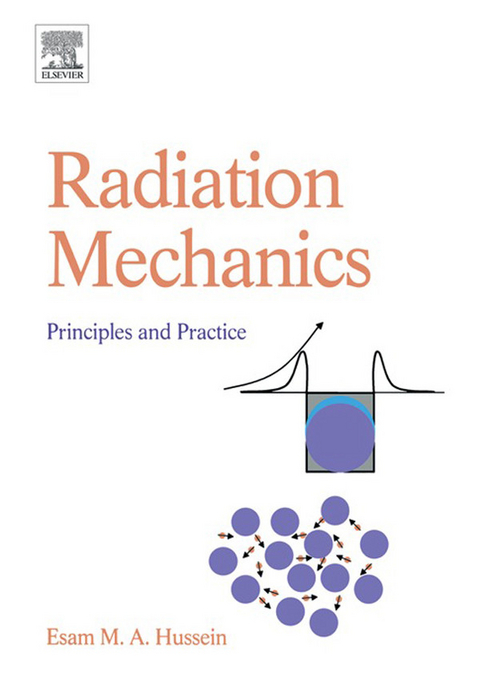
Radiation Mechanics (eBook)
344 Seiten
Elsevier Science (Verlag)
978-0-08-055288-0 (ISBN)
- Covers all aspects of radiation mechanics
- Helps non-nuclear graduates readily familiarize themselves with radiation
- Integrates and coordinates mechanisms, kinematics, cross sections and transport in one volume
- End of each chapter problems to further assist students in understanding the underlying concepts
- Use of computations and Internet resources included in the problems
Mechanics is the science of studying energy and forces, and their effects on matter. It involves mechanisms, kinematics, cross sections, and transport. Radiation mechanism describes how various types of radiation interact with different targets (atoms and nuclei). The book addresses the above four aspects of radiation mechanics integrating these aspects of radiation behavior in a single treatise under the framework of "e;radiation mechanics"e;. - Covers all aspects of radiation mechanics- Helps non-nuclear graduates readily familiarize themselves with radiation- Integrates and coordinates mechanisms, kinematics, cross sections and transport in one volume- End of each chapter problems to further assist students in understanding the underlying concepts- Use of computations and Internet resources included in the problems
Front Cover 1
Radiation Mechanics: Principles and Practice 4
Copyright Page 5
Contents 8
Preface 12
List of Algorithms 16
Chapter 1. Mechanisms 18
1.1 Introduction 18
1.2 Radiation 20
1.2.1 Neutral particles 20
1.2.2 Charged particles 22
1.2.3 Photons 22
1.3 Wave–Particle Duality 24
1.3.1 Corpuscular nature of waves 25
1.3.2 Wave nature of particles 26
1.3.3 Uncertainty principle 27
1.4 Nuclear/Atomic Fields 28
1.4.1 Potential field 29
1.4.2 Nuclear strong-force field 30
1.4.3 Nuclear weak-force field 31
1.4.4 Electromagnetic field 31
1.4.5 Quantum states 33
1.5 Atom and Nucleus 36
1.5.1 Atomic structure 36
1.5.2 Nuclear structure 37
1.6 Nuclear Decay 43
1.6.1 Kinetics 44
1.6.2 Statistics 45
1.6.3 Alpha decay 46
1.6.4 Beta decay 49
1.6.5 Gamma decay 53
1.6.6 Internal conversion 54
1.6.7 Spontaneous fission 55
1.6.8 Decay by neutron or proton emission 56
1.7 Reactions and Interactions 57
1.7.1 Interaction with atomic electrons 57
1.7.2 Interaction with electric field of atom 62
1.7.3 Nuclear interactions 63
1.8 Macroscopic Field 70
1.8.1 Transport space 71
1.8.2 Particle density and flux 72
1.8.3 Atomic/nuclear density 74
1.8.4 Interaction rate 75
1.9 Problems 77
Chapter 2. Collision Kinematics 84
2.1 Overview 84
2.2 Center-of-Mass System 85
2.3 Relativity 91
2.3.1 Special theory of relativity 91
2.3.2 Center of relativistic mass 95
2.3.3 Lorentz transformation of momentum and energy 96
2.4 Conservation Laws 97
2.4.1 Stoichiometric conservation 98
2.4.2 Intrinsic conservation 98
2.4.3 Kinematical conservation 99
2.5 Einsteinian Kinematics 100
2.5.1 Two-body kinematics 100
2.5.2 Analysis using invariants 110
2.5.3 Non-elastic interactions 115
2.5.4 Non-relativistic approximation 120
2.6 Newtonian Kinematics 121
2.7 Specific Interactions 125
2.7.1 Elastic scattering 126
2.7.2 Inelastic scattering 131
2.7.3 Non-elastic collisions 133
2.8 Electromagnetic Interactions 140
2.8.1 Coulomb scattering 140
2.8.2 Radiative collisions 150
2.8.3 Diffraction 161
2.9 Problems 163
Chapter 3. Cross Sections 170
3.1 Introduction 170
3.2 Nuclear Cross-Section Models 173
3.2.1 Optical model 173
3.2.2 Compound nucleus 179
3.2.3 Continuum theory 182
3.2.4 Evaporation 182
3.2.5 Stripping 183
3.2.6 Photonuclear reactions 183
3.2.7 Nucleonic collisions 185
3.3 Neutron Cross Sections 185
3.3.1 Elastic scattering 186
3.3.2 Inelastic scattering 189
3.3.3 Radiative capture 190
3.3.4 Fission 191
3.3.5 Charged-particle production 191
3.3.6 Energy and angular distribution 192
3.3.7 Thermal neutrons 196
3.4 Electrodynamics 200
3.4.1 Quantum electrodynamics 200
3.4.2 Feynman diagrams 206
3.5 Photon Cross Sections 211
3.5.1 Thomson scattering 212
3.5.2 Compton scattering 214
3.5.3 Rayleigh scattering 220
3.5.4 Diffraction 221
3.5.5 Photoelectric effect 222
3.5.6 Pair production 225
3.5.7 Triplet production 230
3.5.8 Delbruck scattering 230
3.6 Charged-Particle Cross Sections 232
3.6.1 Coulomb scattering 232
3.6.2 Rutherford scattering 234
3.6.3 Mott scattering 236
3.6.4 Bremsstrahlung 237
3.6.5 Moller scattering 241
3.6.6 Bhabha scattering 243
3.6.7 Pair annihilation 244
3.7 Data Libraries and Processing 246
3.7.1 Libraries 246
3.7.2 Processing and manipulation 249
3.7.3 Compound and mixture cross sections 254
3.8 Problems 255
Chapter 4. Transport 264
4.1 Boltzmann Transport Equation 264
4.1.1 Basics 264
4.1.2 Transport in void 268
4.1.3 Divergence law 269
4.1.4 Attenuation law 271
4.1.5 Point kernel 272
4.1.6 Diffusion theory 273
4.1.7 Adjoint transport equation 274
4.2 Modal Solution Methods 276
4.2.1 P[sub(1)] approximation 279
4.2.2 Diffusion equation 281
4.2.3 Numerical solution and computer codes 283
4.3 Nodal Solution Methods 283
4.3.1 Discretization of directions: discrete ordinates 284
4.3.2 Discretization of time, energy, and space 287
4.3.3 Multigroup approximation 290
4.3.4 Discretization of transport equation 290
4.3.5 Curved geometries 292
4.3.6 Source term 295
4.3.7 Solution of S[sub(n)] equations 296
4.3.8 Computer codes 300
4.4 Stochastic Methods 301
4.4.1 Introduction 301
4.4.2 Random variables and statistical basis 302
4.4.3 Abstract analysis 303
4.4.4 Random numbers 309
4.4.5 Random number generation 309
4.4.6 Sampling 310
4.4.7 Particle transport 313
4.4.8 Example 319
4.4.9 Computer codes 322
4.5 Transport of Charged Particles 323
4.5.1 Special features 323
4.5.2 Stopping power and range 324
4.5.3 Transport 324
4.6 Problems 325
Bibliography 328
Constants and Units 332
Useful Web Sites 336
Glossary 338
A 338
B 338
C 338
D 338
E 338
F 338
G 338
H 338
I 338
L 338
M 338
N 339
P 339
Q 339
S 339
X 339
Index 340
A 340
B 340
C 340
D 341
E 341
F 342
G 342
H 342
I 342
K 342
L 342
M 342
N 343
P 343
Q 343
R 343
S 344
T 344
U 344
V 344
W 344
X 344
Z 344
| Erscheint lt. Verlag | 7.7.2010 |
|---|---|
| Sprache | englisch |
| Themenwelt | Naturwissenschaften ► Physik / Astronomie ► Atom- / Kern- / Molekularphysik |
| Technik ► Elektrotechnik / Energietechnik | |
| Technik ► Maschinenbau | |
| ISBN-10 | 0-08-055288-9 / 0080552889 |
| ISBN-13 | 978-0-08-055288-0 / 9780080552880 |
| Informationen gemäß Produktsicherheitsverordnung (GPSR) | |
| Haben Sie eine Frage zum Produkt? |
 EPUB (Adobe DRM)
Kopierschutz: Adobe-DRM
Adobe-DRM ist ein Kopierschutz, der das eBook vor Mißbrauch schützen soll. Dabei wird das eBook bereits beim Download auf Ihre persönliche Adobe-ID autorisiert. Lesen können Sie das eBook dann nur auf den Geräten, welche ebenfalls auf Ihre Adobe-ID registriert sind.
Details zum Adobe-DRM
Dateiformat: EPUB (Electronic Publication)
EPUB ist ein offener Standard für eBooks und eignet sich besonders zur Darstellung von Belletristik und Sachbüchern. Der Fließtext wird dynamisch an die Display- und Schriftgröße angepasst. Auch für mobile Lesegeräte ist EPUB daher gut geeignet.
Systemvoraussetzungen:
PC/Mac: Mit einem PC oder Mac können Sie dieses eBook lesen. Sie benötigen eine
eReader: Dieses eBook kann mit (fast) allen eBook-Readern gelesen werden. Mit dem amazon-Kindle ist es aber nicht kompatibel.
Smartphone/Tablet: Egal ob Apple oder Android, dieses eBook können Sie lesen. Sie benötigen eine
Geräteliste und zusätzliche Hinweise
Buying eBooks from abroad
For tax law reasons we can sell eBooks just within Germany and Switzerland. Regrettably we cannot fulfill eBook-orders from other countries.
aus dem Bereich