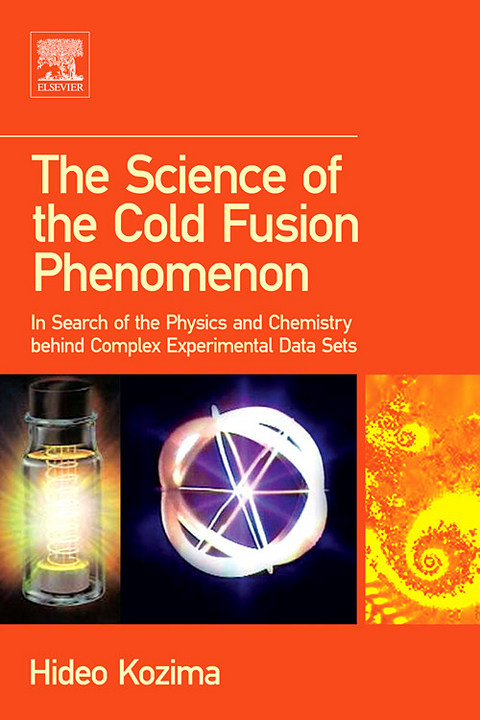
Science of the Cold Fusion Phenomenon (eBook)
208 Seiten
Elsevier Science (Verlag)
978-0-08-046315-5 (ISBN)
* Overviews the abundance of research and investigation that followed the 'cold fusion scandal' in 1989.
* Explores the fundamental science behind the original Fleischmann experiment
Broken up in to three sections, The Science of the Cold Fusion Phenomenon gives a unified explanation of all the significant data on the Cold Fusion Phenomena to date. It presents a history of the Cold Fusion Phenomenon (CFP), gives the fundamental experimental results of the CFP and presents a quantum mechanical treatment of physical problems associated with cold fusion. - Overviews the abundance of research and investigation that followed the 'cold fusion scandal' in 1989- Explores the fundamental science behind the original Fleischmann experiment
Cover 1
Contents 8
Preface 12
Acknowledgements 16
Discovery of the Cold Fusion Phenomenon 18
The first experiments 19
The experiment by Fleischmann et al. 19
The problem of reproducibility 22
Control experiments with light water 23
Confirmation of the experiment by Fleischmann et al. 24
Free space 26
Conditions for fusion reactions in solids 26
Results of nuclear reactions (1.1)–(1.3) 27
Comparison of generated energy with energies of other relevant particles 28
Experiments by Jones et al. and De Ninno et al. 29
Scandals 31
Taubes reports situation around the discovery 31
DOE report 1989 32
Shortcomings of DOE report 33
The dawn of a science 34
Experiments with light water H2O 35
Facts and truth 36
Facts of the Cold Fusion Phenomenon 38
How the experiments are conducted? 40
Condition 1. Making collision number of hydrogen isotopes maximum 40
Condition 2. Adsorption of collided molecules, atoms and ions on the surface 41
Condition 3. Absorption of adsorbed molecules, atoms and ions into solid 41
How and where the CFP occurs? 42
The CFP in transition-metal hydrides and deuterides 43
The CFP in other solids 48
Number of reactions Nx producing an observable x 48
Outline of TNCF model and neutron drop model—Basis of data analysis 50
TNCF model 51
Neutron drop model 52
Nuclear transmutation (NT) 52
Nuclear transmutation by decay (NTD) 55
Nuclear transmutation by absorption (NTA) 57
Nuclear transmutation by fission (NTF) 58
Nuclear transmutation by transformation (NTT ) 61
Isotopic ratio of generated nuclides by NT’s 63
Tritium T (or Triton 31H = t) 63
Neutron n 65
Helium-3 3He and Helium-4 4He 66
Excess heat Q 68
Excess heat in general 68
Extensive measurement of excess heat by McKubre et al. 69
Absence of gamma ray 70
The stability effect in nuclear transmutation 71
The inverse power law for occurrence of events in the CFP 72
After effect and aging effect 74
After effect 74
Aging effect 74
The qualitative reproducibility 75
Summary of experimental results of the CFP 75
Summary of experimental results 76
Tables of analyzed data sets given in the previous book 77
The Science of the Cold Fusion Phenomenon 84
Potency of a model—Examples in modern physics 85
Usefulness of models in science 86
The TNCF model—A phenomenological approach 86
Premises of the TNCF model 87
Nuclear reactions relevant to the TNCF model 89
Number of reactions relevant to observables 92
Explanation of the CFP by the TNCF model 93
Relations between observed values of physical quantities 93
Absolute value of adjustable parameter nn 94
Nuclear transmutation related to stability effect 95
Generation of Helium-4 and excess heat 95
Explanation of experimental data sets where several observables were measured 98
Neutron Energy Spectrum 99
Other theoretical trials to explain events in the CFP 100
Nuclear reactions in free space and in solids 101
Nuclear reactions in free space 101
Effects of free electrons in metals 102
Effects of lattice oscillation 104
Effects of electromagnetic fields in solids 105
Effects of ion beam and high-voltage discharge 106
Trials to verify the Fleischmann’s hypothesis 106
Quantum states of neutrons and properties of lattice nuclei 107
Neutrons in free space 107
Neutrons in solids 108
Neutrons in nucleus 112
Energetics of lattice nuclei related to the CFP 115
Hydrogen isotopes in transition metals 117
Hydrogen isotopes in fcc, hcp, and bcc transition metals 117
Excited states of a proton (deuteron) in CF materials (fcc and hcp transition-metal hydrides (deuterides)) 118
CF-matter and neutron drop model 119
Neutron–proton interaction in solids 119
Super-nuclear interaction between neutrons in different lattice nuclei and neutron valence band 120
Formation of CF-matter including neutron drops 123
Energetics of neutron drop 123
The CF-matter—neutron drops in thin neutron gas formed in solids 125
The neutron drop model of the CFP 126
Experimental data explained by the neutron drop model 126
The CFP as a science of complexity revealed by the stability effect and the inverse-power law 127
Conditions for CF-matter formation 128
Conditions for CF-matter destruction 129
Problem of the reproducibility 130
Applicability of the CFP 130
Epilogue 132
Appendix A. Usage of Symbols and Units in this Book 134
A1. Symbols of elements, nuclides, radiation, etc. 134
A2. Units of energy—eV, keV, MeV, and meV 135
A3. Units of length—Angstrom (Å), Micron ( m), Nanometer (nm), and Femtometer (or Fermi) (fm) 136
Appendix B. On the Conceptual Discrimination among Theory, Model, and Hypothesis 138
B1. Theory 138
B2. Model 139
B3. Hypothesis 139
Appendix C. Examples of Phenomenological Analyses of Experimental Data Sets using TNCF Model 140
C1. Analysis of Experimental Data Sets by Cellucci et al. 140
C2. Analysis of Experimental Data Sets by Chien et al. 144
C3. Analysis of Experimental Data Sets by Miles et al. 149
C4. Analysis of Experimental Data Sets by Clarke et al. 154
C5. Analysis of Experimental Data Sets by Okamoto et al. 160
C6. Analysis of Experimental Data Sets by Miley et al. 165
C7. Analysis of Experimental Data Sets by Dash et al. 169
C8. Analysis of Experimental Data Sets by Bressani et al. 175
Appendix D. Topics on Phases of Science 180
Topic 1. Electromagnetic wave, X-ray, and gamma ray 180
Topic 2. Radioactivity—unexpected things often happen 181
Topic 3. Radium and patent 182
Topic 4. Quantum born as a result of a trial-and-error 184
Topic 5. Bohr’s model of the hydrogen atom 185
Topic 6. Imagination found neutron 186
Topic 7. Wonder of transition-metal hydrides 187
Topic 8. Background neutron 189
Topic 9. 1/f Fluctuation 190
Topic 10. Chaos, fractals, and complexity 191
References 194
Author Index 204
Subject Index 206
| Erscheint lt. Verlag | 26.9.2006 |
|---|---|
| Sprache | englisch |
| Themenwelt | Naturwissenschaften ► Chemie |
| Naturwissenschaften ► Physik / Astronomie ► Atom- / Kern- / Molekularphysik | |
| Technik ► Maschinenbau | |
| ISBN-10 | 0-08-046315-0 / 0080463150 |
| ISBN-13 | 978-0-08-046315-5 / 9780080463155 |
| Informationen gemäß Produktsicherheitsverordnung (GPSR) | |
| Haben Sie eine Frage zum Produkt? |
 EPUB (Adobe DRM)
Kopierschutz: Adobe-DRM
Adobe-DRM ist ein Kopierschutz, der das eBook vor Mißbrauch schützen soll. Dabei wird das eBook bereits beim Download auf Ihre persönliche Adobe-ID autorisiert. Lesen können Sie das eBook dann nur auf den Geräten, welche ebenfalls auf Ihre Adobe-ID registriert sind.
Details zum Adobe-DRM
Dateiformat: EPUB (Electronic Publication)
EPUB ist ein offener Standard für eBooks und eignet sich besonders zur Darstellung von Belletristik und Sachbüchern. Der Fließtext wird dynamisch an die Display- und Schriftgröße angepasst. Auch für mobile Lesegeräte ist EPUB daher gut geeignet.
Systemvoraussetzungen:
PC/Mac: Mit einem PC oder Mac können Sie dieses eBook lesen. Sie benötigen eine
eReader: Dieses eBook kann mit (fast) allen eBook-Readern gelesen werden. Mit dem amazon-Kindle ist es aber nicht kompatibel.
Smartphone/Tablet: Egal ob Apple oder Android, dieses eBook können Sie lesen. Sie benötigen eine
Geräteliste und zusätzliche Hinweise
Buying eBooks from abroad
For tax law reasons we can sell eBooks just within Germany and Switzerland. Regrettably we cannot fulfill eBook-orders from other countries.
aus dem Bereich