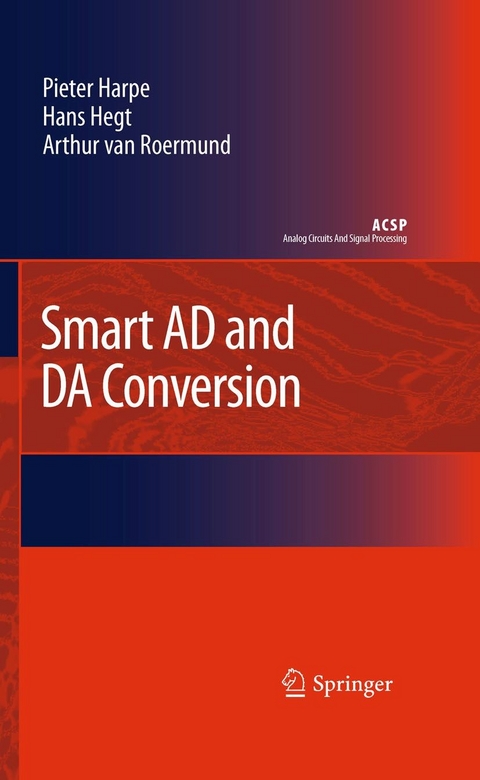
Smart AD and DA Conversion (eBook)
IX, 167 Seiten
Springer Netherland (Verlag)
978-90-481-9042-3 (ISBN)
The history of the application of semiconductors for controlling currents goes back all the way to 1926, in which Julius Lilienfeld led a patent for a "e;Method and apparatus for controlling electric currents"e; [1], which is considered the rst work on metal/semiconductor eld-effect transistors. More well-known is the work of William Shockley, John Bardeen and Walter Brattain in the 1940s [2, 3], after which the development of semiconductor devices commenced. In 1958, independent work from Jack Kilby and Robert Noyce ledto the invention of integrated circuits. A few milestones in IC design are the rst monolithic operational ampli er in 1963 (Fairchild?A702, Bob Widlar) and the rst o- chip 4-bit microprocessor in 1971 (Intel 4004). Ever since the start of the semiconductor history, integration plays an imp- tant role: starting from single devices, ICs with basic functions were developed (e. g. opamps, logic gates), followed by ICs that integrate larger parts of a s- tem (e. g. microprocessors, radio tuners, audio ampli ers). Following this trend of system integration, this eventually leads to the integration of analog and d- ital components in one chip, resulting in mixed-signal ICs: digital components are required because signal processing is preferably done in the digital - main; analog components are required because physical signals are analog by nature. Mixed-signal ICs are already widespread in many applications (e. g. - dio, video); for the future, it is expected that this trend will continue, leading to a larger scale of integration.
List of symbols and abbreviations.
1. INTRODUCTION.
2. AD AND DA CONVERSION. 1 Introduction. 2 Trends in applications. 3 Trends in technology. 4 Trends in system design. 5 Performance criteria. 6 Conclusion.
3. SMART CONVERSION. 1 Introduction. 2 Smart concept. 3 Application of the smart concept. 4 Focus in this work. 5 Conclusion.
4. SMART DA CONVERSION. 1 Introduction. 2 Area of current-steering DACs. 3 Correction of mismatch errors. 4 Sub-binary variable-radix DAC. 5 Design example. 6 Conclusion.
5. DESIGN OF A SUB-BINARY VARIABLE-RADIX DAC. 1 Schematic design. 2 Layout. 3 Self-measurement-circuit implementation. 4 Experimental results. 5 Conclusion.
6. SMART AD CONVERSION. 1 Introduction. 2 Literature review. 3 High-speed high-resolution AD conversion. 4 Smart calibration. 5 Conclusion.
7. DESIGN OF AN OPEN-LOOP T&H CIRCUIT. 1 Literature review. 2 Design goal. 3 T&H architecture. 4 Sampling core architecture. 5 Output buffer architecture. 6 T&H design. 7 Experimental results. 8 Conclusion.
8. T&H CALIBRATION. 1 Introduction. 2 T&H accuracy. 3 T&H calibration method. 4 Analog correction parameters. 5 Digitally assisted analog correction. 6 Simulation results. 7 Implementation of the calibration method and layout. 8 Experimental results. 9 Conclusion.
9. T&H CALIBRATION FOR TIME-INTERLEAVED ADCS. 1 Introduction. 2 Channel matching in time-interleaved T&H’s. 3 Channel mismatch calibration. 4 Channel mismatch detection. 5 Channel mismatch correction. 6 Simulation results. 7 Implementation of the calibration method and layout. 8 Experimental results. 9 Conclusion.
10. CONCLUSIONS.
References. Index.
| Erscheint lt. Verlag | 8.6.2010 |
|---|---|
| Reihe/Serie | Analog Circuits and Signal Processing | Analog Circuits and Signal Processing |
| Zusatzinfo | IX, 167 p. |
| Verlagsort | Dordrecht |
| Sprache | englisch |
| Themenwelt | Naturwissenschaften ► Chemie ► Analytische Chemie |
| Naturwissenschaften ► Physik / Astronomie ► Festkörperphysik | |
| Technik ► Elektrotechnik / Energietechnik | |
| Schlagworte | A-D Converters • Analog Design • Circuit • D-A Converters • detection • Digital Design |
| ISBN-10 | 90-481-9042-8 / 9048190428 |
| ISBN-13 | 978-90-481-9042-3 / 9789048190423 |
| Informationen gemäß Produktsicherheitsverordnung (GPSR) | |
| Haben Sie eine Frage zum Produkt? |
 PDF (Wasserzeichen)
DRM: Digitales Wasserzeichen
Dieses eBook enthält ein digitales Wasserzeichen und ist damit für Sie personalisiert. Bei einer missbräuchlichen Weitergabe des eBooks an Dritte ist eine Rückverfolgung an die Quelle möglich.
Dateiformat: PDF (Portable Document Format)
Mit einem festen Seitenlayout eignet sich die PDF besonders für Fachbücher mit Spalten, Tabellen und Abbildungen. Eine PDF kann auf fast allen Geräten angezeigt werden, ist aber für kleine Displays (Smartphone, eReader) nur eingeschränkt geeignet.
Systemvoraussetzungen:
PC/Mac: Mit einem PC oder Mac können Sie dieses eBook lesen. Sie benötigen dafür einen PDF-Viewer - z.B. den Adobe Reader oder Adobe Digital Editions.
eReader: Dieses eBook kann mit (fast) allen eBook-Readern gelesen werden. Mit dem amazon-Kindle ist es aber nicht kompatibel.
Smartphone/Tablet: Egal ob Apple oder Android, dieses eBook können Sie lesen. Sie benötigen dafür einen PDF-Viewer - z.B. die kostenlose Adobe Digital Editions-App.
Buying eBooks from abroad
For tax law reasons we can sell eBooks just within Germany and Switzerland. Regrettably we cannot fulfill eBook-orders from other countries.
aus dem Bereich