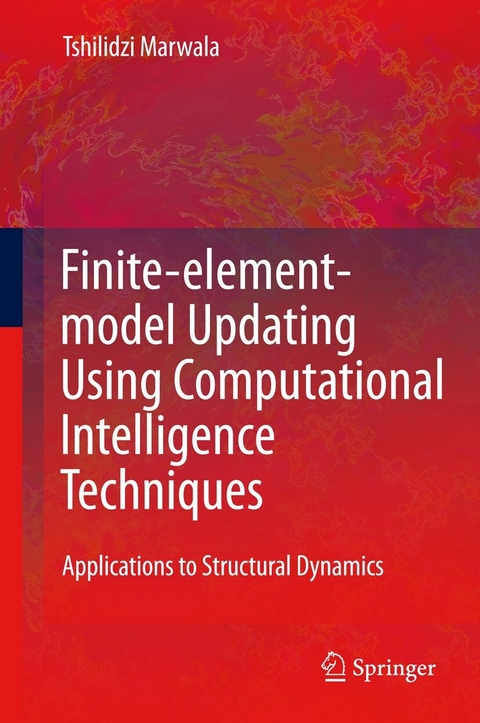
Finite Element Model Updating Using Computational Intelligence Techniques (eBook)
250 Seiten
Springer London (Verlag)
978-1-84996-323-7 (ISBN)
Tshilidzi Marwala is the Executive Dean of the Faculty of Engineering and the Built Environment at the University of Johannesburg. He was previously the Adhominem Professor of Electrical Engineering as well as the Carl and Emily Fuchs Chair of Systems and Control Engineering at the University of the Witwatersrand. He is a Fellow of the Royal Society of Arts as well as the Royal Statistical Society. He holds a PhD in Engineering from the University of Cambridge and a PLD from Harvard University in the USA. He was a post-doctoral research associate at Imperial College working in the general area of computational intelligence. He has been a visiting fellow at Harvard University and Cambridge University. His research interests include the application of computational intelligence to mechanical. civil, aerospace and biomedical engineering. Professor Marwala has made fundamental contributions to engineering including the development of the concept of pseudo-modal energies and the development of Bayesian framework for solving engineering problems such as finite element model updating. He has supervised 40 masters and PhD students many of whom have proceeded to distinguish themselves at universities such as Harvard, Oxford and Cambridge. He has published over 200 papers in journals such as the American Institute of Aeronautics and Astronautics Journal, proceedings and book chapters. He has published two books: Computational Intelligence for Modelling Complex Systems published by Research India Publications as well as Computational Intelligence for Missing Data Imputation, Estimation, and Management: Knowledge Optimization Techniques published by the IGI Global Publications (New York). His work has appeared in prestigious publications such as New Scientist. He is a senior member of the IEEE.
FEM updating allows FEMs to be tuned better to reflect measured data. It can be conducted using two different statistical frameworks: the maximum likelihood approach and Bayesian approaches. This book applies both strategies to the field of structural mechanics, using vibration data. Computational intelligence techniques including: multi-layer perceptron neural networks; particle swarm and GA-based optimization methods; simulated annealing; response surface methods; and expectation maximization algorithms, are proposed to facilitate the updating process. Based on these methods, the most appropriate updated FEM is selected, a problem that traditional FEM updating has not addressed. This is found to incorporate engineering judgment into finite elements through the formulations of prior distributions. Case studies, demonstrating the principles test the viability of the approaches, and. by critically analysing the state of the art in FEM updating, this book identifies new research directions.
Tshilidzi Marwala is the Executive Dean of the Faculty of Engineering and the Built Environment at the University of Johannesburg. He was previously the Adhominem Professor of Electrical Engineering as well as the Carl and Emily Fuchs Chair of Systems and Control Engineering at the University of the Witwatersrand. He is a Fellow of the Royal Society of Arts as well as the Royal Statistical Society. He holds a PhD in Engineering from the University of Cambridge and a PLD from Harvard University in the USA. He was a post-doctoral research associate at Imperial College working in the general area of computational intelligence. He has been a visiting fellow at Harvard University and Cambridge University. His research interests include the application of computational intelligence to mechanical. civil, aerospace and biomedical engineering. Professor Marwala has made fundamental contributions to engineering including the development of the concept of pseudo-modal energies and the development of Bayesian framework for solving engineering problems such as finite element model updating. He has supervised 40 masters and PhD students many of whom have proceeded to distinguish themselves at universities such as Harvard, Oxford and Cambridge. He has published over 200 papers in journals such as the American Institute of Aeronautics and Astronautics Journal, proceedings and book chapters. He has published two books: Computational Intelligence for Modelling Complex Systems published by Research India Publications as well as Computational Intelligence for Missing Data Imputation, Estimation, and Management: Knowledge Optimization Techniques published by the IGI Global Publications (New York). His work has appeared in prestigious publications such as New Scientist. He is a senior member of the IEEE.
to Finite-element-model Updating.- Finite-element-model Updating Using Nelder–Mead Simplex and Newton Broyden–Fletcher–Goldfarb–Shanno Methods.- Finite-element-model Updating Using Genetic Algorithm.- Finite-element-model Updating Using Particle-swarm Optimization.- Finite-element-model Updating Using Simulated Annealing.- Finite-element-model Updating Using the Response-surface Method.- Finite-element-model Updating Using a Hybrid Optimization Method.- Finite-element-model Updating Using a Multi-criteria Method.- Finite-element-model Updating Using Artificial Neural Networks.- Finite-element-model Updating Using a Bayesian Approach.- Finite-element-model Updating Applied in Damage Detection.- Conclusions and Emerging State-of-the-art.
| Erscheint lt. Verlag | 4.6.2010 |
|---|---|
| Zusatzinfo | XV, 250 p. |
| Verlagsort | London |
| Sprache | englisch |
| Themenwelt | Informatik ► Theorie / Studium ► Künstliche Intelligenz / Robotik |
| Mathematik / Informatik ► Mathematik ► Analysis | |
| Mathematik / Informatik ► Mathematik ► Angewandte Mathematik | |
| Naturwissenschaften ► Physik / Astronomie | |
| Technik ► Bauwesen | |
| Technik ► Maschinenbau | |
| Schlagworte | algorithm • algorithms • Bayesian • Computational Intelligence • Design • Evolutionary Computing • Finite Element Method • Finite Element Model • Finite element model updating • Genetic algorithms • linear optimization • Maximum Likelihood • mechanical engineering • Model • Optimization • Simulation • Statistica • structural dynamics • Structural Mechanics • Vibration • Vibration Data |
| ISBN-10 | 1-84996-323-1 / 1849963231 |
| ISBN-13 | 978-1-84996-323-7 / 9781849963237 |
| Informationen gemäß Produktsicherheitsverordnung (GPSR) | |
| Haben Sie eine Frage zum Produkt? |
 PDF (Wasserzeichen)
Größe: 2,2 MB
DRM: Digitales Wasserzeichen
Dieses eBook enthält ein digitales Wasserzeichen und ist damit für Sie personalisiert. Bei einer missbräuchlichen Weitergabe des eBooks an Dritte ist eine Rückverfolgung an die Quelle möglich.
Dateiformat: PDF (Portable Document Format)
Mit einem festen Seitenlayout eignet sich die PDF besonders für Fachbücher mit Spalten, Tabellen und Abbildungen. Eine PDF kann auf fast allen Geräten angezeigt werden, ist aber für kleine Displays (Smartphone, eReader) nur eingeschränkt geeignet.
Systemvoraussetzungen:
PC/Mac: Mit einem PC oder Mac können Sie dieses eBook lesen. Sie benötigen dafür einen PDF-Viewer - z.B. den Adobe Reader oder Adobe Digital Editions.
eReader: Dieses eBook kann mit (fast) allen eBook-Readern gelesen werden. Mit dem amazon-Kindle ist es aber nicht kompatibel.
Smartphone/Tablet: Egal ob Apple oder Android, dieses eBook können Sie lesen. Sie benötigen dafür einen PDF-Viewer - z.B. die kostenlose Adobe Digital Editions-App.
Buying eBooks from abroad
For tax law reasons we can sell eBooks just within Germany and Switzerland. Regrettably we cannot fulfill eBook-orders from other countries.
aus dem Bereich