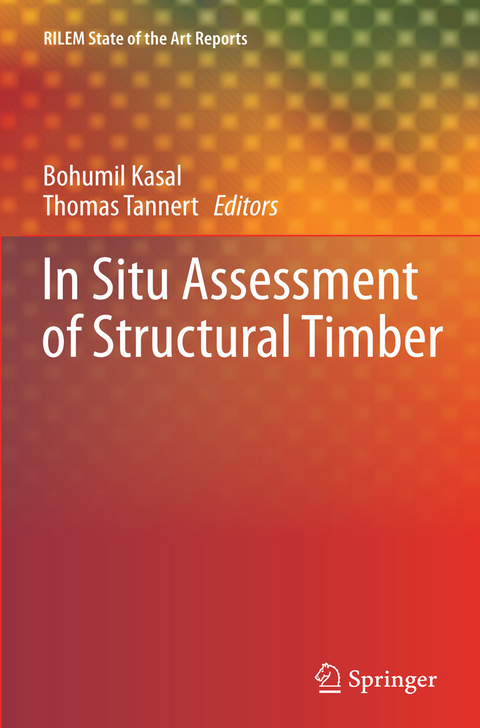
In Situ Assessment of Structural Timber (eBook)
XIX, 129 Seiten
Springer Netherland (Verlag)
978-94-007-0560-9 (ISBN)
Wood is one of the most intriguing structural materials and the only one that is truly renewable. Along with stone, wood is the oldest structural material on the planet and has been extensively used throughout human history. Due to its aesthetical value and positive environmental impact, wood has experienced a renaissance in construction.
As a biodegradable, hygroscopic, non-isotropic material, wood presents special challenges for a professional and requires through knowledge ranging from biology to continuum mechanics.
This state-of-the-art report reflects the current knowledge in the area of in situ assessment of the physical and mechanical properties of wood structures. Nondestructive, semi-destructive and destructive methods are described in a systematic manner where technology, equipment and limitations are discussed. Some of the discussed methods are used in other materials such as masonry and concrete. Most of the methods, however, are specific to wood and special qualifications are required to understand and apply these methods effectively. Existing methods are constantly improved and new methods are being developed. This report includes methods that are used in practice or have shown significant promise and have a body of knowledge that supports statements made in this report.
This is a useable tool for professionals, researchers, educators and students
Wood is one of the most intriguing structural materials and the only one that is truly renewable. Along with stone, wood is the oldest structural material on the planet and has been extensively used throughout human history. Due to its aesthetical value and positive environmental impact, wood has experienced a renaissance in construction.As a biodegradable, hygroscopic, non-isotropic material, wood presents special challenges for a professional and requires through knowledge ranging from biology to continuum mechanics. This state-of-the-art report reflects the current knowledge in the area of in situ assessment of the physical and mechanical properties of wood structures. Nondestructive, semi-destructive and destructive methods are described in a systematic manner where technology, equipment and limitations are discussed. Some of the discussed methods are used in other materials such as masonry and concrete. Most of the methods, however, are specific to wood andspecial qualifications are required to understand and apply these methods effectively. Existing methods are constantly improved and new methods are being developed. This report includes methods that are used in practice or have shown significant promise and have a body of knowledge that supports statements made in this report. This is a useable tool for professionals, researchers, educators and students
Contents 6
Preface 11
Introduction 19
References 21
StressWaves 22
Background 22
Equipment 24
Sounding 24
Sonic Stress Waves 24
Ultrasonic Technique 27
Ultrasonic Echo Technique 28
Application 31
Defect and Deterioration Detection 31
Mechanical Properties 35
Limitations 36
Deterioration and Decay Detection 38
Mechanical Property Prediction 38
References 39
Ground Penetrating Radar 42
Background 42
Dielectric Permittivity of Wood 44
Equipment 46
Applications 49
Detection 50
Moisture Evaluation 51
Limitations 52
References 53
Radiography 55
Background 55
Equipment 56
Technology 56
Gamma Rays 57
X-Rays 57
Radiation Attenuation 58
Imaging 60
Application 63
Limitations 64
References 65
Resistance Drilling 67
Background 67
Equipment 68
Application 69
Limitations 72
References 73
Core-Drilling 74
Background 74
Equipment 75
Application 76
Limitations 79
References 80
Shear Test of Glue Lines 82
Background 82
Equipment 82
Application 84
Determination of Percentage Wood Failure 85
Limitations 85
References 87
Tension Micro-Specimens 89
Background 89
Equipment 90
Application 91
Limitations 92
References 94
Screw Resistance 95
Background 95
Equipment 96
Application 96
Strength Estimate from Screw Withdrawal Test 96
Strength Estimate from Screw Withdrawals and Velocity of Stress Wave 97
Screw Withdrawals and Angles of Entry 97
Screw Withdrawals and Compression Capacity 97
Densities from Screw Withdrawals 98
Stiffness Estimate from Screw Withdrawals and Velocity of Stress Wave 99
Summary 99
Limitations 99
References 100
Hardness Test 101
Background 101
Equipment and Application 102
Janka Hardness Test 103
References 110
Moisture Measurement 112
Background 112
Equipment 113
Pin Meters 113
Pin-less Meters 114
Application 115
Limitations 116
References 116
Species Identification 118
Equipment 118
Macroscopic Evaluation 119
Microscopic Evaluations 119
Application 120
Limitations 120
References 120
Dendrochronology 121
Background 121
Equipment 122
Application 123
Wood Species Identification 123
Limitations 124
References 126
Review of Codes and Standards 127
Codes and Standards 127
International Standards 127
National Standards 128
Description of the Existing Conditions 130
Diagnosis of the Structural Elements 130
Objectives of the Inspection 131
Inspection Procedure 131
Inspection Report 132
References 132
Index 134
| Erscheint lt. Verlag | 10.3.2011 |
|---|---|
| Reihe/Serie | RILEM State-of-the-Art Reports | RILEM State-of-the-Art Reports |
| Zusatzinfo | XIX, 129 p. |
| Verlagsort | Dordrecht |
| Sprache | englisch |
| Themenwelt | Kunst / Musik / Theater ► Allgemeines / Lexika |
| Kunst / Musik / Theater ► Design / Innenarchitektur / Mode | |
| Kunst / Musik / Theater ► Kunstgeschichte / Kunststile | |
| Naturwissenschaften ► Geowissenschaften ► Geografie / Kartografie | |
| Sozialwissenschaften | |
| Technik ► Architektur | |
| Technik ► Bauwesen | |
| Schlagworte | Applications • individual methods • modern and historic buildings • Structural timber • Wood Science and Technology • wood structures |
| ISBN-10 | 94-007-0560-3 / 9400705603 |
| ISBN-13 | 978-94-007-0560-9 / 9789400705609 |
| Informationen gemäß Produktsicherheitsverordnung (GPSR) | |
| Haben Sie eine Frage zum Produkt? |
 PDF (Wasserzeichen)
DRM: Digitales Wasserzeichen
Dieses eBook enthält ein digitales Wasserzeichen und ist damit für Sie personalisiert. Bei einer missbräuchlichen Weitergabe des eBooks an Dritte ist eine Rückverfolgung an die Quelle möglich.
Dateiformat: PDF (Portable Document Format)
Mit einem festen Seitenlayout eignet sich die PDF besonders für Fachbücher mit Spalten, Tabellen und Abbildungen. Eine PDF kann auf fast allen Geräten angezeigt werden, ist aber für kleine Displays (Smartphone, eReader) nur eingeschränkt geeignet.
Systemvoraussetzungen:
PC/Mac: Mit einem PC oder Mac können Sie dieses eBook lesen. Sie benötigen dafür einen PDF-Viewer - z.B. den Adobe Reader oder Adobe Digital Editions.
eReader: Dieses eBook kann mit (fast) allen eBook-Readern gelesen werden. Mit dem amazon-Kindle ist es aber nicht kompatibel.
Smartphone/Tablet: Egal ob Apple oder Android, dieses eBook können Sie lesen. Sie benötigen dafür einen PDF-Viewer - z.B. die kostenlose Adobe Digital Editions-App.
Buying eBooks from abroad
For tax law reasons we can sell eBooks just within Germany and Switzerland. Regrettably we cannot fulfill eBook-orders from other countries.
aus dem Bereich