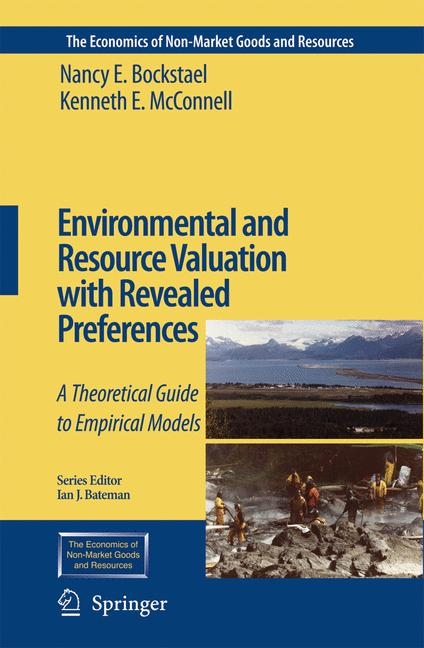
Environmental and Resource Valuation with Revealed Preferences (eBook)
XVI, 376 Seiten
Springer Netherland (Verlag)
978-1-4020-5318-4 (ISBN)
This book provides a systematic review of those economic approaches for valuing the environment and natural resources that use information on what people do, not what they say. The authors have worked on models of revealed preferences for valuing environmental and natural resources for several decades. The book provides a candid review of the major conceptual challenges and an exploration of neglected issues in the literature.
Environmental and Resource Valuation with Revealed Preferences: A Theoretical Guide to Empirical Models provides a systematic review of those economic approaches for valuing the environment and natural resources that use information on what people do, not what they say. The authors have worked on models of revealed preferences for valuing environmental and natural resources for several decades and authored some of the seminal papers in the field. The book is a natural outcome of their conceptual contributions and their many years of experience in empirical policy research, natural resource damage litigation and teaching on the topic. The chief purpose of Environmental and Resource Valuation with Revealed Preferences is to collect in one place current thought on the various revealed preference approaches to environmental valuation and to subject these approaches to consistent theoretical critique.
PREFACE. 1. SETTING THE STAGE. 1.1. Oil Spills and Valuation. 1.2. Where Do We Begin? 1.3. The Purpose and Approach of the Book. 1.4. The Maintained Assumptions. 1.5. What the Book Omits. 1.6. A Look Ahead. 2. WELFARE ECONOMICS FOR PRICE CHANGES. 2.1. Introduction. 2.2. Compensation Measures. 2.2.1. Willingness to Pay and Willingness to Accept. 2.3. From Behavior to Welfare Measures. 2.3.1. So What is Wrong with Consumer Surplus? 2.4. From Ordinary Demands to Welfare. 2.4.1. Multiple Price Changes. 2.5. Income and Welfare Effects. 2.5.1. Endogenous Income. 2.6. Non-Linear Budget Constraints. 2.7. Conclusions. 3. THE CONCEPT OF COMPLEMENTARITY. 3.1. Introduction. 3.2. The Basic Problem. 3.3. The Public Good as an Attribute. 3.3.1. Weak Complementarity. 3.3.2. Can Weak Complementarity Be Tested? 3.4. Weak Complementarity and Marshallian Demands. 3.4.1. The Willig Condition. 3.5. Welfare without Weak Complementarity. 3.6. Conclusions. 4. IMPLEMENTING WEAK COMPLEMENTARITY. 4.1. Introduction. 4.2. Specifying Demand as a Function of Quality. 4.2.1. Translations of Utility Functions. 4.2.2. Utility Parameters as a Function of Quality. 4.3. Weak Complementarity and Household Production. 4.3.1. Household Production and Constant Marginal Costs. 4.3.2. Incorporating Time Costs. 4.3.3. Time in Incomplete and Partial Demand Systems. 4.3.4. On-Site Time and Non-linear Budget Constraints. 4.4. Information and Behavioral Change. 4.5. Quality Changes and Induced Price Effects. 4.5.1. Induced Price Changes. 4.6. Conclusions. 5. MEASURING WELFARE IN DISCRETE CHOICE MODELS. 5.1. Introduction. 5.2. The Basic Discrete Choice Model. 5.3. Welfare in the Random Utility Model. 5.3.1. More Welfare Calculations with the Linear Model. 5.3.2. Welfare Measurement with Imperfect Information. 5.4. Generalizing Discrete Choice Models. 5.4.1. Nested Models: Relaxing the IIA Property. 5.4.2. Mixed Logit Models: A Further Generalization. 5.5. The Larger Consumer Choice Problem. 5.5.1. The Role of Income. 5.5.2. The Frequency of Choice. 5.5.3. The Generalized Corner Solution Model. 5.6. The Hedonic Travel Cost Model. 5.6.1. The Structure of the Model. 5.6.2. The Hedonic Cost Function. 5.6.3. Making Sense of the Story. 5.6.4. Welfare Measures in the Hedonic Travel Cost Model. 5.7. Conclusion. 6. HEDONIC MODELS OF HETEROGENOUS GOODS. 6.1. Introduction. 6.2. The Theory of Hedonic Models. 6.2.1. Rosen's Bid Function. 6.2.2. The Hedonic Price Function. 6.3. Welfare Measures in Hedonic Markets. 6.3.1. Defining `Pure Willingness to Pay'. 6.3.2. Revealing `Pure Willingness to Pay'. 6.3.3. Welfare Effects of Exogenous Events. 6.4. Some Econometric Issues. 6.4.1. Estimating the Hedonic Price Function Only. 6.4.2. Recovering Information on Preferences. 6.5. The Housing Choice as a Discrete Choice. 6.5.1. Drawbacks of Discrete Choice Housing Models. 6.6. Conclusions. 7. HEDONIC WAGE ANALYSIS. 7.1. Introduction. 7.2. Hedonic Wages in Theory. 7.2.1. The Simple Model. 7.2.2. Revising the Model: The Wage vs Risk Trade-off. 7.2.3. Important Underlying Assumptions. 7.2.4. The Determinants of the Hedonic Function. 7.2.5. The Anomaly of Safer Jobs and Higher Pay. 7.2.6. Endogenous Sorting. 7.2.7. Welfare with the Hedonic Wage Model. 7.3. Estimating the `Value of a Statistical Life'. 7.3.1. Data Sources for Wage and Risk Variables. 7.3.2. Variability in Specifications. 7.3.3. Fragility of Estimates of the Wage-Risk Trade-off. 7.3.4. The Challenge of Transferring $VSL$ Estimates. 7.4. Wage Hedonics and Locational Amenities. 7.4.1. The Roback Model. 7.4.2. Migration and Disequilibrium. 7.4.3. Welfare Interpretations. 7.4.4. Locational Amenities in a Discrete Choice Framework. 7.5. Conclusions. 8. PUBLIC GOODS IN HOUSEHOLD PRODUCTION. 8.1. Introduction. 8.2. The Structure of the Problem. 8.2.1. A Simple Result for Constant Marginal Costs. 8.3. Restrictions on the Demand for an Input. 8.3.1. The Case of a Separable Production Relationship. 8.3.2. Demand for Essential Inputs. 8.3.3. Wea
| Erscheint lt. Verlag | 31.3.2007 |
|---|---|
| Reihe/Serie | The Economics of Non-Market Goods and Resources | The Economics of Non-Market Goods and Resources |
| Zusatzinfo | XVI, 376 p. |
| Verlagsort | Dordrecht |
| Sprache | englisch |
| Themenwelt | Naturwissenschaften ► Biologie ► Ökologie / Naturschutz |
| Sozialwissenschaften ► Politik / Verwaltung | |
| Technik ► Umwelttechnik / Biotechnologie | |
| Wirtschaft ► Volkswirtschaftslehre ► Makroökonomie | |
| Wirtschaft ► Volkswirtschaftslehre ► Mikroökonomie | |
| Schlagworte | consumer • Environment • environmental benefits • Production • public goods • revealed preferences • Utility • Valuation |
| ISBN-10 | 1-4020-5318-5 / 1402053185 |
| ISBN-13 | 978-1-4020-5318-4 / 9781402053184 |
| Informationen gemäß Produktsicherheitsverordnung (GPSR) | |
| Haben Sie eine Frage zum Produkt? |
 PDF (Wasserzeichen)
DRM: Digitales Wasserzeichen
Dieses eBook enthält ein digitales Wasserzeichen und ist damit für Sie personalisiert. Bei einer missbräuchlichen Weitergabe des eBooks an Dritte ist eine Rückverfolgung an die Quelle möglich.
Dateiformat: PDF (Portable Document Format)
Mit einem festen Seitenlayout eignet sich die PDF besonders für Fachbücher mit Spalten, Tabellen und Abbildungen. Eine PDF kann auf fast allen Geräten angezeigt werden, ist aber für kleine Displays (Smartphone, eReader) nur eingeschränkt geeignet.
Systemvoraussetzungen:
PC/Mac: Mit einem PC oder Mac können Sie dieses eBook lesen. Sie benötigen dafür einen PDF-Viewer - z.B. den Adobe Reader oder Adobe Digital Editions.
eReader: Dieses eBook kann mit (fast) allen eBook-Readern gelesen werden. Mit dem amazon-Kindle ist es aber nicht kompatibel.
Smartphone/Tablet: Egal ob Apple oder Android, dieses eBook können Sie lesen. Sie benötigen dafür einen PDF-Viewer - z.B. die kostenlose Adobe Digital Editions-App.
Buying eBooks from abroad
For tax law reasons we can sell eBooks just within Germany and Switzerland. Regrettably we cannot fulfill eBook-orders from other countries.
aus dem Bereich